
In the modern household, appliances serve as the mechanical backbone of daily operations, preserving our food, sanitizing our garments, and maintaining a comfortable living environment. However, these complex machines represent significant financial investments. When a major unit fails prematurely, it disrupts the household workflow and necessitates a substantial capital outlay for replacement. Furthermore, the environmental cost of manufacturing and disposing of “white goods” drives the conscientious consumer toward longevity. By adopting a regimen of systematic care, homeowners can significantly delay the obsolescence of their equipment. This guide outlines seven professional-grade strategies designed to optimize performance and ensure durability.

1. Prioritize Refrigerator Coil Maintenance and Seal Integrity
The refrigerator is unique among household devices as it operates continuously. Because of this perpetual duty cycle, proper refrigerator care is paramount to avoiding motor burnout. The most critical, yet frequently overlooked, component of a refrigerator is the condenser coil. Located either at the back of the unit or behind a kick plate at the bottom, these coils dissipate the heat removed from the interior compartments.
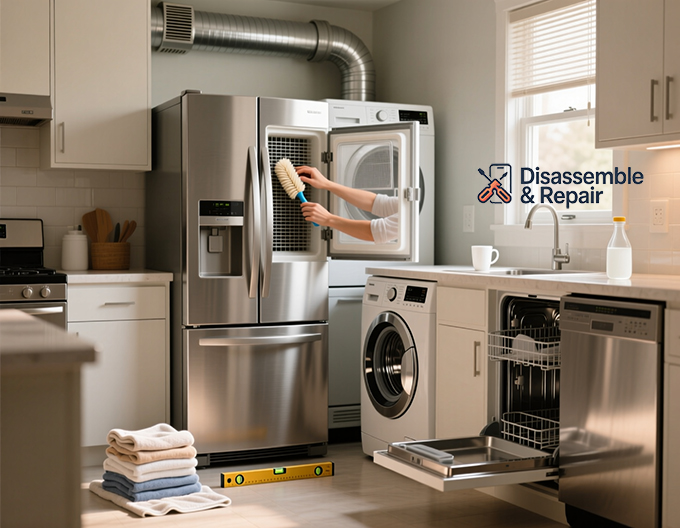
When dust, pet hair, and kitchen grease accumulate on these coils, they act as an insulating blanket. This forces the compressor to work continuously at maximum capacity to achieve the desired temperature, drastically shortening its operational life. To prevent this, disconnect the power and vacuum these coils using a brush attachment every six months.
Additionally, the integrity of the door gaskets—the rubber seals that ensure an airtight closure—must be maintained. A compromised seal allows cold air to escape and warm air to infiltrate, causing the compressor to cycle unnecessarily. regularly clean these seals with warm soapy water to remove food residue that can degrade the rubber. If a dollar bill can slide easily through the closed door, the seal requires replacement.
2. The Critical Importance of Airflow and Filtration
Whether dealing with an HVAC system, a clothes dryer, or a range hood, airflow is the lifeblood of efficiency. Restricted airflow causes motors to overheat and systems to fail. The simplest, most effective protocol to prevent this strain is the discipline to clean filters regularly.
For heating and cooling systems, a clogged filter forces the blower motor to push air against excessive resistance. This not only increases energy consumption but can also lead to the evaporator coil freezing or the heat exchanger cracking. Similarly, a dryer with a saturated lint screen presents a severe fire hazard and extends drying times, subjecting the heating element and drum bearings to prolonged wear.
By establishing a strict schedule to inspect and clean filters—or replace them where necessary—you maintain optimal static pressure within the system. This reduces the mechanical load on fans and compressors, directly correlating to a longer service life for the unit.
3. Optimizing Dishwasher Mechanics through Cleaning
A common misconception regarding dishwashers is that they are self-cleaning devices. in reality, food particles, mineral deposits from hard water, and undissolved detergent can accumulate in the filter trap, spray arms, and drain hose. Over time, this buildup restricts water flow and strains the pump assembly.
To extend lifespan and ensure pristine cleaning results, the filter located at the bottom of the tub must be manually cleaned to remove debris. Furthermore, inspect the rotating spray arms; the small holes can become obstructed with calcification or seeds. A simple cleaning with a wire or toothpick ensures water is distributed with the correct pressure.
Periodically running an empty cycle with a specialized cleaner or a cup of white vinegar can dissolve mineral scale and clear grease from the internal plumbing. This form of preventive maintenance protects the pump and seals from premature degradation caused by abrasive buildup.
4. Balancing Loads and Inspecting Hoses in Washing Machines
The physical forces exerted during a washing machine’s spin cycle are immense. Consistently overloading the machine disrupts the center of gravity, placing excessive torque on the drive belt, motor, and drum bearings. Over time, this habit will inevitably lead to mechanical misalignment and catastrophic failure. Adhering to the manufacturer’s load capacity guidelines is a non-negotiable aspect of appliance maintenance.
Equally important is the condition of the water supply hoses. Rubber hoses degrade over time, becoming brittle and prone to bursting, which can cause significant water damage to the home. Inspect these hoses annually for blisters, cracks, or corrosion on the fittings. Proactive replacement with stainless steel braided hoses offers superior durability and peace of mind.
5. Thermal Management in Ovens and Ranges
The accumulation of carbonized food spills on the floor of an oven or the burners of a range does more than create smoke; it can impede the appliance’s thermal regulation. In electric ovens, debris on the heating element can cause hot spots, leading to element failure. In gas ranges, clogged burner ports result in uneven flame distribution and inefficient heating.
It is advisable to wipe up spills immediately after the appliance has cooled. However, exercise caution with the self-cleaning feature found on many modern ovens. This cycle utilizes extreme temperatures—often exceeding 900 degrees Fahrenheit—to incinerate residue. While effective, the intense heat can stress electronic control boards and door lock mechanisms. Manual cleaning is often a safer alternative to extend lifespan for aging units.
6. Embracing the Philosophy of Preventive Maintenance
The distinction between a device that lasts five years and one that lasts fifteen often lies in the owner’s approach to care. Reactive maintenance waits for a breakdown to occur; preventive maintenance anticipates and averts it. This philosophy encompasses everything from listening for unusual noises to checking the level of appliances.
For instance, a washing machine or refrigerator that is not perfectly level will experience uneven wear on its internal components due to vibration. Using a simple spirit level to adjust the feet of the appliance ensures stable operation. By treating these machines as precision instruments rather than static boxes, homeowners can mitigate the cumulative wear and tear that leads to early retirement of the unit.
7. Knowing When to Consult a Repair Guide vs. a Professional
Despite the best maintenance efforts, mechanical components have a finite lifecycle. When an issue arises, the astute homeowner must decide between a DIY approach and professional intervention. For minor issues, such as replacing a refrigerator door shelf or a dishwasher rack wheel, a reliable repair guide or manufacturer manual is an invaluable resource. These documents provide schematics and part numbers essential for accurate troubleshooting.
However, complex problems involving refrigerants, gas lines, or high-voltage circuitry require the expertise of a licensed technician. Attempting to repair these systems without proper training can pose safety risks and may void warranties. Understanding the limits of one’s technical proficiency is a crucial component of appliance maintenance.
Conclusion
The longevity of household appliances is not solely a matter of manufacturing quality but largely a result of consistent, intelligent stewardship. By implementing a routine that includes rigorous refrigerator care, the discipline to clean filters, and a general adherence to preventive maintenance, homeowners can maximize the return on their investments.
We encourage you to perform a comprehensive audit of your major appliances this week. Check the seals, clear the vents, and level the machines. These small investments of time will pay dividends in the form of reduced repair bills and a more sustainable home environment.

Frequently Asked Questions
What are the best ways to extend the lifespan of household appliances?
To maximize appliance longevity, focus on preventive maintenance rather than reactive repairs. Key strategies include regularly cleaning filters and refrigerator coils to ensure proper airflow, avoiding overloading washing machines to protect bearings, and ensuring all units are level to prevent uneven wear from vibration.
How often should I clean my refrigerator condenser coils?
You should disconnect the power and vacuum your refrigerator’s condenser coils every six months. When dust and grease accumulate on the coils, they act as insulation, forcing the compressor to run continuously at maximum capacity, which significantly shortens the refrigerator’s life.
How do I check if my refrigerator door gasket needs replacing?
You can test the seal integrity using the “dollar bill test.” Close the refrigerator door on a dollar bill; if the bill slides out easily, the gasket is compromised. A loose seal allows cold air to escape, causing the motor to cycle unnecessarily, and should be replaced immediately.
Is the self-cleaning cycle safe to use on my oven?
While convenient, the self-cleaning cycle uses extreme temperatures exceeding 900 degrees Fahrenheit, which can stress electronic control boards and door lock mechanisms, especially in older units. Manual cleaning is often the safer alternative to prevent premature component failure.