

Proper ventilation is crucial for maintaining a healthy home environment, preventing mold growth, and protecting structural integrity from moisture damage. While mounting the unit is often a matter of carpentry, the most critical phase of the project is the electrical work. Wiring a Bathroom Exhaust Fan requires precision, adherence to local building codes, and a strict commitment to safety procedures. Whether you are a seasoned DIY enthusiast or a homeowner looking to understand the process before hiring an electrician, knowing the correct electrical protocols is vital.
This article focuses specifically on the electrical connections involved. However, it is important to understand that wiring is just one part of the broader installation process. For a comprehensive overview of the entire project, including ductwork and housing installation, you should refer to the parent topic: “How to Install a Bathroom Exhaust Fan.” If you are managing a complete new setup, our resource on Install a Bathroom Exhaust Fan: A DIY Guide will provide the necessary context for the steps below.

Understanding Electrical Safety and Preparation
Before stripping a single wire, safety must be your absolute priority. Electrical work carries inherent risks, and failing to de-energize the circuit can result in severe injury or fatal shock.
Essential Tools and Gear
To perform safe fan wiring, you will need specific tools designed for electrical work:
- Non-contact voltage tester: To verify power is off.
- Wire strippers/cutters: For preparing wire ends.
- Lineman’s pliers: For twisting wires together.
- Wire nuts (wire connectors): Appropriately sized for the gauge of wire used.
- Electrical tape: For added security on connections.
- Screwdrivers: Phillips and flathead.
Turning Off the Power
Locate your home’s main service panel (breaker box). Identify the circuit breaker that controls the bathroom lights and fan. Switch it to the “OFF” position. Once you are in the bathroom, attempt to turn on the existing light or fan to confirm the power is cut. For absolute certainty, use a non-contact voltage tester on the wires inside the switch box and the ceiling housing before touching anything.
The Standard Exhaust Fan Wiring Diagram
To successfully connect your fan, you must understand the exhaust fan wiring diagram relevant to your specific unit. Most residential bathroom fans operate on a standard 120-volt circuit.
Identifying Wire Colors
In a standard US residential electrical setup (NM cable or Romex), you will typically encounter the following wires:
- Black (Hot): Carries the current from the source to the switch, and from the switch to the fan.
- White (Neutral): Returns the current to the service panel.
- Bare Copper or Green (Ground): Provides a safe path for electricity in the event of a fault.
The Basic Loop
In the simplest configuration, power enters the switch box first. A “switch leg” then runs up to the fan.
- At the Switch: The incoming hot wire connects to one terminal of the switch. The outgoing hot wire (going to the fan) connects to the other terminal. Neutrals are usually tied together in the back of the box (unless a smart switch requiring a neutral is used). Grounds are connected to the switch and the box.
- At the Fan: The black wire from the switch connects to the fan’s black wire (motor). The white wire connects to the fan’s white wire. The ground connects to the fan housing’s green screw or green wire.
Step-by-Step: Wiring a Bathroom Exhaust Fan
Once the mechanical installation is secure, you can proceed with the electrical connection. If you are swapping out an older unit rather than installing a new one, the process is similar, though removal requires care. You can learn more about the removal process in our article on how to Replace an Old Bathroom Exhaust Fan in 7 Steps.
Here is the procedure for Wiring a Bathroom Exhaust Fan in a standard configuration:
Step 1: Prepare the Junction Box
Open the junction box on the fan housing. You should see the fan’s internal wires (typically black, white, and green/ground). Pull the house supply cable through the cable clamp on the side of the housing. Tighten the clamp to secure the cable, ensuring the outer sheathing extends at least 1/4 inch inside the box to protect the wires from sharp metal edges.
Step 2: Connect the Ground Wire
Always connect the ground first. This ensures that if the circuit is accidentally energized, there is a path to ground.
- Twist the bare copper wire from your house cable together with the green wire (or connect it to the green ground screw) inside the fan housing.
- Secure the connection with a wire nut.
Step 3: Connect the Neutral Wires
- Take the white wire from the house cable (the neutral) and the white wire from the fan motor.
- Strip about 3/4 inch of insulation off the ends if not already done.
- Hold the ends parallel and twist a wire nut clockwise over them until tight. Give them a gentle tug to ensure they are secure.
Step 4: Connect the Hot Wires
- Connect the black wire from the house cable (the switched hot) to the black wire coming from the fan motor.
- Secure with a wire nut.
After all connections are made, carefully push the wires back into the junction box and replace the metal cover.
Wiring Advanced Configurations
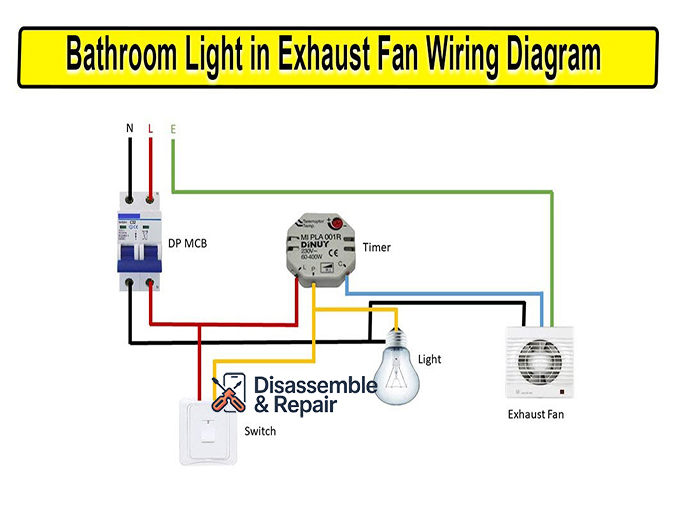
Many modern bathrooms utilize combination units, such as a fan with a light, or a fan with a heater and nightlight. These require more complex electrical connections.
Fan and Light Combo (Single Switch)
If you want the fan and light to operate simultaneously on one switch:
- Connect both the fan’s black wire and the light’s black (or blue) wire to the single incoming switched black wire from the wall.
- Connect all white neutrals together.
- Connect all grounds together.
Fan and Light Combo (Separate Switches)
For independent control, you need a 3-wire cable (Black, Red, White, Ground) running from the switch to the fan.
- At the Switch: One switch controls the Black wire; the second switch controls the Red wire.
- At the Fan: Connect the house Black wire to the fan motor wire. Connect the house Red wire to the light kit wire.
- Neutrals: Connect the single house white wire to both the fan and light neutral wires.
Troubleshooting Your Electrical Connection
Even with careful planning, issues can arise. If your fan does not operate after restoring power, check the following:
Check the Breaker and GFCI
Ensure the breaker didn’t trip immediately upon turning it on, which indicates a short circuit (likely a hot wire touching ground). Also, if the fan is installed over a tub or shower, it must be GFCI protected. Check if the GFCI outlet or breaker has tripped.
Inspect Wire Nut Connections
Turn the power back off and open the housing. A loose wire nut is a common culprit. Ensure that the copper strands are actually touching and twisted together, not just the insulation.
Verify Switch Operation
Sometimes the fault lies in an old switch rather than the fan wiring. Use your voltage tester to ensure the switch is successfully sending power through the outgoing wire when toggled on.
Final Thoughts on Safety and Compliance
Electrical work is governed by the National Electrical Code (NEC). Always ensure your work meets these standards. For example, all splices must be inside a junction box, and cables must be secured within 8 to 12 inches of the box.
Successfully Wiring a Bathroom Exhaust Fan is a rewarding project that improves your home’s air quality and comfort. By following the wiring diagrams carefully, securing your connections, and respecting electrical safety protocols, you can ensure a reliable installation. However, if at any point you feel unsure about the condition of your home’s wiring or the complexity of the circuit, do not hesitate to consult a licensed electrician. Safety is always the most important component of any home improvement project.

Here’s an FAQ generated from the provided text:
Frequently Asked Questions
Q: Why is proper ventilation important in a bathroom?
A: Proper ventilation is crucial for maintaining a healthy home environment, preventing mold growth, and protecting structural integrity from moisture damage.
Q: What is the most critical phase of installing a bathroom exhaust fan?
A: While mounting the unit is often a matter of carpentry, the most critical phase of the project is the electrical work, which requires precision, adherence to local building codes, and a strict commitment to safety procedures.
Q: Does this article cover the entire installation process for an exhaust fan?
A: No, this article specifically focuses on the electrical connections involved. For a comprehensive overview of the entire project, including ductwork and housing installation, you should refer to the parent topic: “How to Install a Bathroom Exhaust Fan” or the resource “Install a Bathroom Exhaust Fan: A DIY Guide”.
Q: What is the absolute priority before starting any electrical work on an exhaust fan?
A: Safety must be your absolute priority. Electrical work carries inherent risks, and failing to de-energize the circuit can result in severe injury or fatal shock. Always turn off the power first.
Q: What essential tools are needed for wiring a bathroom exhaust fan safely?
A: To perform safe fan wiring, you will need specific tools designed for electrical work, including:
- Non-contact voltage tester
- Wire strippers/cutters
- Lineman’s pliers
- Wire nuts (wire connectors)
- Electrical tape
- Screwdrivers (Phillips and flathead)
Q: How do I turn off the power before wiring an exhaust fan?
A: Locate your home’s main service panel (breaker box) and identify the circuit breaker that controls the bathroom lights and fan. Switch it to the “OFF” position. Then, in the bathroom, attempt to turn on the existing light or fan to confirm the power is cut. For absolute certainty, use a non-contact voltage tester on the wires inside the switch box and the ceiling housing before touching anything.
Q: What voltage do most residential bathroom fans operate on?
A: Most residential bathroom fans operate on a standard 120-volt circuit.
Q: What are the standard wire colors and their functions in a US residential electrical setup?
A: In a standard US residential electrical setup (NM cable or Romex), you will typically encounter the following wires:
- Black (Hot): Carries the current from the source to the switch, and from the switch to the fan.
- White (Neutral): Returns the current to the service panel.
- Bare Copper or Green (Ground): Provides a safe path for electricity.