
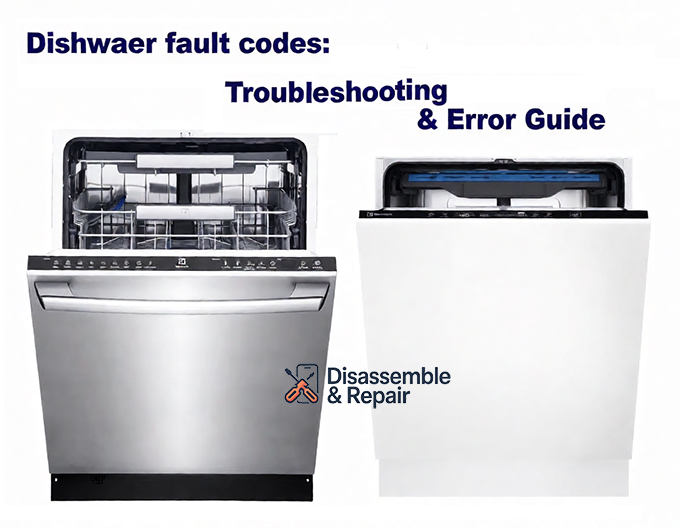
Modern dishwashers are sophisticated appliances that communicate problems through specific signals, commonly known as Dishwasher fault codes. These alphanumeric indicators appear on the digital display to alert owners when a component, such as the drain pump or heating element, is not functioning correctly.
Understanding these codes is the first step in effective appliance repair. Instead of guessing why your machine has stopped mid-cycle, these codes provide a roadmap for diagnosis. Whether you are a DIY enthusiast looking to fix a simple clog or a homeowner trying to decide if you need a professional service technician, deciphering these error messages is critical.
This guide covers the most frequent fault codes across major brands, explains how to enter diagnostic modes, and offers troubleshooting steps for key components like the water inlet valve and control board.
Understanding Dishwasher Fault Codes
The “brain” of your appliance is the control board, a printed circuit board that monitors every cycle. It relies on various sensors—including temperature sensors, turbidity sensors, and the leak sensor—to ensure the machine runs safely and efficiently.
When a sensor detects an anomaly, such as water not reaching the correct temperature or a failure to drain, the control board interrupts the cycle and triggers an error message. These messages are not random; they correspond to specific sections of the user manual that outline the nature of the problem.
While codes vary by manufacturer, they generally fall into four main categories:
- Water Supply Issues: The machine cannot fill with water.
- Drainage Issues: The dirty water cannot leave the tub.
- Heating Issues: The water is cold, or the drying cycle fails.
- Leak Detection: Water is detected in the base pan.
Common Symptoms Associated with Codes
- Blinking Lights: On models without a digital display, a pattern of blinking lights often represents the fault code.
- Beeping: Continuous beeping usually accompanies critical errors like leaks.
- Stalled Cycle: The dishwasher stops and refuses to restart until the error is cleared.
Major Component Failures and Their Codes
To effectively use a troubleshooting guide, you must link the code to the physical component. Below is a breakdown of common parts that trigger dishwasher fault codes.
1. Drain Pump and Drainage Errors
One of the most common issues involves the drain pump. If your dishwasher fails to empty the water, it will trigger a specific code.
- Common Codes: Bosch (E24, E25), LG (OE), Samsung (5C, 5E, SE), Whirlpool (F9E1).
- The Problem: These codes suggest the drain pump is blocked, the drain hose is kinked, or the pump impeller is broken.
- The Fix:
- Clean the filter at the bottom of the tub.
- Check the drain hose connection under the sink for clogs.
- Inspect the pump impeller for debris like glass shards or toothpicks.
2. Water Inlet Valve and Filling Errors
If the machine cannot fill with water within a set time limit, the water inlet valve is often the culprit.
- Common Codes: Bosch (E15, E1), LG (IE), Samsung (4C, 4E), Whirlpool (F6E1).
- The Problem: The inlet valve solenoid may be burnt out, the water supply tap might be closed, or the inlet screen could be clogged with sediment.
- The Fix:
- Ensure the water supply valve to the dishwasher is fully open.
- Disconnect the supply hose and clean the mesh screen on the inlet valve.
- Test the valve for continuity using a multimeter; if it fails, replace it.
3. Heating Element and Temperature Errors
The heating element ensures water is hot enough to sanitize dishes and dry them effectively. When this fails, cleaning performance drops significantly.
- Common Codes: Bosch (E09), LG (HE), Samsung (HE, HC), Whirlpool (F7E1 or F3E2).
- The Problem: A burnt-out heating element, a faulty thermistor (temperature sensor), or a loose connection on the control board.
- The Fix:
- Visually inspect the heating element for blistering or breaks.
- Check the wiring continuity.
- On some models (like Bosch), the heater is integrated into the wash pump (heat pump), requiring a more complex replacement.
4. Leak Sensor and Float Switch Errors
Modern dishwashers have a safety mechanism involving a leak sensor and a float switch. If water accumulates in the base pan (underneath the tub), these sensors activate to prevent flooding.
- Common Codes: Bosch (E15), Samsung (LC, LE), LG (AE, E1).
- The Problem: The float switch is stuck in the “up” position, or the leak sensor detects moisture due to a loose hose or door seal leak.
- The Fix:
- Immediate Action: Turn off the water supply.
- Tilt the machine back (at a 45-degree angle) to drain water from the base pan (have towels ready).
- This often resets the sensor, but you must find the source of the leak to prevent the code from returning.
How to Enter Diagnostic Mode
For a more precise diagnosis, technicians use a special diagnostic mode. This forces the dishwasher to run a self-check of all components, often displaying saved dishwasher fault codes that may not have appeared during a standard cycle.
Warning: Always consult your specific user manual or technical sheet, as key sequences change between models.
Whirlpool / KitchenAid / Maytag
Most Whirlpool-family dishwashers use a “1-2-3” button sequence.
- Ensure the machine is in Standby mode (plugged in but off).
- Select any three buttons (e.g., High Temp, Sani Rinse, Heated Dry).
- Press them in sequence: 1-2-3, 1-2-3, 1-2-3.
- All lights should illuminate, and the machine will cycle through a test program. Count the clean light flashes to determine the error (e.g., 6 flashes, pause, 4 flashes = Code F6E4).
Bosch
Bosch dishwashers often require a “Power” and “Select” button combination.
- Hold down the “Start/Reset” button and one of the cycle select buttons (often “Auto” or “Glass”).
- While holding, press the “On/Off” button.
- Release the buttons when the display flashes or shows a code (like P0 or P1).
- Press the cycle button to scroll through stored error codes (e.g., E24).
Samsung
Samsung units typically use a combination of cycle buttons held for 3-5 seconds.
- Power on the dishwasher.
- Press and hold the “Delay Start” and “Auto” (or “Heavy” and “Express 60”) buttons simultaneously for roughly 3 seconds.
- The machine will light up and may display a code if an error is currently active.
LG
LG dishwashers usually use a simple Power and Start combination.
- With the door open, press the “Power” button.
- Immediately press and hold the “Soil Level” and “High Temp” (or “Spray” and “Delay Start”) buttons simultaneously.
- Close the door to begin the test cycle.
Advanced Troubleshooting and Appliance Repair Tips
When simple fixes do not resolve the issue, the problem may lie deeper within the system.
Control Board Malfunctions
If your dishwasher acts erratically—beeping randomly, flashing lights without a clear pattern, or refusing to start despite power—the control board may be corrupted or damaged.
- Diagnosis: Inspect the board for burn marks or swollen capacitors.
- Solution: Control boards are rarely repairable and usually require replacement. Ensure you order the exact part number listed on the appliance’s model sticker.
Resetting the Control Board
Before ordering parts, always try a “Hard Reset.”
- Turn off the breaker to the dishwasher at your home’s electrical panel.
- Wait for 5 minutes.
- Turn the breaker back on.
This clears the memory and can sometimes resolve “ghost” dishwasher fault codes caused by power surges.
When to Call a Service Technician
While many codes indicate problems solvable by a DIYer, some situations require a professional. You should contact a service technician if:
- The error involves the main wiring harness.
- You smell burning plastic or hear loud grinding noises.
- The repair requires pulling the dishwasher out of cabinetry and you are uncomfortable with plumbing/electrical connections.
- The appliance is still under warranty. DIY repairs can void manufacturer warranties.
Conclusion
Dishwasher fault codes are not just warnings; they are precise tools designed to help you maintain the longevity of your appliance. By understanding the relationship between these codes and components like the drain pump, water inlet valve, and heating element, you can save time and money on unnecessary service calls.
Always keep your user manual handy, as it contains the specific definitions for your model. Whether it is a simple clogged filter triggering a drain error or a sensitive leak sensor saving your kitchen from a flood, paying attention to these codes ensures your dishwasher continues to serve your household efficiently. Remember to prioritize safety: always disconnect power and water before attempting any physical repairs.
Frequently Asked Questions
What should I do first when a fault code appears on my dishwasher?
Before performing any repairs, you should attempt a “Hard Reset.” Turn off the dishwasher’s circuit breaker at your home’s electrical panel and leave it off for at least five minutes. This clears the control board’s memory and can resolve “ghost” codes caused by temporary power surges or minor electronic glitches.
How can I identify a fault code if my dishwasher doesn’t have a digital display?
On models without an alphanumeric display, the appliance communicates errors through specific patterns of blinking lights or audible beeping. You will typically need to count the number of flashes or beeps between pauses and then cross-reference that number with the troubleshooting section of your user manual.
What does it mean if my dishwasher triggers a leak sensor error?
A leak sensor or float switch error (such as Bosch’s E15 or Samsung’s LC) indicates that moisture has been detected in the base pan underneath the tub. This is a safety feature designed to prevent flooding. To address it, turn off the water supply, drain any accumulated water by carefully tilting the machine, and then inspect the door seals and hose connections for the source of the leak.
How do I access the diagnostic mode on my appliance?
Diagnostic mode is entered using a specific sequence of button presses, which varies by manufacturer. For example, Whirlpool often uses a “1-2-3” sequence on three different buttons, while LG typically uses a combination of the Power, Soil Level, and High Temp buttons. Because these sequences are model-specific, you should consult your technical sheet or user manual for the exact instructions.
When is it necessary to call a professional service technician?
You should contact a professional if you smell burning plastic, hear loud grinding noises, or if the fault code involves the main wiring harness or control board circuitry. Additionally, if your dishwasher is still under warranty, you should avoid DIY repairs, as opening or modifying the components can void your coverage.