
Is your dishwasher not working no water entering the tub to clean your dishes? Few kitchen malfunctions are as frustrating as opening your appliance after a full cycle only to find dry, dirty plates staring back at you. When a dishwasher fails to fill, the issue can range from a simple closed valve to a failed internal component.
This guide will walk you through a professional troubleshooting process to identify why your machine is dry. We will examine critical components like the water inlet valve, float switch, and door latch assembly to help you restore your dishwasher’s performance.
Dishwasher Not Working No Water: Initial Checks
Before dismantling your appliance, it is essential to rule out the simplest explanations. Many “breakdowns” are actually just external supply issues.
Safety Warning: Before performing any repairs or accessing internal components, always disconnect the dishwasher from the power source (unplug it or flip the circuit breaker) and turn off the water supply.
Verify the Water Supply
The most obvious culprit is often overlooked: the water supply itself. Your dishwasher relies on a dedicated water supply line connected to your home’s plumbing, typically found under the kitchen sink.
- Locate the Shut-Off Valve: Look for the shut-off valve connected to the dishwasher’s supply line. It is usually a small oval or lever handle.
- Check Valve Position: Ensure this valve is turned all the way to the “Open” position. If it was bumped or accidentally closed, water cannot reach the unit.
- Inspect for Kinks: Examine the water supply line running from the cabinet to the dishwasher. If the line is kinked or pinched by a drawer or the appliance itself, the flow will be restricted.
- Test Water Pressure: Your dishwasher requires a minimum water pressure (usually around 20 PSI) to function the water inlet valve correctly. If your kitchen sink has low pressure, the dishwasher likely suffers the same issue.
Inspect the Door Latch Assembly
A dishwasher has a safety mechanism ensuring it never runs with the door open. This is controlled by the door latch assembly. If the latch is broken or the microswitches inside it are not engaging, the control board will not signal the water valve to open.
- Symptoms: The control panel lights might be on, but the cycle will not start, or the machine hums but no water enters.
- Troubleshooting: Close the door firmly. Listen for a distinct “click.” If the latch feels loose or does not click, the assembly may be misaligned or broken. You can test the door switches for continuity using a multimeter to confirm they are closing the electrical circuit.
The Water Inlet Valve
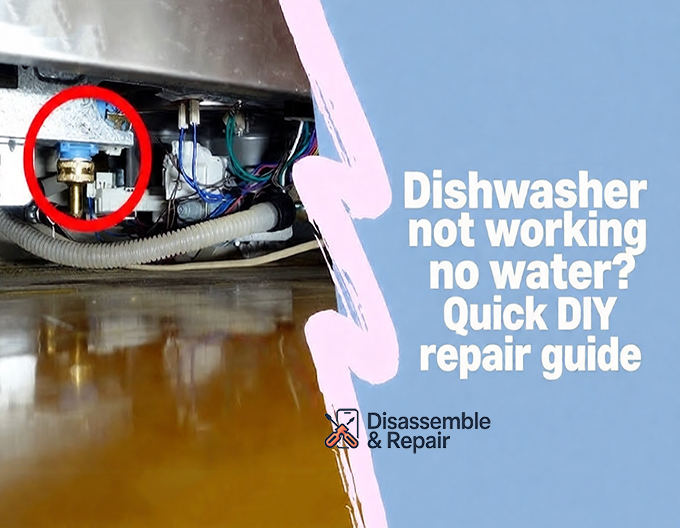
If your water supply is on and the door is latching correctly, the water inlet valve is the next most likely suspect. This component is the gateway that physically opens to let water into the machine and closes to stop it.
How It Works
The inlet valve uses a solenoid valve—an electromagnetic coil—to open a gate mechanism. When the dishwasher cycle calls for water, the control board sends an electrical signal to the solenoid, opening the valve.
Diagnosing a Faulty Inlet Valve
There are two main ways this valve fails: mechanical clogging or electrical failure.
- Clogged Inlet Screen: Inside the valve, there is a small filter mesh known as the inlet screen. Its job is to catch sediment and debris from your water pipes. Over time, calcium deposits or debris can completely block this screen.
- Fix: You can disconnect the supply line and inspect the screen. If it is dirty, clean it carefully. However, if the screen is permanently damaged, the entire valve usually needs replacement.
- Solenoid Failure: If the solenoid coil burns out, it cannot open the valve even if it receives power.
- Test: If you hear a loud humming noise during the fill cycle but see no water, the solenoid might be trying to energize a stuck valve. Alternatively, total silence suggests the solenoid has failed electrically. A multimeter test showing infinite resistance (an open circuit) confirms the part is dead.
The Float Switch and Overfill Protection
Your dishwasher has a built-in safety system to prevent flooding your kitchen. This system relies on the overfill protection float and the float switch.
The Overfill Protection Float
Locate a small plastic dome or cylinder on the floor of the dishwasher tub (usually in the front corner). This is the float. As water rises, this float lifts.
The Float Switch mechanism
Underneath the float (below the tub) sits the float switch. If the water gets too high, the float triggers this switch to cut power to the water inlet valve immediately.
Why It Causes “No Water” Issues:
If the float gets stuck in the “up” position due to soap scum, debris, or a dropped fork, the dishwasher thinks it is already full. Consequently, it will never activate the water inlet valve.
Troubleshooting Steps:
- Manual Check: Lift the plastic float in the tub up and down. It should move freely and drop back down under its own weight.
- Listen for the Click: When you drop the float, you should hear a crisp clicking sound from the switch below.
- Clean Debris: Remove any gunk or trapped food particles around the float stem that might be causing friction.
- Test the Switch: If the float moves fine but you suspect the switch is bad, you can test the float switch for continuity. If the switch reads as “open” even when the float is down, it needs to be replaced.
Drain Hose and Siphoning Problems
It might seem counterintuitive, but a dishwasher not working no water issue can sometimes be a drainage issue in disguise. This phenomenon is called siphoning.
If your drain hose is installed incorrectly, water might be flowing into the dishwasher and immediately flowing out down the drain. This happens if the drain hose does not have a “high loop” or an air gap.
- The High Loop: The drain hose must loop up as high as possible under the counter (or connect to an air gap) before attaching to the sink drain or disposal.
- The Symptom: You might hear water entering the machine, but the tub never fills up.
- The Fix: Check your drain hose installation. Ensure it is elevated above the water level of the dishwasher tub to prevent gravity from pulling the fresh water out.
The Electronic Control Board
The control board is the brain of the dishwasher. It sequences the dishwasher cycle, sending power to the drain pump, motor, and water inlet valve at precise times.
If you have verified that the water supply is on, the inlet valve is functional, the float switch is down, and the door latch is engaged, the issue may lie with the control board itself.
- The Failure: A relay on the board that controls the water inlet valve may have burned out. This means the board simply never sends the electrical signal to open the valve.
- Diagnosis: This is difficult to diagnose visually unless you see burn marks on the circuit board. A technician would typically test for voltage at the wire harness connecting to the inlet valve. If no voltage is present during the fill cycle, the control board is likely defective.
Summary of Troubleshooting Steps
To successfully diagnose why your dishwasher is dry, follow this logical order of operations:
- External Supply: Confirm the shut-off valve is open and the water supply line is not kinked.
- Door Latch: Ensure the door clicks shut and the door latch assembly switches are continuous.
- Float Assembly: Check that the overfill protection float moves up and down freely and is not stuck in the “full” position.
- Inlet Valve: Listen for humming. Inspect the inlet screen for debris. Test the solenoid valve for electrical continuity.
- Drainage: Verify the drain hose is not siphoning water out as fast as it enters.
- Control: If all else fails, suspect the control board.
When to Call a Professional
While checking a float or cleaning a screen is a manageable DIY task, other repairs require electrical expertise. If your troubleshooting points toward a faulty control board, burnt wiring, or if you are uncomfortable testing live voltage or replacing the water inlet valve, it is best to contact a professional appliance repair technician.
A dishwasher running without water can damage the main circulation pump and heater if left unresolved. By systematically checking the water pressure, valves, and switches outlined above, you can often identify the problem and determine if a simple cleaning or a new part is required to get your dishes sparkling clean again.
Frequently Asked Questions
Why is my dishwasher running through a cycle but no water is entering?
The most common causes are a closed water shut-off valve under the sink, a kinked supply line, or a faulty water inlet valve. If you hear a humming sound but the tub remains dry, the inlet valve’s solenoid may have failed or its internal filter screen might be blocked by mineral deposits.
How can I tell if the float switch is preventing my dishwasher from filling?
Locate the small plastic float on the floor of your dishwasher tub. Lift it up and down; it should move freely and produce a distinct clicking sound. If it is stuck in the “up” position due to food debris or soap scum, the machine will incorrectly sense that it is already full and will not trigger the water inlet valve to open.
Does a broken door latch affect the water supply?
Yes. The door latch assembly acts as a safety sensor. If the latch is broken or the internal microswitches fail to engage, the electronic control board will not receive the signal that the door is closed. For safety, the dishwasher will refuse to start the fill cycle to prevent potential leaking.
Why does it sound like water is entering the machine, but the tub stays empty?
This is often the result of “siphoning.” If the drain hose is not installed with a “high loop” (looped up higher than the tub’s water level) or connected to an air gap, gravity can pull water out of the dishwasher as fast as it flows in. Checking the height and positioning of your drain hose can resolve this issue.
When should I replace the water inlet valve instead of cleaning it?
While you can clean the small mesh screen inside the valve if it is clogged with sediment, a mechanical or electrical failure requires a full replacement. If the valve’s solenoid shows no continuity during a multimeter test or if the valve is physically cracked and leaking, it must be replaced to restore proper function.