
Encountering a Sharp washer E1 error can be a frustrating interruption to your daily laundry routine. This specific alphanumeric code is a notification from your appliance’s diagnostic system indicating that the washing machine is unable to fill with water within the expected timeframe. As a staple in many households, Sharp washing machines are designed to be durable, but like all appliances, they require specific conditions to operate correctly.
When the logic board detects that the water level has not reached the preset requirement required by the pressure switch, it halts the cycle to prevent damage to the internal components or dry running. While this may sound alarming, the issue is often related to external water supply factors or minor maintenance requirements rather than catastrophic mechanical failure. This comprehensive guide will walk you through the diagnosis and repair process, utilizing professional insights to get your machine back up and running.
Understanding the Sharp Washer E1 Error
To effectively resolve the issue, one must first understand the mechanics behind the Sharp washer E1 error. In modern laundry appliances, specifically the Front load washing machine and top load variants, the cycle begins with the opening of the Water inlet valve. The machine anticipates a specific change in internal air pressure, monitored by the Pressure switch, which corresponds to the rising water level in the drum.
If the machine does not detect adequate water volume after a set period—usually between 10 to 15 minutes depending on the specific model’s logic in the User manual—the system triggers the E1 error code. This safety mechanism ensures the Drain pump does not run dry and the heating element does not activate without water, which could cause significant thermal damage. Therefore, the E1 error is fundamentally a water supply timeout alert.
Initial Checks: External Water Supply Factors
Before disassembling the machine or calling a technician, you must rule out the most common and easily rectifiable causes. These external factors are responsible for the majority of E1 error cases.
The Water Supply Tap
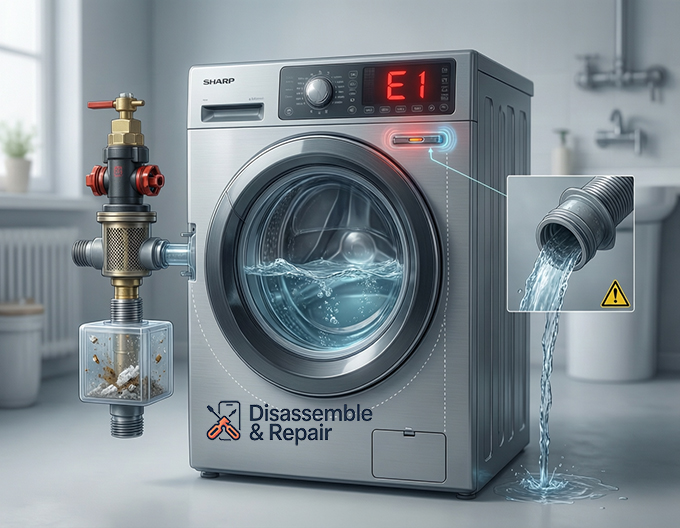
The most frequent culprit is often the simplest. Ensure that the Water supply tap connected to the machine is fully open. If the tap was accidentally closed or only partially opened, the flow rate will be insufficient to fill the drum within the logic board’s time limit. Turn the handle counter-clockwise until it stops to ensure maximum flow.
Water Pressure Issues
Your washing machine requires a minimum Water pressure to force the water through the detergent drawer and into the drum. If your home is experiencing low water pressure due to municipal work or plumbing issues, the machine may time out. You can test this by disconnecting the hose from the machine (after turning off the tap) and running water into a bucket. If the flow is a weak trickle, the issue lies with your home plumbing, not the Sharp washer E1 error mechanism.
The Inlet Hose Condition
Inspect the hose connecting the tap to the machine. If the washing machine has been pushed back too hard against the wall, the hose may be kinked or flattened. A restriction here acts exactly like a closed tap. Straighten out any bends to ensure a clear path for the water.
The Primary Culprit: Blocked Inlet Filters
If the water supply is on and the pressure is good, the next most likely cause is a blockage. Over time, sediment, calcium deposits, and debris from your water pipes can accumulate in the mesh screens designed to protect the machine.
Cleaning the Inlet Filter
The Inlet filter is a small mesh screen located inside the threaded connection where the hose meets the washing machine.
- Safety First: Unplug the washing machine from the power outlet.
- Cut Supply: Turn off the Water supply tap tightly.
- Disconnect: Unscrew the water inlet hose from the back of the washing machine. Have a towel ready, as some residual water will spill.
- Inspect: Look inside the valve opening on the machine. You should see a small plastic or metal mesh.
- Clean: Use a pair of needle-nose pliers to gently pull the filter out. Rinse it under running water and use a soft brush to remove debris.
- Reassemble: Reinsert the filter, reconnect the hose, and turn the water back on. Check for leaks before testing the machine.
Mechanical Troubleshooting: Internal Components
If external checks and cleaning the filters do not resolve the Sharp washer E1 error, the issue likely lies within the machine’s internal components. This section of the Troubleshooting guide requires a higher level of technical comfort.
The Water Inlet Valve
The Water inlet valve is the electromagnetic gatekeeper that opens to let water in when the Control board sends a signal. Even if filters are clean, the solenoid coils inside the valve can burn out, or the mechanical valve can seize shut.
- Diagnosis: If you start a cycle and hear a low hum but no water enters, the valve is receiving power but failing mechanically. If there is no sound and no water, the valve may have an electrical fault or is not receiving power.
- Solution: A faulty inlet valve cannot be repaired; it must be replaced with an OEM part matching your specific model number.
The Pressure Switch
The Pressure switch (or water level sensor) tells the computer how much water is in the unit. If this switch malfunctions, it may fail to register that water is entering the machine. Consequently, the computer thinks the drum is empty and triggers the E1 error, even if the drum is actually full.
- symptoms: The machine fills with water endlessly until it overflows, or it stops filling immediately.
- Check: Locate the pressure switch under the top panel. Ensure the small air tube connecting the switch to the drum is not clogged or disconnected.
The Drainage System Connection
While E1 is primarily an inlet error, the Drainage system plays a secondary role. If the Drain hose is installed incorrectly (siphoning), water might flow into the machine and immediately flow out down the drain. Because the water level never rises, the machine times out.
- The Siphon Effect: Ensure the drain hose is not inserted too far down the standpipe and that the end of the hose is elevated above the water level in the drum (usually at least 60cm from the floor).
Advanced Diagnostics: Control Board and Wiring
In rare scenarios, the Sharp washer E1 error stems from the Control board (PCB). The PCB is the brain of the operation. If the circuitry responsible for sending voltage to the water inlet valve is damaged—often due to a power surge or moisture—the valve will never open.
Additionally, inspect the wiring harness connecting the inlet valve to the main board. Vibration from the spin cycle can sometimes loosen connectors or chafe wires, breaking the electrical circuit. If you are not certified to handle high-voltage electronics, this is the stage where you should consult a professional technician.
Preventive Maintenance to Avoid E1 Errors
Preventing the Sharp washer E1 error is generally easier than fixing it. Regular maintenance ensures your appliance operates efficiently for years.
- Quarterly Filter Checks: Make it a habit to check the Inlet filter every three months, especially if you live in an area with hard water.
- Inspect Hoses: Periodically check the inlet and Drain hose for signs of wear, brittleness, or kinks.
- Correct Loading: Do not overload your Front load washing machine. While this typically causes motor errors, excessive vibration can loosen internal connections related to the pressure switch.
- Tap Management: If you are going away for an extended period, turn off the Water supply tap to relieve pressure on the inlet valve seals.
Conclusion
The Sharp washer E1 error is a protective measure designed to save your machine from operating without water. By systematically checking the water supply, cleaning the Inlet filter, and verifying the integrity of the Water inlet valve and Pressure switch, you can resolve the majority of these issues without expensive repair bills. Always consult your User manual for model-specific diagrams and safety warnings before attempting internal repairs. If the problem persists after these steps, the fault likely lies with the Control board, necessitating professional intervention. By following this guide, you ensure the longevity of your appliance and the efficiency of your laundry routine.
Frequently Asked Questions
What does the E1 error code mean on a Sharp washing machine?
The E1 error is a water supply timeout notification. It indicates that the washing machine has failed to fill with enough water to reach the required level within a specific timeframe (usually 10 to 15 minutes). This is a safety feature designed to prevent the machine from running dry or damaging the heating element.
Can I fix the E1 error without calling a professional technician?
Yes, many causes of the E1 error are external and easy to fix. You should first ensure the water supply tap is fully open, check that the inlet hose is not kinked or pinched, and clean the mesh inlet filters. These simple maintenance steps resolve the majority of E1 error cases.
Why does the E1 error appear even if I can see water entering the machine?
If water is entering but the error still triggers, you may be experiencing a “siphon effect.” This happens if the drain hose is inserted too far into the standpipe or is positioned too low, causing water to flow out of the machine as quickly as it flows in. Additionally, a faulty pressure switch or a clogged pressure tube may prevent the machine from “sensing” the water that is actually there.
How do I clean the inlet filters to resolve this error?
To clean the filters, turn off the water supply and unplug the machine. Unscrew the inlet hose from the back of the washer to reveal a small mesh screen inside the valve. Use needle-nose pliers to gently remove the screen, rinse it under running water to remove debris or calcium buildup, and then reassemble the components.
What should I do if the basic checks don’t clear the E1 code?
If the tap is open, the hoses are clear, and the filters are clean but the error persists, the issue is likely a mechanical failure of the water inlet valve or an electrical fault in the pressure switch or control board. In these instances, you may need to replace the faulty component with an official OEM part or contact a qualified repair service.