
Comfee washer installation instructions
Following these professional comfee washer installation instructions will ensure your new appliance operates smoothly and safely. Whether you are setting up a compact portable model or a standard unit, correct installation is critical for preventing leaks, excessive vibration, and potential damage to your home’s plumbing.
This guide provides a comprehensive walkthrough for installing your Comfee washing machine, covering everything from removing transit hardware to establishing secure water and electrical connections.
Pre-Installation checklist and unboxing
Before lifting the machine into place, you must locate the user manual included in the box. This document contains specific diagrams for your model. Upon unboxing, verify that you have all necessary components: the water inlet hose, the drain hose assembly, the quick-connect adapter, and the noise-reduction bottom cover (if applicable).
Removing the Shipping Bolts
The most critical initial step is removing the shipping bolts (also known as transit bolts) located at the rear of the unit. These heavy-duty bolts secure the drum during transport to prevent internal damage.
- Locate the 3 or 4 bolts on the back panel.
- Use the supplied wrench to loosen and remove them completely.
- Insert the provided plastic caps into the holes to seal the cabinet.
Warning: Failure to remove these bolts will cause severe vibration (“walking”) and loud banging during the spin cycle, which can permanently damage the washer.
Step-by-Step comfee washer installation instructions
Once the machine is positioned near your water source and drainage area, you can proceed with the plumbing and leveling adjustments.
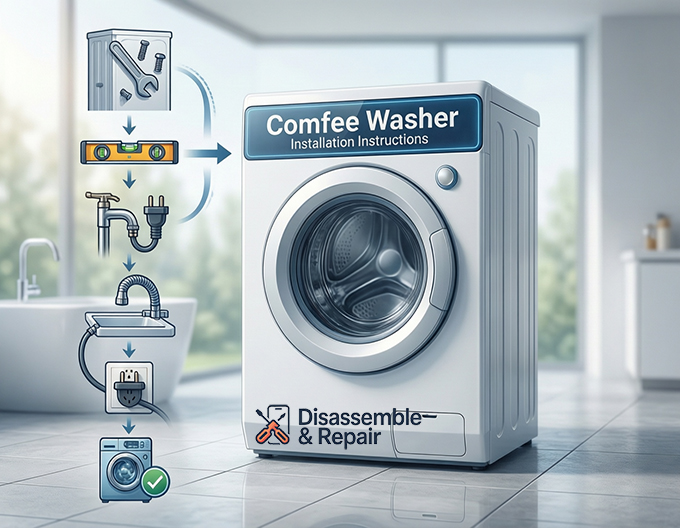
1. Leveling the appliance
Stability is essential for quiet operation. Comfee washers come equipped with adjustable leveling legs at the front (and sometimes the rear).
- Place the washer on a solid, flat floor.
- Tilt the machine slightly to adjust the legs. Turn the legs clockwise to raise the washer or counter-clockwise to lower it.
- Use a bubble level or check the position of the inner tub; it should be perfectly centered and not leaning against one side.
- Once level, tighten the locking nuts against the chassis to secure the legs in place.
2. Connecting the water supply
Your Comfee washer draws water through a dedicated inlet hose. Most portable models are designed to connect directly to a standard sink faucet using a quick-connect adapter, while stationary models connect to permanent water supply valves.
For Portable Models (Sink Connection):
- Remove the aerator from your sink faucet.
- Install the faucet adapter. This component typically consists of two parts: a faucet fitting and a hose fitting. Ensure the rubber gasket is inserted to prevent leaks.
- Connect the inlet hose to the cold water intake valve on the back of the washer. Hand-tighten the connection, then give it a slight turn with pliers—do not overtighten.
- Snap the other end of the hose onto the faucet adapter using the quick-connect mechanism.
For Stationary models:
- Connect the inlet hoses to the hot and cold water supply valve taps on your wall.
- Flush the taps briefly into a bucket to remove debris before connecting the hoses to the machine’s intake valves.
3. Setting up the drainage system
Proper drainage prevents flooding. You will need to install the drain hose securely.
- Connection: Attach the drain hose to the drain outlet on the back of the washer. Secure it with the provided clamp.
- Positioning: For portable units, hook the goose-neck end of the hose over the edge of your sink.
- Stationary Setup: If connecting to a standpipe or dedicated drain pipe, ensure the hose is inserted about 4 to 6 inches deep.
- Air Gap: Ensure the connection is not airtight. There must be an air gap between the hose and the drain pipe to prevent siphoning, which can cause the washer to fill and drain simultaneously.
4. Electrical requirements
Safety is paramount when dealing with water and electricity.
- Electrical Grounding: Your Comfee washer requires a standard 120V, 60Hz outlet. It is equipped with a 3-prong grounding plug.
- Safety Rule: Never remove the ground prong or use an adapter that bypasses the ground. The appliance must be properly grounded to protect against shock in the event of a malfunction.
- Avoid using extension cords, as they may not supply consistent power to the motor.
Final testing
After completing the connections, run a test cycle to ensure everything is secure.
- Turn on the water faucet or open the supply valves.
- Plug the machine in.
- Select the “Normal” cycle with a small load or empty drum.
- Watch the inlet hose and drain hose connections closely for any signs of dripping.
- Listen for unusual noise during the spin cycle. If the machine vibrates excessively, re-check the leveling legs.
By adhering to these steps, you ensure your Comfee washer is installed correctly, maximizing its lifespan and efficiency.
Frequently questions asked
Why is my new Comfee washer vibrating violently and moving across the floor?
The most common cause of excessive vibration, or “walking,” is the failure to remove the shipping bolts located on the rear of the machine. These must be removed with a wrench before the first use. Additionally, ensure the leveling legs are properly adjusted and locked so the machine sits flat on a solid surface.
Can I use an extension cord if the power outlet is too far away?
It is strongly recommended that you do not use an extension cord. Comfee washers require a consistent power supply from a standard 120V, 60Hz grounded outlet. Extension cords may not supply enough power to the motor and can increase the risk of electrical fire or malfunction.
How do I prevent the washer from filling and draining at the same time?
This issue is usually caused by “siphoning.” To prevent this, ensure there is an air gap between the drain hose and the standpipe. Do not create an airtight seal at the drain connection, and ensure the hose is only inserted 4 to 6 inches into the drain pipe.
What should I do if I experience leaks at the water inlet connection?
First, check that the rubber gasket is properly seated inside the hose fitting. If you are using a portable model, ensure the faucet adapter is screwed on straight and the quick-connect is fully snapped into place. Hand-tighten the connections and use pliers for only a slight extra turn; overtightening can damage the threads and cause more leaks.