
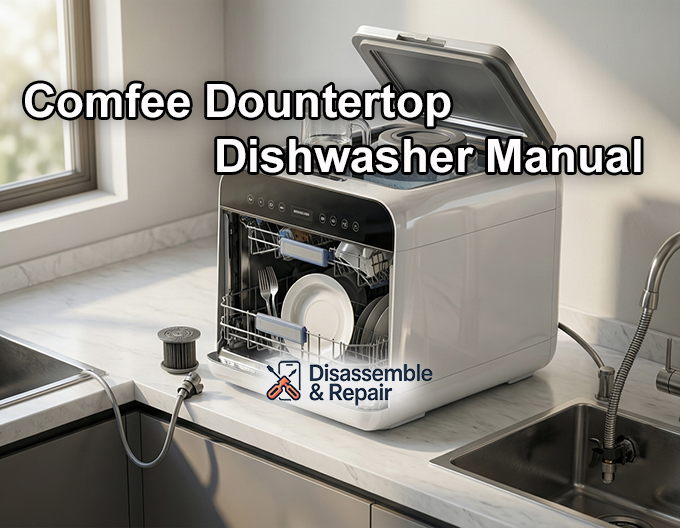
If you have recently purchased a compact appliance for your kitchen, reviewing the comfee countertop dishwasher manual is essential for ensuring optimal performance and longevity. This document serves as a complete user guide, consolidating critical information regarding installation, daily operation, troubleshooting, and maintenance for models such as the CDC22P1AWW and CDC17P0AWW.
Designed for modern living, the Comfee countertop dishwasher offers a compact portable design that fits perfectly in apartments, dorms, and RVs. Whether you are using the built-in water tank or connecting directly to a sink, understanding the manufacturer’s guidelines will help you achieve sparkling clean dishes with every cycle.
User safety precautions
Before operating your new appliance, safety must be the top priority. The manual outlines specific user safety precautions to prevent electrical shock, water damage, or personal injury.
- Electrical Grounding: Always ensure the dishwasher is plugged into a grounded outlet. Do not use an extension cord or an adapter plug, as this can lead to overheating and fire hazards.
- Sharp Objects: Load sharp items like knives with the handles up to prevent injury when unloading.
- Door Safety: Do not abuse, sit on, or stand on the door or dish rack of the dishwasher. The unit could tip over, causing injury.
- Hot Water & Steam: Be careful when opening the door during or immediately after a wash cycle. Hot steam may escape, posing a burn risk.
- Detergents: Dishwasher detergents are strongly alkaline and can be extremely dangerous if swallowed. Avoid contact with skin and eyes and keep children away from the dishwasher when the door is open.
Installation instructions: Comfee countertop dishwasher manual
One of the standout features of this appliance is its versatility. The installation instructions provided in the Comfee Countertop Dishwasher Manual detail two primary methods for setting up your machine: connecting to a faucet or using the manual water tank.
Positioning and drain hose setup
regardless of how you supply water, the drainage setup is consistent.
- Place the dishwasher on a flat, sturdy surface near a sink.
- Locate the drain hose setup on the back of the unit.
- Connect the drain hose to the drain port and secure it with a clamp.
- Place the free end of the hose into the sink or a bucket. Ensure the hose is not kinked and is secured so it does not flop out during the high-pressure drain cycle. The drain hose should not be elevated more than 1 meter (approx. 39 inches) above the surface where the dishwasher sits.
Method 1: Faucet adapter connection
For a continuous water supply, you can hook the dishwasher up to your kitchen sink.
- Remove the aerator from your existing kitchen faucet.
- Screw the provided faucet adapter onto the faucet tap.
- Connect the inlet hose to the port on the back of the dishwasher.
- Attach the quick-connect fitting to the faucet adapter.
- Turn on the hot water slowly and check for any leaks at the connection points.
Method 2: Using the built-in water tank
If you cannot connect to a faucet, the Comfee dishwasher features a built-in 5-liter water tank.
- Open the water tank cap located on the top of the unit.
- Fill the provided pitcher with cold or warm water.
- Pour water slowly into the tank.
- Continue filling until the unit beeps for 3 seconds, indicating the tank is full. The “Tap” icon on the display will turn off when sufficient water is detected.
Operating your dishwasher
Understanding the dishwasher cycles and how to properly load the machine is key to getting the best results.
Loading the compact portable design
Despite its small footprint, the interior is designed to hold up to 6 place settings.
- Plate Rack: Load plates facing the center.
- Cup Shelf: Place cups, glasses, and small bowls on the upper rack. Angle them slightly so water can run off freely.
- Cutlery Basket: Place forks and spoons in the basket. Knives should be placed handle-up for safety.
- Spray Arm Clearance: Before closing the door, spin the spray arms manually to ensure they do not hit any tall plates or cutlery.
Detergent dispenser and rinse aid
The detergent dispenser is located on the inside of the door.
- Detergent: Use only detergent specifically made for automatic dishwashers (powder, liquid, or tablet). Do not use regular hand-washing dish soap, as it will create excessive suds and may cause an overflow.
- Rinse Aid: The rinse aid dispenser is next to the detergent cup. Filling this helps dry dishes faster and prevents water spots.
Dishwasher cycles
Select the appropriate cycle based on your load:
- Normal: For normally soiled loads (standard daily use).
- Rapid/Speed: A shorter cycle for lightly soiled loads that do not need drying.
- ECO: Energy-efficient cycle for normally soiled loads; uses less water and energy but takes longer.
- Glass: For lightly soiled crockery and glass.
- Fruit: A specialized cold-water cycle for washing hard-surface fruits (requires no detergent).
- Baby Care/Steam: High-temperature wash suitable for sanitizing baby bottles.
Maintenance and cleaning
Regular maintenance ensures your dishwasher runs efficiently and prevents bad odors.
Filter maintenance
The filter system consists of a coarse filter, a flat (main) filter, and a micro (fine) filter. These prevent food remnants from re-circulating onto your dishes.
- Remove the Filter: Rotate the cylinder filter counter-clockwise to unlock it and lift the entire assembly out.
- Clean: Rinse all three parts under running water. Use a soft brush to remove stuck food particles.
- Reassemble: Put the fine filter back, followed by the coarse/cylinder filter. Rotate clockwise to lock it in place.
- Tip: Perform filter maintenance once a week to prevent clogs.
Spray arms cleaning
The spray arms can become clogged with hard water deposits or food debris, reducing cleaning power.
- Remove: Pull the lower spray arm upward to remove it. For the upper spray arm (if applicable to your model), unscrew the nut clockwise.
- Inspect: Check the nozzle holes for blockages.
- Clean: Use a pin or toothpick to clear any debris from the holes. Rinse under running water.
- Reinstall: Snap the arms back into place and ensure they spin freely.
Troubleshooting guide
If your appliance encounters an issue, the digital display may show an error code. This troubleshooting guide will help you identify and resolve common problems without needing a technician.
Common error codes
| Error Code | Meaning | Possible Cause | Solution |
|---|---|---|---|
| E1 | Water Inlet Issue | Faucet is closed, water tank is empty, or inlet is restricted. | Check water supply. If using the tank, add more water until the beep sounds. If using a faucet, ensure the valve is open and the hose is not kinked. |
| E3 | Heating Malfunction | Heating element or sensor failure. | This usually requires professional service. Contact Comfee customer support. |
| E4 | Overflow / Leak | Too much water in the base, often caused by using the wrong detergent. | Tilt the machine 45 degrees to drain water from the base. Check for leaks. Ensure you are using automatic dishwasher detergent, not hand soap. |
Other common issues
Dishwasher will not drain:
- Check the drain hose setup for kinks.
- Ensure the sink is not clogged.
- Check the filters for blockage.
Excessive Foam/Suds:
- You likely used liquid hand dish detergent instead of dishwasher detergent.
- Open the door and let the suds dissipate. Add a gallon of cold water to the tub, close the door, and run a “Rapid” cycle to drain the water.
White film on inside surface:
- Hard water minerals. Clean the interior with a damp sponge and dishwasher detergent. Use the detergent dispenser correctly and ensure rinse aid is filled.
Noise during operation:
- A rattling sound often means a spray arm is hitting the dishes. Pause the cycle and rearrange the items.
By following this comfee countertop dishwasher manual guide, you can ensure your compact appliance remains a reliable helper in your kitchen. Regular maintenance of the filters and spray arms, combined with correct installation and loading practices, will guarantee efficient cleaning performance for years to come.
Frequently asked questions
Can I use regular hand dish soap in my Comfee dishwasher?
No, you must only use detergent specifically formulated for automatic dishwashers, such as powders, liquids, or tablets. Using regular hand-washing soap will create excessive suds, which can lead to machine overflows, leaks, and error codes.
What should I do if the E1 error code appears on the display?
The E1 code indicates a water inlet issue. If you are using the manual water tank, fill it until the unit beeps for three seconds. If you are connected to a faucet, ensure the water supply is turned on, the inlet hose is not kinked, and there are no restrictions in the water line.
How often do the filters need to be cleaned?
To ensure optimal cleaning performance and prevent odors, you should perform filter maintenance once a week. This involves removing the filter assembly, rinsing the three components under running water, and using a soft brush to remove any trapped food particles.
How do I know when the built-in water tank is full?
When pouring water into the top of the unit, continue until the dishwasher emits a beep that lasts for 3 seconds. Additionally, the “Tap” icon on the digital display will turn off once the sensor detects that the tank has reached its 5-liter capacity.
What is the “Fruit” cycle used for?
The Fruit cycle is a specialized cold-water program designed to wash hard-surface fruits. Unlike other dishwasher cycles, this setting does not require any detergent and is intended to rinse away surface debris from produce.