
Owning a compact appliance offers convenience for small living spaces, but seeing sudden alerts can be confusing without a clear guide to comfee portable washing machine error codes. These digital indicators are the appliance’s way of communicating specific internal failures, ranging from simple drainage blocks to more complex sensor malfunctions. By understanding what each code represents, you can often resolve the issue yourself without needing professional repair services.
Understanding comfee portable washing machine error codes
When your washer detects a malfunction, it halts operation and displays a combination of letters and numbers. This section breaks down the most common Comfee Portable Washing Machine Error Codes, helping you identify whether the problem lies with the water supply, drainage system, or internal components like the circuit board.
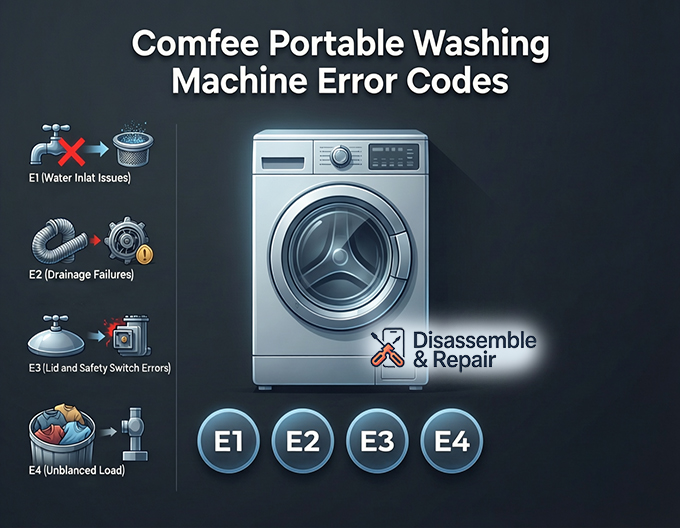
E1: Water inlet issues
The E1 error code signifies that the washing machine is not filling with water within the expected timeframe. This is one of the most frequent issues and is usually related to the water supply rather than a mechanical failure.
- Check the Water Supply: Ensure your home’s water faucet is fully open. If you are using a quick-connect adapter, verify that it is securely attached to the faucet and that water pressure is sufficient.
- Inspect the Inlet Valve: The inlet valve controls the flow of water into the tub. Over time, the mesh filter inside this valve can become clogged with sediment or debris. Turn off the water, disconnect the hose, and gently clean the filter. If the valve itself is defective, it may not open even when powered, requiring replacement.
- Examine the Water Level Sensor: If the water is physically entering the tub but the machine still triggers E1, the water level sensor (or pressure switch) might be failing to send the “full” signal to the main board. This component relies on air pressure changes; ensure the small air tube connected to it is not kinked or punctured.
SEE MORE:How to fix Comfee washing machine error E4
E2: Drainage failures
The E2 code indicates that the washer is unable to drain water effectively. This error stops the cycle before the spin stage to prevent water damage or overflow.
- Inspect the Drain Hose: A kinked or flattened drain hose is the most common culprit. Ensure the hose is not bent sharply behind the machine. Additionally, check the height of the hose; if it is positioned too high (usually above 47 inches), the drain pump may struggle to push the water out.
- Check the Drain Pump: The drain pump is responsible for expelling water. Small objects like coins, lint, or buttons can jam the pump’s impeller. Listen for a humming noise during the drain cycle, which often indicates a jammed pump trying to operate.
- Clear Blockages: If the pump is working but water flows slowly, there may be a clog in the internal plumbing or the filter housing. Cleaning these areas often resolves the E2 error immediately.
SEE MORE: How to fix Comfee washing machine error E2
E3: Lid and safety switch errors
Safety is a priority in portable washers, and the E3 code appears when the machine detects that the lid is open or the lid switch is faulty.
- Close the Lid Properly: The simplest fix is to ensure the lid is completely closed. If a physical obstruction prevents it from latching, the machine will not start.
- Test the Lid Switch: The lid switch is a safety mechanism that cuts power to the motor if the lid is lifted. If the magnet or mechanical lever inside the switch is broken or misaligned, the machine will “think” the lid is open even when it is shut.
- Check for Obstructions: Sometimes, a small piece of clothing caught near the hinge can prevent the switch from engaging.
SEE MORE: How to fix Comfee washing machine error E3
E4: Unbalanced load
The E4 code is triggered when the washer detects an unbalanced load. This protects the internal motor and suspension system from damage caused by violent shaking.
- Redistribute Laundry: Stop the machine and manually rearrange the wet clothes. Heavy items like jeans or towels can clump on one side of the drum, causing the tub to bang against the cabinet.
- Level the Machine: If the washer itself is not sitting flat on the floor, it will vibrate excessively. Adjust the leveling feet at the bottom of the unit until the machine is stable.
- Check Suspension Rods: In older units, worn-out suspension rods may fail to dampen the movement of the tub, causing frequent E4 errors even with small loads.
SEE MORE: How to fix Comfee washing machine error E4
Advanced troubleshooting and internal components
While the standard codes cover most daily issues, some problems point to deeper electrical or mechanical faults. Understanding the role of specific internal entities can help you decide whether to attempt a DIY fix or call a professional.
Circuit board and electrical glitches
The circuit board acts as the brain of the washing machine. If you experience erratic codes, such as the display flashing random numbers or the machine skipping cycles, the board may be compromised.
- Resetting the Unit: Unplug the washer for at least 5 minutes to discharge residual power. This “hard reset” can sometimes clear temporary glitches in the control logic.
- Moisture Damage: Since portable washers are often used in bathrooms or damp areas, humidity can affect the board. Ensure the control panel stays dry.
The role of the pressure switch and overflow protection
The pressure switch monitors the water level to prevent an overflow. If this switch fails or the air hose connected to it becomes blocked with soap scum, the machine might overfill, potentially leaking water onto your floor.
- Symptoms of Failure: If the machine keeps filling with water even after it reaches the top, or if it drains while filling, the pressure switch system requires immediate attention.
- Cleaning the Air Chamber: Located near the bottom of the tub, the air chamber connects to the pressure switch via a clear tube. Blowing gently into this tube (after disconnecting it from the switch) can sometimes clear obstructions.
Internal motor and mechanical noises
The internal motor drives the pulsator and the spin basket. While motor failures are less common than sensor errors, they are critical.
- Overheating: If the motor overheats due to overloading, the machine may shut down to protect itself, potentially showing an unlisted error or simply refusing to start until it cools down.
- Capacitor Issues: A failing motor capacitor can result in a hum without movement. If the drum refuses to turn but you hear the motor trying to engage, the capacitor is a likely suspect.
Maintenance tips to prevent error codes
Preventative maintenance is the best way to avoid seeing Comfee Portable Washing Machine Error Codes in the future. Referencing your user manual regularly ensures you are following the manufacturer’s specific guidelines for care.
- Clean the Inlet Filters: Every few months, remove the water inlet hoses and clean the mesh filters to prevent E1 errors.
- Inspect the Drain Pump Filter: Many portable models have a coin trap or lint filter near the pump. Keeping this clear prevents E2 drainage issues.
- Balance Your Loads: Avoid washing single heavy items. Always wash bulky items in pairs or mix them with lighter clothes to maintain equilibrium and avoid E4 errors.
- Use High-Efficiency (HE) Detergent: Excess suds can confuse the water level sensor and lead to drainage problems. Use the appropriate amount of detergent for the load size.
Conclusion
Troubleshooting your appliance doesn’t always require a technician. By identifying the specific comfee portable washing machine error codes, you can pinpoint the exact system causing the trouble—whether it’s a clogged drain hose, a faulty inlet valve, or a simple unbalanced load.
Always prioritize safety by unplugging the machine before inspecting internal parts like the circuit board or internal motor. If a problem persists despite your best troubleshooting efforts, consult the user manual or contact Comfee customer support. Armed with this knowledge, you can ensure your portable washer continues to provide efficient cleaning performance for years to come.
Frequently asked questions
How do I fix the E1 error on my Comfee washer?
The E1 code indicates a water inlet issue where the machine isn’t filling properly. To resolve this, ensure your water faucet is fully open and the inlet hose is not kinked. You should also disconnect the hose and clean the small mesh filter inside the inlet valve, as sediment buildup often blocks water flow.
What should I do if my machine shows the E4 code?
An E4 error means the load inside the drum is unbalanced. To fix this, pause the cycle and manually redistribute the wet clothing so it sits evenly around the pulsator. Additionally, ensure the washing machine is placed on a flat, level surface; you can adjust the leveling feet at the bottom to stabilize the unit.
Why is my Comfee washing machine not draining (E2 error)?
An E2 error signifies a drainage failure. Check the drain hose for any sharp bends or kinks that might be obstructing water flow. Also, ensure the drain hose is not installed higher than 47 inches, as the pump may not have enough power to push water above that height. Finally, check the drain pump for clogs like lint or small coins.
How can I reset my Comfee portable washing machine?
If your washer is displaying erratic behavior or a “ghost” error code, you can perform a hard reset. Unplug the power cord from the wall outlet and leave it disconnected for at least 5 minutes. This allows the electrical charge in the circuit board to dissipate, often clearing temporary software glitches.
Does the type of detergent I use affect error codes?
Yes, using the wrong type or too much detergent can lead to errors. It is highly recommended to use High-Efficiency (HE) detergent. Standard detergents can create excessive suds that may confuse the water level sensor or lead to drainage issues, potentially triggering E1 or E2 error codes.