
Is your Ge Profile Refrigerator Water Dispenser Not Working, leaving you without access to chilled, filtered water? This frustrating issue often stems from a few specific components that can be diagnosed and repaired without needing a professional technician immediately.
When a high-end appliance like a GE Profile series malfunctions, the cause is typically traceable to a specific part of the dispensing system. This comprehensive guide will walk you through the troubleshooting process, examining every critical component from the SmartWater filter to the internal solenoid valve. By systematically checking these elements, you can restore your refrigerator’s functionality.
Troubleshooting guide: GE profile refrigerator water dispenser Not working
When diagnosing why water isn’t flowing, it is essential to follow a logical path, starting with the simplest external factors before moving to internal mechanical failures. This section breaks down the most frequent culprits.
1. The control lock and dispenser settings
Before dismantling any parts, verify the settings on your dispenser control board. Many GE Profile models feature a “Lock” or “Control Lock” button designed to prevent accidental dispensing by children or during cleaning.
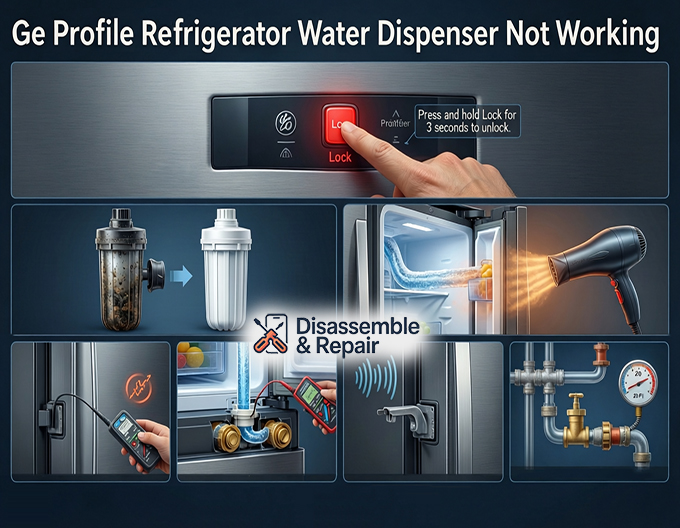
If the lock light is illuminated, the dispenser paddle will not activate the water flow. Press and hold the lock button for three seconds to disengage it. Additionally, if the control board display appears blank or unresponsive, try resetting the refrigerator by unplugging it for 30 seconds. This “hard reset” can sometimes clear electronic glitches affecting the dispenser control board.
2. Water filter and filter housing issues
One of the most common reasons for restricted water flow is a clogged or improperly installed water filter. GE recommends replacing the SmartWater filter every six months. As the filter traps contaminants, it can become saturated, significantly reducing water pressure to the point where water merely trickles or stops completely.
How to Test:
To determine if the filter is the problem, remove the current filter and install the bypass plug that came with your refrigerator. If the water flow returns to normal with the bypass plug in place, your filter is clogged and needs immediate replacement.
Sometimes, the issue lies within the filter housing itself. If you install a new filter and water still does not dispense, debris may be caught in the housing, or the mechanism that engages the filter could be damaged. Ensure you are using a genuine GE filter, as third-party alternatives often fail to depress the valve inside the housing correctly.
3. Frozen water line in the door
A design characteristic of certain GE Profile side-by-side models is the susceptibility of the water tube to freeze inside the freezer door. This usually happens if the freezer temperature is set too low (below 0°F) or if the insulation inside the door has degraded.
Symptoms:
If you hear the dispenser motor or valve humming when you press the actuator but no water comes out, a frozen water line is a likely suspect. The blockage typically occurs about four to six inches up the tube from the dispenser area.
The Fix:
You can thaw the line using a specialized water line buddy tool or a hairdryer set to low heat. Be extremely careful not to warp the plastic door liner. Direct the warm air at the dispenser recess and the inside of the door where the line runs. To prevent recurrence, ensure your freezer temperature is set between 0°F and 5°F. GE also offers a heater kit for the dispenser water tube for chronic cases.
4. Defective door switch
The door switch is a safety interlock that turns off the water and ice dispenser when the refrigerator door is open. If this switch fails electrically, the refrigerator control system will “think” the door is always open, thereby disabling the dispenser.
Testing the Switch:
Locate the door switch on the refrigerator frame. With the door open, press the switch manually. The interior lights should turn off. If the lights stay on, or if the dispenser does not activate when you manually hold the switch down, the component is likely defective. You can verify this with a multimeter by checking for continuity. A lack of continuity means the switch must be replaced to restore power to the dispenser.
5. Faulty water inlet valve
The water inlet valve is the electromechanical gatekeeper that controls water flow to your dispenser and ice maker. It is typically located at the bottom rear of the refrigerator. This assembly often contains two or more solenoids—coils of wire that create a magnetic field to open the valve plunger.
Mechanical vs. Electrical Failure:
- Electrical Failure: If the solenoid valve coils burn out, the valve cannot open. You can test this by unplugging the refrigerator, removing the wire harness from the valve, and measuring the resistance of the coils with a multimeter. Infinite resistance indicates a failed solenoid.
- Mechanical Failure: Sometimes the valve gets stuck due to calcium buildup. In this case, the solenoids might energize (you might hear a buzzing sound), but the valve remains physically closed.
If the valve is defective, it cannot be repaired and must be replaced as a complete assembly.
6. Dispenser actuator and microswitch
The actuator is the paddle or lever you press with your glass. Behind this plastic lever sits a small microswitch. When you press the actuator, it clicks the microswitch, sending a signal to the water inlet valve to open.
If the actuator hinge is broken, it may not make contact with the switch. Alternatively, the microswitch itself can fail. If you press the paddle and hear no “click” and the dispenser light does not turn on, the issue is likely in this mechanical linkage or the switch itself. Accessing this requires removing the dispenser interface panel. A multimeter continuity test on the microswitch will confirm if it is carrying the electrical signal.
7. Insufficient home water pressure
Ideally, your GE Profile refrigerator requires a water pressure of at least 20 PSI to function correctly. If the pressure is too low, the water inlet valve may not close fully after dispensing, leading to dripping, or it may not open at all.
Check the saddle valve (the valve connecting your fridge to your home’s plumbing). Ensure it is fully open. If you use a reverse osmosis system, the pressure might be too low for the refrigerator’s internal valve to operate. In such cases, an independent water line or a booster pump may be necessary.
SEE MORE: GE refrigerator not cooling but freezer working?
Advanced diagnostic steps
If the basic troubleshooting above does not resolve the issue, you may need to investigate the wiring and electronic controls deeper.
Inspecting the wire harness
The wire harness connecting the door components to the main chassis can sometimes become damaged, especially at the hinge where it flexes every time the door opens. Inspect the wires at the bottom of the freezer door for any signs of fraying, cuts, or loose connections. A severed wire here will cut off communication between the dispenser control board and the main control board.
Dispenser control board failure
The dispenser control board is the brain behind the interface. It regulates the power sent to the solenoid valve and interprets signals from the microswitch. If the board has shorted out or has a corrupted circuit, it may fail to send the “open” voltage to the water valve even if all other components are working.
Replacing the control board is a more expensive repair and should generally be done after all other mechanical causes (filter, valve, switch, frozen line) have been ruled out.
Conclusion
Resolving a Ge Profile Refrigerator Water Dispenser Not Working scenario requires a systematic approach. Start with the easiest maintenance tasks: changing the SmartWater filter and checking for a frozen water line. If these are not the cause, proceed to test the door switch, microswitch, and water inlet valve.
Regular maintenance, such as changing the filter every six months and keeping the condenser coils clean, will help maintain proper water pressure and prevent many of these issues. If you are uncomfortable using a multimeter or disassembling the door panel, contacting a certified GE appliance repair technician is the safest route to ensure your refrigerator is repaired correctly.
Frequently asked questions
How do I know if my water filter is the reason the dispenser stopped working?
The easiest way to test this is by removing the current filter and installing the bypass plug that originally came with your refrigerator. If the water flow returns to normal with the bypass plug in place, your filter is clogged and needs to be replaced.
Why is my dispenser locked, and how do I fix it?
Many GE Profile models include a “Control Lock” feature to prevent accidental dispensing by children or during cleaning. If the lock light is illuminated, the dispenser will not function. To unlock it, press and hold the “Lock” or “Control Lock” button on the interface for three seconds.
What should I do if the water line inside the freezer door is frozen?
You can thaw a frozen water line by using a hairdryer set to low heat, directing the air at the dispenser recess and the inside of the door. To prevent the line from freezing again, ensure your freezer temperature is set between 0°F and 5°F. If the problem persists, GE offers a specialized heater kit for the water tube.
How often should I replace the SmartWater filter in my GE Profile refrigerator?
GE recommends replacing the water filter every six months. As the filter traps contaminants, it eventually becomes saturated, which significantly reduces water pressure and can eventually stop the flow of water to the dispenser.
Can I use a third-party water filter instead of a genuine GE filter?
It is recommended to use genuine GE filters. Third-party alternatives often have slight design differences and may fail to properly depress the valve inside the filter housing, leading to restricted water flow or no water at all.