
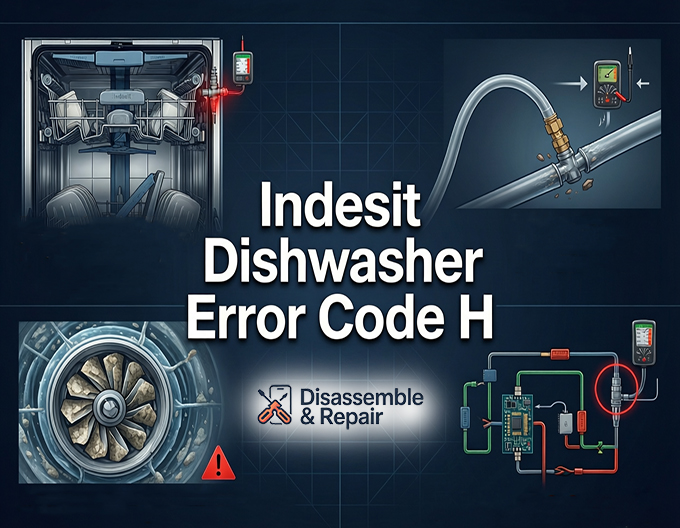
When your appliance display flashes the Indesit Dishwasher Error Code H, it effectively halts your kitchen routine, signaling a specific operational failure that requires immediate attention. This fault code typically indicates a problem with the water supply system, meaning the machine is struggling to fill with water or detect the correct water level required for a wash cycle.
Understanding the root cause of this error is the first step toward a successful appliance repair. While modern dishwashers are complex machines, the logic behind the “H” code is usually grounded in a few key components: the water supply line, the inlet valve, or the internal sensing mechanisms. By methodically testing these parts, you can often resolve the issue without needing to replace the entire unit.
This guide will walk you through the technical diagnosis of Indesit Dishwasher Error Code H, providing professional insights into testing components like the water inlet valve and pressure switch, and explaining how to use a multimeter to verify the integrity of your machine’s electrical system.
Understanding the “H” fault code
In the ecosystem of Indesit fault codes, “H” is distinctively associated with water intake and flow measurement. Unlike heating or drainage errors, which trigger different alphanumeric sequences, the “H” code tells the user that the control board has not received a “filled” signal within the expected timeframe.
On some models, this error might appear as “H2O,” explicitly pointing to a water shortage. However, if your digital display simply shows a flashing “H,” it is often accompanied by the machine humming (the sound of the drain pump running) or sitting silent after an initial start-up attempt.
Primary causes of error code H
- Restricted Water Supply: A kinked hose or a closed supply tap is the most common and easily fixed culprit.
- Faulty Water Inlet Valve: The solenoid that opens to let water in may have failed mechanically or electrically.
- Defective Flow Meter: This sensor counts the amount of water entering the machine. If it sends erratic data to the main PCB, the cycle aborts.
- Pressure Switch Malfunction: If the switch cannot detect that water has entered the tub, the machine will “time out” and display the error.
Safety and preparation
Before attempting any diagnostics, safety must be your priority. Disconnect the dishwasher from the mains electricity and turn off the water supply. You will need a specific set of tools to perform a professional-grade diagnosis:
- Multimeter: Essential for performing a continuity test on electrical components.
- Screwdrivers: Torx and Phillips heads are commonly used in Indesit appliances to remove panels.
- Towels/Bucket: To catch residual water from hoses.
- User Manual: Handy for identifying the specific layout of your model, as designs can vary.
Diagnosing the water inlet valve
The water inlet valve is the gatekeeper of your dishwasher. It is an electromagnetic solenoid that opens when the control board sends a signal. If the “H” error persists despite a good water supply from the tap, this valve is the first component to investigate.
To access the valve, you typically need to remove the plinth (kick plate) at the bottom front of the machine or the side panel, depending on your model.
Testing the valve with a multimeter
- Locate the Valve: It is found where the water fill hose connects to the dishwasher.
- Disconnect Wiring: Carefully remove the wiring harness connectors attached to the valve terminals.
- Set Multimeter: Set your multimeter to the resistance (Ohms) setting, usually denoted by the Greek letter Omega ($\Omega$) or a sound wave icon for continuity.
- Measure Resistance: Place the probes on the two terminals of the solenoid. A healthy valve should read between 2000 and 4000 Ohms (2-4 k$\Omega$).
- Interpret Results:
- Infinite Resistance (OL): The solenoid coil is open (broken). The valve must be replaced.
- Zero or Near-Zero Resistance: The coil is shorted. Replace the valve immediately to prevent damage to the control board.
Inspecting the pressure switch and flow meter
If the valve tests okay, the problem may lie in how the machine senses the water. Indesit dishwashers use a pressure switch and sometimes a flow meter (turbine) to monitor water levels.
The pressure switch
The pressure switch uses air pressure from a small tube connected to the sump to determine if there is enough water in the tub.
- Check the Hose: Ensure the small rubber tube connecting the sump to the switch is not blocked with gunk or kinked. A blockage here prevents air pressure from reaching the switch, causing the “H” error because the machine “thinks” it is empty.
- Continuity Test: You can test the switch contacts for continuity. With no water (no pressure), there should be continuity between specific terminals (consult your specific wiring diagram). When you blow gently into the switch, you should hear a “click,” and the continuity path should change.
The flow meter
In many modern Indesit models, a flow meter (a small turbine inside the water maze/air break on the side of the machine) sends pulses to the PCB. If the wiring harness to this sensor is corroded or the turbine is stuck, the Indesit Dishwasher Error Code H will trigger.
- Visual Inspection: Check for limestone or debris blocking the turbine.
- Wiring Check: Ensure the connector is seated firmly on the flow meter PCB.
The role of other components: Heating element and NTC sensor
While Indesit Dishwasher Error Code H is fundamentally a water supply fault, it is crucial to understand why technicians also inspect the heating system during a comprehensive repair.
The heating element and the NTC sensor (Negative Temperature Coefficient thermistor) work in tandem with the water system. The heating element must never activate unless the pressure switch confirms the presence of water; otherwise, it would burn out.
Why mention the NTC sensor?
Sometimes, a confusing fault can occur where a faulty thermistor sends incorrect signals, interfering with the cycle logic. Although rare for code “H,” if you have resolved all water supply issues and the error persists, inspecting the NTC sensor is a valid secondary step.
- Testing the NTC Sensor: Located in the sump, the thermistor changes resistance based on temperature. At room temperature (20°C), an Indesit NTC should typically read roughly 20k Ohms to 60k Ohms (check specific model data). If it reads open or shorted, it could be confusing the control board, though this usually triggers an F10 or F03 code.
Heating element health check
After fixing the “H” error, always run a test cycle. Because the machine may have been dry-cycling or stopping abruptly, it is wise to verify the heating element is still functional.
- Access: Usually found at the bottom of the tub or integrated into the wash pump.
- Test: Disconnect power and wires. Measure resistance across the element terminals. A reading of approx 25-30 Ohms indicates a healthy element. If it reads infinity (open circuit), the element is blown.
Wiring harness and control board
If all mechanical and sensor components test successfully, the issue may be electrical. The wiring harness in dishwashers, particularly the section running through the door hinge, is prone to fraying or breaking over time.
Inspecting the wiring
- Check the bundle of wires at the bottom of the door.
- Look for any exposed copper or severed insulation. A broken wire leading to the inlet valve or flow meter will result in an open circuit, mimicking a failed component.
- Repair any damaged wires using proper crimp connectors or soldering, ensuring they are insulated against moisture.
The control board
The control board (PCB) is the brain of the operation. If it fails to send voltage to the inlet valve or fails to read the signal from the flow meter, the Indesit Dishwasher Error Code H will be displayed. Diagnosing a PCB fault is difficult without specialized equipment. Typically, if every other component (valve, switch, wiring) is confirmed working, the PCB is the remaining suspect. Look for visual signs of burn marks or blown capacitors on the board.
Step-by-Step reset and test procedure
Once you believe you have identified and rectified the fault—whether by unblocking a hose, replacing the water inlet valve, or fixing a wire—you must reset the appliance to clear the memory.
- Reset: Press and hold the “Start/Reset” button for approximately 5-10 seconds until you hear a beep or the display clears.
- Power Cycle: Unplug the dishwasher for 15 minutes to allow the capacitors on the control board to discharge.
- Test Run: Select a short “Rinse” cycle. This cycle primarily tests the fill and drain functions without engaging the heating element extensively, making it the perfect diagnostic test for the “H” error.
- Observation: Listen for the hum of the inlet valve opening and the sound of water rushing into the side chamber.
Summary
The Indesit Dishwasher Error Code H is a protective mechanism designed to prevent your machine from running dry. While it can be frustrating, it is rarely fatal to the appliance. By systematically isolating the “fill” components—starting with the water supply and water inlet valve, moving to the pressure switch and flow meter, and finally checking the wiring harness—you can effectively diagnose the issue.
Always remember that successful appliance repair relies on accurate testing. Using a multimeter to verify resistance and continuity removes the guesswork, saving you money on unnecessary spare parts. Whether it’s a simple kinked hose or a failed solenoid, addressing the “H” code promptly ensures your Indesit dishwasher returns to optimal performance, protecting more expensive parts like the heating element from future strain.
Frequently asked questions
What does the Indesit dishwasher “H” error code mean?
The “H” error code (sometimes displayed as “H2O”) indicates a failure in the water supply system. It means the control board has detected that the dishwasher is not filling with water or is unable to accurately sense the water level within a specific timeframe. Common causes include a closed water tap, a kinked supply hose, or a faulty internal component like the water inlet valve.
How can I tell if my water inlet valve is broken?
A faulty water inlet valve is a primary cause of the “H” error. You can test it using a multimeter set to the resistance (Ohms) setting. After disconnecting the power and the wiring to the valve, place the probes on the solenoid terminals. A functional valve should provide a reading between 2000 and 4000 Ohms. If the multimeter shows infinite resistance (OL), the valve is “open” and must be replaced.
Can a blocked hose cause the “H” error code?
Yes. Both external and internal hoses can trigger this fault. Ensure the main water supply hose behind the machine isn’t kinked or pinched. Additionally, check the small rubber tube connected to the internal pressure switch; if this tube is blocked with debris or grease, the machine cannot “sense” the air pressure changes caused by rising water, leading it to time out and display the error.
How do I reset my Indesit dishwasher to clear the “H” code?
Once you have inspected the water supply and performed any necessary repairs, you should reset the appliance. Press and hold the “Start/Reset” button for 5 to 10 seconds until the display clears or you hear a beep. For a complete “hard reset,” unplug the machine from the power outlet for about 15 minutes to allow the control board capacitors to fully discharge before running a test cycle.
Is the “H” error related to the dishwasher’s heating element?
While the “H” code specifically refers to water intake, it is connected to the heating system’s safety logic. The dishwasher will not activate the heating element if it cannot confirm that there is enough water in the tub. If you experience the “H” error frequently, it is a good idea to test the heating element with a multimeter (it should read 25-30 Ohms) to ensure it wasn’t damaged by “dry-cycling” during the fault.