
Encountering an Lg Washing Machine Te Error can be frustrating, especially when it interrupts your laundry routine with a load of wet clothes stuck inside. This specific error code is a protective measure used by the appliance to signal a malfunction within the heating or temperature sensing system. Rather than ignoring the issue or immediately replacing the machine, a systematic approach to troubleshooting can often identify the root cause, which typically lies with the thermistor, heating element, or wiring harness.
This professional guide is designed to help you understand, diagnose, and resolve the TE error on your LG front load washer. We will explore the technical aspects of the fault, the entities involved—such as the control board and temperature sensor—and provide detailed steps for testing components using a multimeter.
Understanding the TE Error Code
The TE error code on an LG washer stands for “Thermistor Error” or “Temperature Error.” It indicates that the main control board (Main PCB) has detected an abnormal resistance reading from the temperature sensor. The washing machine constantly monitors the water temperature to ensure it matches the selected cycle settings. If the data received from the sensor is out of the expected range, the machine halts operation to prevent overheating or damage to the clothes.
The system relies on a closed loop of communication between several key components. When this loop is broken due to a failed part or a continuity issue, the Lg Washing Machine Te Error is triggered. While it often points to a bad sensor, it can also result from issues with the heating element or the electrical connections linking these parts.
Read more LG washing machine E4 error
Common causes of the LG washing machine TE error
Before disassembling your machine, it is essential to understand the potential culprits. The error is rarely caused by a software glitch and usually points to a hard failure in one of the following components:
1. Defective thermistor (Temperature sensor)
The thermistor is a variable resistor that changes its electrical resistance based on temperature. As the water heats up, the resistance drops. If the thermistor fails, it may report an “open” (infinite resistance) or “short” (zero resistance) circuit to the control board, triggering the error immediately.
2. Faulty heating element
The heating element is responsible for raising the water temperature. If the element burns out or develops a break in its internal coil, it will fail to heat the water. In some LG models, the control board runs a diagnostic check on the heater circuit before the cycle begins. If it detects a lack of continuity, it will display the TE error.
3. Damaged wiring harness
Vibration during the spin cycle can cause wires to rub against the metal chassis or the outer tub. Over time, this friction can wear through the insulation, causing a short circuit or a broken wire. Loose connections at the heating element or the Main PCB are also frequent causes of intermittent TE errors.
Read more LG washer leaves clothes wet after spin
4. Main PCB (Control board) failure
Although less common, the main printed circuit board (PCB) can develop faults. If the relay governing the heater fails or if the sensing circuit is damaged, the board may erroneously display an error code even if the peripheral components are functioning correctly.
Tools required for diagnosis
To accurately diagnose the issue, you will need specific tools to measure electrical values. Visual inspection is helpful, but it cannot confirm the health of internal electronic components.
- Multimeter: Essential for measuring Resistance (Ohms) and checking Continuity.
- Screwdrivers: Phillips and flat-head for removing the back panel.
- Socket Wrench Set: Typically 10mm, to remove the heating element if necessary.
- Towels: To catch any residual water when removing the heater assembly.
How to troubleshoot the LG washing machine Te error
Follow these steps systematically to isolate the problem. Always prioritize safety by disconnecting the appliance from the power source before performing any tests.
Step 1: Perform a hard reset
Occasionally, a power surge or a temporary glitch in the control board logic can trigger a false positive.
Read more How to reset LG washing machine Smart diagnosis
- Unplug the washing machine from the wall outlet.
- Press and hold the “Start/Pause” button for 5 seconds to dissipate any residual static electricity.
- Wait for at least 3 minutes.
- Plug the machine back in and attempt to run a “Rinse + Spin” cycle.
If the error returns, you have a hardware issue that requires physical inspection.
Step 2: Access the heating assembly
On most LG front load washers, the heating element and thermistor are located at the back of the tub, accessible by removing the rear panel.
- Turn off the water supply and disconnect the inlet hoses if necessary to move the machine.
- Remove the screws securing the rear metal panel.
- Locate the heating assembly at the bottom of the drum. You will see a metal plate with terminals and a smaller white plastic probe (the thermistor) inserted next to it.
Step 3: Inspect the wiring harness
Before testing the components, visually inspect the wiring harness. Look for:
- Corrosion: Green or white powdery deposits on the connectors.
- Burnt Wires: Blackened insulation or melted plastic connectors.
- Breaks: Wires that have been severed or pinched.
Ensure the ground wire (usually yellow/green) is securely attached to the heating element bracket. If the wiring looks intact, proceed to electrical testing.
Step 4: Test the thermistor resistance
This is the most critical step. You will need your multimeter set to the Ohms (Ω) setting.
- Disconnect the wire connector attached to the thermistor (the small white sensor).
- Place the multimeter probes on the two metal terminals of the thermistor.
- Check the reading.
Technical Specifications:
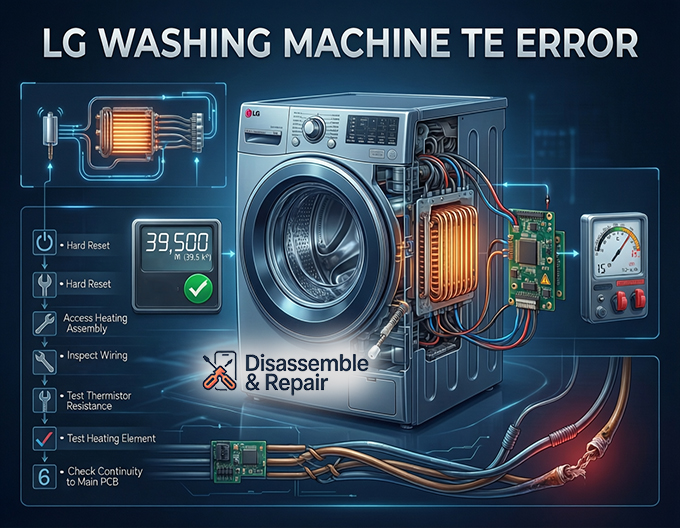
For most LG washing machines, a healthy thermistor should read approximately 39.5 kΩ (39,500 Ohms) at room temperature (around 77°F or 25°C).
- If the reading is Infinite (OL), the sensor is “open” and must be replaced.
- If the reading is Zero (0 Ω), the sensor is “shorted” and must be replaced.
- If the reading is significantly off (e.g., 10 kΩ at room temperature), the sensor has drifted and is no longer accurate.
Step 5: Test the heating element
If the thermistor tests fine, the issue may be the heating element.
- Disconnect the two heavy power wires connected to the heating element terminals.
- Set your multimeter to the lowest Ohms setting (usually 200Ω).
- Place one probe on each of the heating element terminals.
Technical Specifications:
A functional LG heating element typically has a resistance between 12 and 18 Ohms.
- No Continuity (OL): The internal coil is broken, and the element requires replacement.
- High Resistance: If the reading is erratic or very high, the element is failing.
Ground Fault Test:
Switch your multimeter to continuity mode (often indicated by a sound wave symbol). Place one probe on a heater terminal and the other on the metal casing of the element (ground). The meter should not beep. If it beeps, the element is “leaking” electricity to the ground, which can cause the TE error and trip your home’s circuit breaker.
Step 6: Checking continuity to the main PCB
If both the heating element and thermistor yield correct resistance values, the issue may lie in the wiring harness running from the back of the drum to the main control board.
- Locate the main PCB (usually behind the top control panel).
- Identify the connector for the heating circuit (consult your machine’s wiring diagram, often found inside the top cover).
- Check for continuity between the plug at the thermistor end and the plug at the PCB end. Infinite resistance here indicates a broken wire inside the harness.
Advanced troubleshooting: The control board
If all mechanical and electrical components test within range, the fault likely lies with the Main PCB. The board may not be sending the correct voltage to the heater or may be unable to interpret the signal from the temperature sensor.
Replacing the Main PCB is more expensive and complex. Before condemning the board, ensure that all connections are tight. A loose connection at the board can mimic a component failure. If you must replace the board, ensure the part number matches your specific LG model exactly, as different firmware versions exist for similar-looking machines.
Repair vs. Replacement
When facing an LG washing machine TE error, the decision to repair often depends on the specific failed component:
- Thermistor: This is an inexpensive part and easy to replace. It is highly recommended to repair.
- Heating Element: Moderately priced and straightforward to install. Repair is usually the best option.
- Wiring Harness: Can be repaired by splicing new wires if the damage is localized.
- Main PCB: This is a costly part. If your machine is over 10 years old, you might consider the cost of the board against the price of a new unit.
Preventative maintenance
While component failure can happen due to age, certain habits can extend the life of your heating system:
- Avoid Excessive Vibration: Ensure the machine is perfectly level. excessive shaking damages the wiring harness.
- Use High-Efficiency Detergent: Excess suds can create pressure and overheat the system, stressing the heating element.
- Periodic Hot Washes: Running a monthly maintenance cycle with hot water helps prevent limescale buildup on the thermistor and heating element. Limescale acts as an insulator, causing the element to work harder and the thermistor to read inaccurately.
Conclusion
The TE error code is a clear indicator that your LG washing machine’s temperature regulation system has been compromised. By using a multimeter to test the resistance of the thermistor and heating element, you can pinpoint the issue with high accuracy. Remember that a reading of approximately 39.5 kΩ for the thermistor and 12-18 Ω for the heating element are your benchmarks for a healthy system. Whether it is a simple sensor swap or a wiring repair, following these troubleshooting steps can save you the cost of a service call and get your appliance back to peak performance.
Read more LG washing machine PF error
Frequently asked questions
What exactly does the TE error code mean?
The TE error code stands for “Thermistor Error” or “Temperature Error.” It indicates that the washing machine’s main control board is detecting an incorrect or missing resistance signal from the temperature sensor (thermistor). This prevents the machine from operating to avoid potential overheating or damage to your laundry.
Can a simple reset fix the TE error?
In some cases, a temporary electronic glitch can trigger a false TE error. You can attempt a hard reset by unplugging the washer, holding the “Start/Pause” button for five seconds to clear residual power, and waiting three minutes before plugging it back in. However, if the error returns during a cycle, it usually indicates a hardware failure in the thermistor, heating element, or wiring.
What tools do I need to diagnose the problem myself?
To accurately identify which part has failed, you will need a multimeter to test for resistance (Ohms) and continuity. Additionally, you will need a Phillips-head screwdriver to remove the back panel and a socket wrench (typically 10mm) if you need to remove the heating assembly.
What are the correct multimeter readings for a healthy LG washer?
When testing at room temperature (approx. 77°F), a functional thermistor should show a resistance of about 39.5 kΩ. The heating element should show a resistance between 12 and 18 Ohms. If your multimeter displays “OL” (Open Line) for either component, the part is defective and must be replaced.
Is it expensive to repair a TE error?
The cost depends on the specific cause. The thermistor is an inexpensive part and relatively easy to replace. The heating element is moderately priced. However, if the issue lies within the Main PCB (control board), the repair can be more costly. Because most TE errors are caused by the sensor or heater, repairing the unit is usually much cheaper than buying a new washing machine.