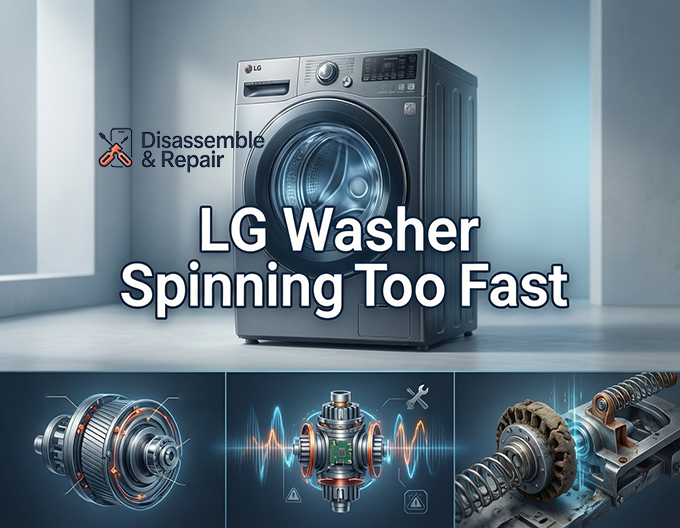

Homeowners are frequently alarmed by the violent vibrations and excessive noise associated with an LG washer spinning too fast during the final stages of the laundry cycle. This phenomenon, where the drum appears to accelerate beyond safe limits or design parameters, typically suggests a breakdown in the communication between the motor, the sensors, and the main control systems. While high-efficiency machines are designed to reach high RPMs for effective water extraction, uncontrolled speed poses a risk to the appliance’s structural integrity and your home’s flooring.
As a Senior SEO Specialist and technical content expert, I have compiled a comprehensive guide to diagnosing this specific issue. Below, we will explore the intricate relationship between the electronic control board, the direct drive motor, and the mechanical suspension system to determine why your washer has lost the ability to regulate its spin speed.
Read more LG washing machine error code list
Understanding Why Is Your LG Washer Spinning Too Fast?
To diagnose the problem, one must first understand the mechanics of the LG Direct Drive Motor. Unlike older belt-driven systems, the direct drive system connects the motor directly to the tub. This allows for precise control over the RPM (Revolutions Per Minute). Under normal operation, the washer modulates its speed based on the cycle selected and the weight of the clothes.
When users report an LG washer spinning too fast, they are usually describing one of two scenarios:
- Actual Overspeed: The motor is receiving incorrect voltage or signals, causing it to ramp up to maximum RPM instantly without the necessary ramp-up logic.
- Perceived Overspeed (Stability Failure): The washer is spinning at a standard high speed (e.g., 1200 RPM), but mechanical failures in the suspension make it feel like the machine is spinning out of control due to violent shaking.
Distinguishing between these two is the first step in a professional repair process.
The Critical Role of the Rotor Position Sensor (Hall Sensor)
The most common electronic cause for speed regulation issues is the Rotor Position Sensor, often referred to as the Hall Sensor. This small component is mounted on the stator behind the motor rotor. Its primary function is to monitor the exact position and speed of the motor and relay this data to the Main Control Board.
The Hall Sensor acts as a digital tachometer. It counts the rotations and ensures the Direct Drive Motor is spinning at the speed requested by the wash program.
Symptoms of Hall Sensor Failure:
If the Hall Sensor fails or sends erratic data, the Main Control Board loses its “eyes” on the motor. In some logic failures, the board may assume the motor is not spinning fast enough and increase the power, leading to the drum spinning significantly faster than intended for the specific Spin Cycle Phase. This often results in a distinct “jet engine” whining noise before the machine potentially shuts down to protect itself.
The Main Control Board and Speed Regulation
The Main Control Board is the brain of the operation. It interprets data from the Hall Sensor and sends voltage to the stator coils to drive the motor. If the triac on the control board (the component that regulates power to the motor) shorts out, it can send full, unregulated power to the motor immediately.
While less common than sensor failure, a bad control board results in immediate, maximum acceleration the moment the spin cycle engages. If your LG washer spinning too fast issue occurs instantly upon starting a spin cycle rather than gradually, the Main Control Board is a primary suspect.
Mechanical Instability: Shock Absorbers and Suspension Springs
In many cases, the machine is spinning at the correct RPM, but the physical dampening system has failed. This creates the illusion of excessive speed because the energy is not being absorbed.
Shock Absorbers
LG front-load washers typically utilize three to four Shock Absorbers attached to the base of the unit and the outer tub. These components dampen the movement of the tub during high RPM spins. If the shocks are worn out, the tub will oscillate violently. This lack of resistance allows the tub to build up kinetic energy that mimics an over-speed condition.
Suspension Springs
The tub is suspended from the top of the cabinet by Suspension Springs. These springs hold the weight of the assembly. If a spring stretches or breaks, the tub becomes misaligned. During the spin cycle, this misalignment causes the drum to rotate off-center. Even at moderate speeds, an off-center rotation creates centrifugal force that feels like the washer is spinning dangerously fast.
Unbalanced Load and the UE Error Code
Modern LG washers are equipped with sophisticated software designed to detect an Unbalanced Load. Before reaching high speeds, the washer attempts to distribute the clothes evenly. If the sensors detect a weight imbalance, the machine should trigger a UE Error Code and stop the cycle or attempt to re-rinse the clothes to redistribute them.
However, if the suspension is weak or the Hall Sensor is providing marginally incorrect data, the machine may fail to trigger the UE Error Code. Instead, it attempts to power through the imbalance. This results in the machine accelerating a heavy, wet, unbalanced load to high speeds, causing severe vibration and the sensation that the washer is “running away.”
Calibration Mode and System Reset
Whenever parts are replaced, or if the washer is exhibiting speed anomalies, running the Calibration Mode is essential. This diagnostic function resets the weight sensors and the load detection algorithm on the Main Control Board.
Why Calibration Matters
Over time, the mechanical stiffness of the washer changes. If the board is operating on old calibration data, it may miscalculate the amount of force required to spin the drum. Calibrating the machine allows the Main Control Board to learn the current friction and weight values of the empty drum.
Read more How to remove dirt from LG washing machine
General Steps for LG Calibration (Consult your specific manual):
- Empty the drum completely.
- Power on the washer.
- Press and hold the specific key combination (often “Temp” and “Delay End” or “Spin” and “Soil”) until the display shows a code.
- Press the Start button. The drum will rotate back and forth to measure the weight and motor resistance.
- Once finished, the machine will turn off.
Diagnostic Workflow for High-Speed Issues
If you are troubleshooting this issue professionally, follow this logical workflow to isolate the fault:
Phase 1: Mechanical Inspection
- Check for Stability: Ensure the washer is level on the floor.
- Inspect Shocks: Remove the rear or front panel (depending on the model). Press down on the tub. If it bounces like a basketball, the Shock Absorbers are shot. There should be significant resistance.
- Check Springs: Ensure both Suspension Springs are intact and seated correctly.
Phase 2: Electronic Diagnostics
- Run Calibration: Perform the Calibration Mode to reset the board’s logic.
- Sensor Check: If the issue persists, access the service mode to check the RPM reading. If the RPM reading on the display fluctuates wildly (e.g., jumping from 400 to 0 to 1000), the Rotor Position Sensor is likely defective.
- Visual Inspection of Rotor: Remove the back panel and the rotor bolt. Inspect the plastic teeth on the rotor and the magnetic Hall Sensor on the stator for cracks or debris.
Phase 3: Control System
- Error History: Check the diagnostic mode for stored error codes. A history of motor errors points toward the Main Control Board or the wiring harness connecting the motor.
- Board Inspection: Visually inspect the Main Control Board for burn marks or blown capacitors near the motor connection relays.
Conclusion
An LG washer spinning too fast is rarely a sign of a “powerful” clean; rather, it is a symptom of a control loss or mechanical failure. Whether the root cause lies in a faulty Hall Sensor misreporting RPMs, a Main Control Board failing to regulate voltage, or worn Shock Absorbers failing to dampen the energy of the Direct Drive Motor, prompt attention is required.
Read more LG washer keeps disconnecting from wifi
ignoring this issue can lead to catastrophic failure, including shattered drum spiders, damaged bearings, or cracked flooring. By systematically checking the entities outlined above—from the UE Error Code logic to the physical condition of the Suspension Springs—you can restore your appliance to its optimal, quiet, and efficient operation. If you lack experience with high-voltage electronics, it is always recommended to contact a certified LG technician to replace internal components.
Frequently Asked Questions
Why is my LG washer making a loud “jet engine” whining noise during the spin cycle?
This high-pitched sound usually indicates that the Rotor Position Sensor (Hall Sensor) is failing. When this sensor sends incorrect data, the Main Control Board may lose track of the drum’s actual RPM and supply excessive voltage to the motor, causing it to accelerate beyond its intended speed.
How can I tell if my washer is actually over-speeding or just vibrating excessively?
Actual over-speeding is typically characterized by the motor ramping up to maximum speed almost instantly or reaching RPMs that sound much higher than usual. If the drum is spinning at a standard speed but the machine is shaking violently, the problem is likely mechanical, such as worn-out shock absorbers or a broken suspension spring that can no longer dampen the vibration.
Will running a Calibration Mode fix the spinning issue?
Calibration Mode can resolve issues where the Main Control Board is miscalculating the load weight or motor resistance. By resetting these values, the board can more accurately regulate the power sent to the Direct Drive Motor. While it won’t fix a broken part like a Hall Sensor, it is a critical first step in troubleshooting electronic speed anomalies.
What should I do if my washer spins fast with an unbalanced load but never shows a UE error?
If the washer attempts to spin a heavy, unbalanced load at high speeds without triggering a UE (Unbalanced Error) code, it usually suggests the suspension system is weak or the Hall Sensor is providing “marginally” incorrect data. You should inspect the shock absorbers for resistance and ensure the machine is perfectly level to prevent the sensors from being bypassed.