
If you are facing the frustrating issue of an LG washer not spinning but motor running, you are not alone. This specific problem often indicates a mechanical disconnect between the motor’s power and the drum itself, rather than a total motor failure. In this guide, we will explore the internal components of your LG washing machine to pinpoint why the cycle stalls despite the motor sounding active. We will cover critical parts such as the rotor assembly, drive belt, and Hall sensor to help you restore your appliance to working order.
Diagnosing an LG Washer Not Spinning But Motor Running
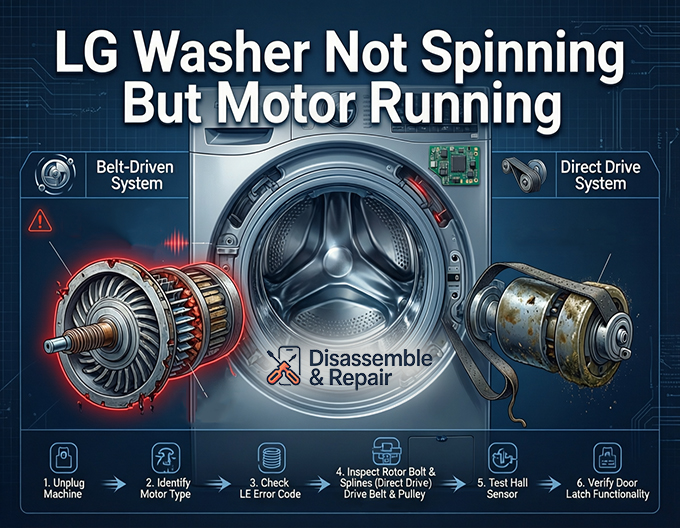
When you hear the hum of the motor but see a stationary washing machine drum, the diagnosis depends heavily on the type of LG washer you own. LG manufactures two primary types of systems: belt-driven and direct drive. Identifying which system your machine uses is the first step in solving the puzzle of an LG washer not spinning but motor running.
Before diving into complex disassembly, verify that the door latch is fully engaged. The door latch is a safety mechanism that communicates with the control board. If the latch is physically broken or fails electronically, the control board may allow the motor to agitate or hum but prevent the high-speed spin cycle to avoid accidents. Listen for the distinct “click” of the lock engaging before the cycle begins.
The “LE” Error Code Connection
On many modern LG units, this mechanical failure is accompanied by an LE error code on the digital display. While “LE” technically stands for “Locked Motor Error,” it can be misleading. It doesn’t always mean the motor is seized. Instead, it often signifies that the motor is running but the Hall sensor (or Rotor Position Sensor) is not detecting the expected rotation of the drum. This discrepancy triggers the error and halts the cycle to protect the machine.
Inspecting Direct Drive Models
Most modern LG front-load and top-load washers feature a Direct drive motor. In this system, the motor is attached directly to the back of the drum, eliminating the need for belts and pulleys. If you have a direct drive unit, the issue likely lies within the connection between the motor and the drum.
Check the Rotor Assembly and Plastic Splines
The rotor assembly is a large, magnet-lined metal saucer located on the back of the drum (accessible by removing the rear panel). It connects to the driveshaft via a central mounting point.
- Access the Rotor: Unplug the washer and remove the back panel screws. You will see the large rotor assembly.
- Inspect the Rotor Bolt: In the center of the rotor is the rotor bolt. If this bolt has come loose, the rotor may wobble or fail to engage the shaft tightly, causing the motor to spin without turning the drum.
- Check the Splines: This is a common failure point. The rotor connects to the metal shaft using teeth known as splines. In some older or specific models, the rotor hub utilizes plastic splines to interface with the metal shaft. Over time, or due to heavy unbalanced loads, these plastic splines can strip completely.
- The Symptom: The motor spins the metal shaft, but because the plastic teeth are stripped, the rotor assembly slips, and the drum remains stationary.
- The Fix: Remove the rotor bolt and pull the rotor off. Inspect the center hub. If the teeth are ground down or smooth, the entire rotor assembly must be replaced.
Testing the Stator and Hall Sensor
Behind the rotor assembly sits the stator, a ring of copper coils that creates the electromagnetic field to drive the rotor. Mounted on the stator is the Hall sensor.
- The Role of the Hall Sensor: This small sensor monitors the position and speed of the rotor. If it fails, the control board loses track of the motor’s speed. The board may attempt to run the motor, but without speed feedback, it will shut down the spin cycle and likely throw the LE error code.
- Testing: You can test the Hall sensor using a multimeter. You will need to check for resistance across its terminals (consult your specific model’s service manual for the correct ohm readings). If the sensor is dead, the motor might jerk or hum but fail to build up the speed required for spinning.
Inspecting Belt-Driven Models
While less common in newer premium models, many LG washers still utilize a traditional belt system. If you do not have a “Direct Drive” badge on the front of your machine, you likely have a belt-driven unit.
Drive Belt Issues
The most obvious culprit in a belt-driven LG washer not spinning but motor running scenario is the drive belt itself.
- Slipped Belt: The belt may have simply slipped off the motor pulley or the large drum pulley. This results in the motor spinning freely (and loudly) with zero resistance, while the drum stays still.
- Broken or Worn Belt: Inspect the belt for fraying, cracks, or snapping. A broken belt effectively disconnects the motor from the drum.
- Tension: Even if the belt is attached, it may have stretched over years of use. If it is too loose, the motor pulley will spin inside the belt loop without gripping it enough to rotate the heavy washing machine drum, especially when wet laundry adds significant weight.
Motor Pulley Problems
Check the motor pulley attached to the motor shaft. It should be tight and secure. If the pulley is damaged or has accumulated grease and debris, it may not provide enough friction to grab the drive belt. Cleaning the pulley and replacing the belt is often the most effective repair.
Advanced Electrical Troubleshooting
If the mechanical components (belt, rotor, splines) are intact, the issue may be electrical.
The Control Board
The control board is the brain of the washer. It sends voltage to the motor and interprets signals from sensors. If the board has a blown relay or a software fault, it might send power to the motor windings in an erratic pattern. This can cause the motor to hum or vibrate without actually spinning the drum. Diagnosing a bad control board is usually a process of elimination after you have ruled out the rotor, stator, Hall sensor, and door latch.
Read more LG washing machine no power no lights
Wiring and Connections
Vibration during the spin cycle can sometimes loosen wire harnesses. Check the connections leading from the motor/stator to the main control board. A loose wire can cause intermittent power delivery, where the motor runs weak or stops under load.
Read more LG washing machine not draining water
Summary of Repair Steps
To successfully fix an LG washer not spinning but motor running, follow this logical order of operations:
Read more LG washer overflowing with soap
- Safety First: Always unplug the machine before removing any panels.
- Identify Motor Type: Determine if you have a Direct Drive or belt-driven model.
- Check Codes: Look for the LE error code or similar indicators on the display.
- Inspect Mechanical Linkage:
- Direct Drive: Check the rotor bolt for tightness and the plastic splines for damage.
- Belt Drive: Check the drive belt for breakage or slipping and inspect the motor pulley.
- Test Sensors: If mechanical parts are fine, test the Hall sensor on the stator.
- Verify Door Lock: Ensure the door latch is functioning correctly.
By methodically checking these entities—from the simple drive belt to the hidden plastic splines of the rotor assembly—you can often identify the root cause without needing a full machine replacement. Whether it is a $20 sensor or a stripped rotor hub, understanding the mechanics behind the symptom ensures you perform the right repair.
Frequently Asked Questions
What does the LE error code mean on my LG washer?
The LE error code stands for “Locked Motor Error.” While it sounds like the motor is stuck, it often means the control board is receiving conflicting information. Specifically, the motor may be running, but the Hall sensor cannot detect the drum’s rotation. This is frequently caused by a mechanical issue, such as stripped rotor splines or a faulty sensor, rather than a seized motor.
How do I know if my LG washer uses a belt or a direct drive system?
Most modern LG washers feature a “Direct Drive” badge on the front of the machine, indicating the motor is attached directly to the drum. If your machine does not have this badge, it is likely a belt-driven model. You can also verify this by removing the back panel: a direct drive model has a large metal rotor assembly in the center, while a belt-driven model has a pulley system connected by a rubber belt.
What are rotor splines and why do they cause spinning issues?
Rotor splines are the “teeth” inside the center hub of the rotor assembly that lock onto the motor’s driveshaft. In some LG models, these splines are made of plastic. Over time or due to heavy loads, these plastic teeth can wear down or strip completely. When this happens, the motor shaft will spin, but it won’t be able to grip the rotor to turn the drum, resulting in a motor that runs while the drum stays still.
Read more LG washing machine E3 error
Can a broken door latch prevent the washer from spinning even if the motor works?
Yes. The door latch is a critical safety component. If the latch is physically broken or if its electronic sensor fails to signal the control board that the door is securely locked, the washer may refuse to enter the high-speed spin cycle. In some cases, the machine may allow the motor to hum or agitate slowly but will stop short of a full spin to prevent potential injury or damage.