
Encountering a Samsung washing machine TE1 error can be a significant inconvenience, bringing your laundry routine to an abrupt halt. This specific error code serves as a critical alert from your appliance’s self-diagnostic system, indicating a malfunction within the water temperature sensing circuit. As a sophisticated piece of machinery, your front load washer relies on precise thermal readings to regulate washing cycles, and when this communication is disrupted, the machine ceases operation to prevent overheating or component damage.
In this technical guide, we will deconstruct the mechanical and electrical reasons behind this fault code. By understanding the interaction between the thermistor, heating element, and control board, you can effectively diagnose and potentially resolve the issue. Whether you are a DIY enthusiast comfortable with a multimeter or a homeowner trying to determine if professional repair is necessary, this article provides the detailed insights required to address the problem.
Understanding the Technical Basis of the TE1 Code
To effectively troubleshoot, one must first understand what the machine is trying to communicate. The TE1 code is specifically related to the water temperature sensor, often referred to technically as the thermistor or NTC sensor (Negative Temperature Coefficient).
In a functioning system, the NTC sensor monitors the water temperature inside the drum. It sends a continuous signal—specifically a resistance value—back to the main PCB (Printed Circuit Board). As the water temperature rises, the electrical resistance of the sensor decreases. The main computer interprets this changing resistance to control the heater.
Read more Samsung washing machine UB error
The TE1 error triggers when the control board detects an abnormal reading from the sensor. This usually manifests in two ways:
- Open Circuit: The resistance is infinite, suggesting a cut wire or a completely failed sensor.
- Short Circuit: The resistance is near zero, suggesting internal sensor damage or bridged wires.
- Out of Range: The sensor is reporting a temperature that is physically impossible (e.g., boiling or freezing) or does not change despite the heater being active.
Primary Causes of the Malfunction
While the error code points to the temperature sensor, the root cause can stem from several distinct components within the washing assembly.
1. Defective Thermistor (NTC Sensor)
The most common culprit is the sensor itself. Over time, exposure to hard water, detergent residue, and constant thermal cycling can cause the internal components of the sensor to degrade. If the thermistor fails to provide an accurate resistance reading, the washer locks out for safety.
2. Wiring Harness and Electrical Connections
The vibration of a washing machine during high-speed spin cycles can strain the internal cabling. The wiring harness connecting the sensor to the main PCB may suffer from abrasion, loose electrical connections, or corrosion. Even a momentary disconnection due to vibration can trigger the TE1 fault.
Read more Samsung washing machine HE1 error
3. Compromised Heating Element
The heating element and the thermistor are often located in the same assembly at the bottom of the tub. If the heating element has an insulation leak or has physically warped, it can damage the adjacent sensor or interfere with the electrical signals.
4. Main PCB Failure
Although less common, the control board itself may be at fault. If the logic circuit responsible for reading the temperature data is damaged (often due to power surges), it may falsely report a TE1 error even if the sensor and wiring are in perfect condition.
Safety Protocols Before Troubleshooting
Before attempting any diagnostic procedures, safety is paramount. You will be dealing with high-voltage components and water systems.
- Disconnect Power: Always unplug the machine from the mains electricity. Turning it off at the button is not sufficient.
- Water Supply: Turn off the water supply taps to prevent accidental flooding if hoses are disconnected.
- Drainage: Ensure the drum is empty. You may need to manually drain the machine using the emergency drain hose located behind the filter cover at the bottom front.
Diagnosing and Resolving the Samsung Washing Machine TE1 Error
The following steps outline a professional workflow for isolating the issue. You will need a standard digital multimeter to perform these tests accurately.
Step 1: The Reset Procedure
Before disassembling the machine, attempt a hard reset to rule out a temporary software glitch.
- Unplug the washer for at least 5 to 10 minutes.
- While unplugged, press and hold the Start/Pause button for 5 seconds to dissipate residual power in the capacitors.
- Reconnect power and run a Rinse+Spin cycle.
If the Samsung washing machine TE1 error persists immediately or during the cycle, proceed to physical inspection.
Step 2: Accessing the Components
On most Samsung front load washer models, the heating assembly is located at the bottom of the tub. Access usually requires removing the back panel of the machine.
- Move the machine away from the wall.
- Remove the screws securing the rear cover.
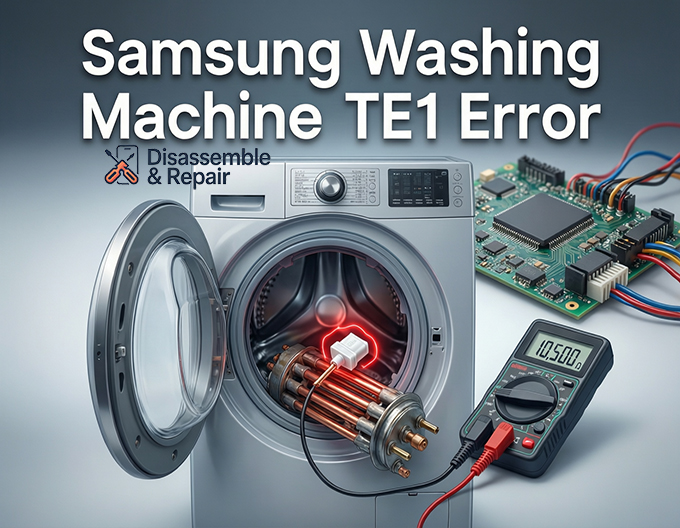
- Locate the heating element assembly at the bottom of the outer tub. You will see a metal flange with wires attached. The thermistor is typically a small probe embedded into this flange, usually with a white plastic connector.
Step 3: Inspecting the Wiring Harness
Visually inspect the wires leading from the heating element and thermistor up toward the control board. Look for:
- Pinched or stripped wires.
- Burn marks or melting near the connectors.
- Corrosion on the plug terminals.
Ensure all electrical connections are seated firmly. Disconnect and reconnect the plugs to scrape off any potential oxidation.
Step 4: Testing the Thermistor with a Multimeter
This is the definitive test for the TE1 error.
- Set your multimeter to the Ohms (Ω) / resistance setting.
- Disconnect the wiring harness from the thermistor.
- Place the multimeter probes on the two terminals of the sensor.
- Analyze the reading:
- At room temperature (approx. 20°C / 68°F), a healthy Samsung NTC sensor typically reads between 10,000 to 12,000 Ohms (10kΩ – 12kΩ). Note: Consult your specific model’s technical sheet if available, as values can vary slightly.
- If the reading is infinite (OL) or zero, the thermistor is electrically dead and must be replaced.
- If the reading is significantly outside the expected range, the sensor has drifted and requires replacement.
Step 5: Checking the Heating Element
While you are in the area, check the heating element.
- Set the multimeter to continuity mode or low resistance.
- Measure across the two heater terminals. You should see a resistance typically between 15Ω and 30Ω.
- Check for a ground fault: Place one probe on a heater terminal and the other on the metal casing of the heater or the earth tag. There should be no continuity (infinite resistance). If you get a reading here, the heater is shorting to the ground, which can cause erratic sensor errors and poses a safety hazard.
Step 6: Diagnostic Mode and Main PCB
If the sensor and heater pass the multimeter tests and the wiring appears intact, the issue likely lies with the main PCB.
Advanced users can enter the machine’s diagnostic mode (often by holding specific button combinations like Delay End + Soil Level and then Power, though this varies by model). In this mode, you can view the real-time temperature reading the computer is seeing.
- If the sensor reads correctly with a meter but the diagnostic mode shows an error or impossible temperature, the control board is failing to interpret the signal correctly. This necessitates a board repair or replacement.
Replacement and Preventative Measures
Replacing the Thermistor
If you identify a faulty sensor:
Read more Samsung washer stuck on rinse cycle
- Loosen the central nut on the heating element assembly (do not remove it completely).
- This relaxes the rubber seal. You may need to wiggle the heating element out slightly to release the thermistor, or simply pull the thermistor out if it is seated independently.
- Insert the new NTC sensor.
- Tighten the nut to expand the seal (ensure it is watertight).
- Reconnect the wiring harness.
Preventing Recurrence
To prevent future occurrences of the Samsung washing machine TE1 error, consider the following maintenance tips:
- Descaling: Scale buildup acts as an insulator. If the heating element or sensor is covered in limescale, the sensor cannot read the water temperature accurately. Use a washing machine descaler every 1 to 3 months.
- Avoid Overloading: Excessive vibration from overloading can damage the wiring harness and loosen connections over time.
- Surge Protection: Since the main PCB is sensitive to voltage fluctuations, plugging your washer into a surge protector can prevent electronic damage that leads to false error codes.
Conclusion
The Samsung washing machine TE1 error is a clear indicator that the thermal regulation system of your appliance has been compromised. While the code might seem intimidating, breaking it down into its components—the thermistor, wiring harness, and control board—makes the troubleshooting process manageable.
By utilizing a multimeter to check resistance and ensuring the integrity of your electrical connections, you can often identify the fault without the immediate need for a service call. However, if the diagnostic steps point toward a complex main PCB failure or if you are uncomfortable handling electrical components, contacting a certified Samsung technician is the recommended course of action. Proper diagnosis ensures that your front load washer returns to optimal performance, extending the lifespan of your appliance and ensuring safe operation for years to come.
Frequently Asked Questions
What does the TE1 error code mean on a Samsung washing machine?
The TE1 error indicates a malfunction in the water temperature sensing circuit. This happens when the washing machine’s main control board receives an abnormal resistance signal from the thermistor (NTC sensor). It is a safety feature designed to prevent the machine from operating when it cannot accurately monitor or regulate water temperature.
Can I fix the TE1 error by simply resetting my washer?
In some cases, a TE1 error can be caused by a temporary software glitch. To perform a hard reset, unplug the machine for 5 to 10 minutes and hold the Start/Pause button for 5 seconds to dissipate residual power. If the error code reappears after you restore power and start a new cycle, the problem is likely a physical fault with the thermistor, wiring, or heating element.
What resistance reading should I look for when testing the thermistor?
Using a digital multimeter set to the Ohms (Ω) setting, a functional Samsung thermistor should typically read between 10,000 and 12,000 Ohms (10kΩ – 12kΩ) at room temperature (approximately 20°C / 68°F). If the multimeter shows “OL” (infinite resistance) or zero Ohms, the sensor is defective and must be replaced.
Where is the thermistor located on most Samsung front load washers?
The thermistor is usually found at the bottom of the outer tub, embedded within the heating element assembly. To access it, you typically need to move the machine away from the wall and remove the rear access panel. It is identified by a small probe with a plastic connector attached to the metal flange of the heater.
Can a buildup of limescale cause a TE1 error?
Yes, heavy limescale buildup can act as an insulator on the thermistor or heating element. This prevents the sensor from accurately reading the water temperature, leading to “out of range” errors. Regularly descaling your washing machine every 1 to 3 months can help prevent the sensor from drifting and trigger a TE1 fault.