
The Samsung washing machine HE2 error is a specific fault code that indicates a malfunction in the appliance’s heating system. While this code generally points to a failure in the heating element or its associated sensors, understanding whether it applies to your washer’s water heater or a dryer component (in combo units) is critical for a successful repair.
Understanding the Samsung Washing Machine HE2 Error
The Samsung washing machine HE2 error typically appears when the main control board detects that the temperature is not rising as expected during a cycle. Unlike the HE1 error, which signals dangerous overheating, HE2 usually means the heating system is “open” or non-functional—essentially, the machine is trying to heat, but the temperature sensor isn’t registering a change.
Read more Samsung washing machine TC error
This error is most common in Samsung washer-dryer combos, where it specifically points to the drying cycle heating circuit. However, it can also occur in standard front load washers if the water heating element fails to raise the water temperature by a specific amount (usually 2°C) within a set timeframe (often 10 minutes).
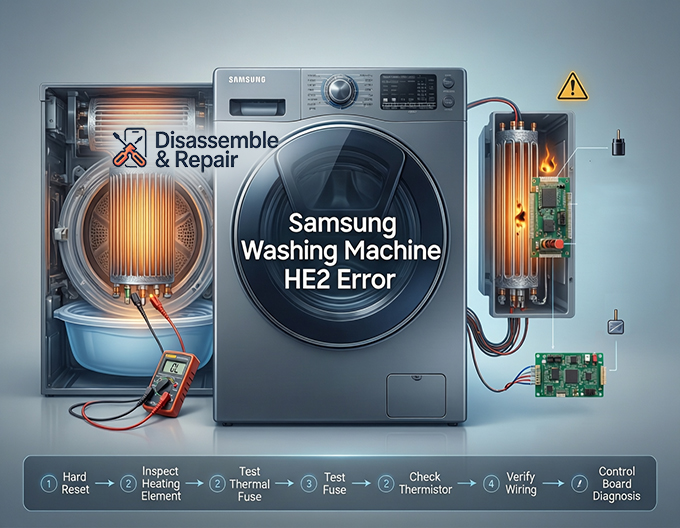
Common Causes of the HE2 Code
- Faulty Heating Element: The resistive coil has broken internally, preventing it from generating heat.
- Tripped Thermal Fuse: A safety device that cuts power if temperatures get too high. If it blows, the heater won’t work.
- Defective Thermistor (NTC Sensor): The temperature sensor may be sending incorrect resistance readings to the control board.
- Wiring Harness Issues: Loose connections, burnt wires, or damaged insulation can break the electrical circuit.
- Control Board Failure: In rare cases, the brain of the washer fails to send voltage to the heater relay.
Safety Precautions Before Troubleshooting
Before attempting any diagnosis, safety is paramount. Samsung appliance repair involves working with high-voltage components.
- Disconnect Power: Unplug the washing machine from the wall outlet. Turning it off at the button is not enough; you must sever the electrical connection completely.
- Water Supply: Turn off the hot and cold water taps to prevent leaks if you need to move the machine.
- Discharge Capacitors: If you are working near the control board, wait at least 5 minutes after unplugging the unit to allow capacitors to discharge.
- Protective Gear: Wear work gloves to protect against sharp sheet metal edges inside the cabinet.
Tools Required for Diagnosis
To properly fix the Samsung washing machine HE2 error, you will need the following tools:
Read more Samsung washing machine not spinning but making noise
- Multimeter: Essential for performing a resistance check and continuity test.
- Screwdriver Set: Philips and flathead screwdrivers for removing body panels.
- Needle-Nose Pliers: For disconnecting wire clips from terminals.
- Towels: To catch any residual water when accessing internal components.
Step-by-Step Troubleshooting Guide
1. Perform a Hard Reset
Sometimes, the HE2 code is a temporary glitch caused by a power surge or a software error.
- Unplug the washer for 10–15 minutes.
- Plug it back in and run a short cycle (like Rinse + Spin) followed by a heated cycle.
- If the error returns, proceed to physical troubleshooting.
2. Inspect the Heating Element (Dryer vs. Washer)
If you have a washer-dryer combo, the HE2 error almost exclusively relates to the dryer heating element.
For Washer-Dryer Combos (Dryer Heater):
- Access: The dryer assembly is usually located at the top of the machine under the top lid. Remove the screws at the back of the top panel and slide it off.
- Visual Check: Look for the metal duct housing the heater. Inspect the wiring harness for any signs of burning or melting.
- Multimeter Test:
- Set your multimeter to the lowest Ohms (Ω) setting.
- Disconnect the wires from the heating element terminals.
- Place one probe on each terminal.
- Expected Reading: A healthy dryer heating element typically reads between 10 and 50 Ohms. If your meter reads “OL” (Open Loop) or infinity, the element is broken and needs replacement.
For Standard Front Load Washers (Water Heater):
- Access: The water heating element is located at the bottom of the tub. You will likely need to remove the back panel or the front panel (depending on the model) to access it.
- Multimeter Test: Similar to the dryer element, test the terminals for resistance. A standard water heating element should read between 20 and 30 Ohms.
3. Check the Thermal Fuse and Thermostats
The thermal fuse acts as a fail-safe. If the dryer duct clogged with lint and overheated in the past, this fuse may have blown permanently.
- Location: You will find several button-sized components mounted on the heater housing. These are the thermostats and thermal fuses.
- Continuity Test:
- Set your multimeter to “Continuity” (the mode that beeps).
- Touch the probes to the terminals of the thermal fuse.
- Result: You should hear a beep (continuity). If there is no beep, the fuse has blown and broken the circuit, causing the HE2 error.
- Note: Some thermostats have a small reset button in the center. Try pressing this button. If it clicks, you may have just reset the system, but you must investigate why it tripped (e.g., clogged airflow).
4. Test the Thermistor (Temperature Sensor)
The thermistor (or NTC sensor) varies its resistance based on temperature. If it fails, the control board “thinks” the heater isn’t working.
- Location: Usually embedded near the heating element.
- Resistance Check:
- Set the multimeter to the 20kΩ or 200kΩ setting.
- Measure the resistance across the sensor terminals at room temperature (approx. 20°C/68°F).
- Expected Reading: Most Samsung thermistors read between 10kΩ and 15kΩ at room temperature. Consult your specific model’s tech sheet found inside the cabinet for exact values.
- If the reading is “OL” or zero, the sensor is faulty.
Wiring and Control Board Inspection
If the heating element, thermal fuse, and thermistor all test fine, the issue may lie in the power delivery.
- Wiring Harness: Trace the wires from the heater back to the main control board. Look for pinch points, cuts, or loose plugs. Vibration during the spin cycle can sometimes disconnect these wires.
- Control Board: Inspect the relay on the printed circuit board (PCB) that controls the heater. Look for burn marks or swollen capacitors. If the board is not sending 120V (or 240V in some regions) to the heater during a cycle, the board itself may require Samsung appliance repair or replacement.
Preventing Future HE2 Errors
Once you have cleared the Samsung washing machine HE2 error, routine maintenance can prevent recurrence:
- Clean Dryer Ducts: If you have a combo unit, fluff buildup restricts airflow, causing the heating element to overheat and burn out.
- Descaling: In hard water areas, limescale can coat the water heating element, acting as an insulator. This forces the element to work harder and eventually fail. Run a monthly cleaning cycle with a descaling agent.
- Avoid Overloading: Overloading the drum restricts air and water circulation, leading to localized hotspots that can trip thermal sensors.
When to Call a Professional
While many DIY enthusiasts can handle a multimeter test, some steps require professional intervention. You should seek expert help if:
- You are uncomfortable working with high-voltage electricity.
- The diagnostic tests are inconclusive (all parts seem fine, but the error persists).
- The control board requires soldering or component-level repair.
- The appliance is still under warranty (DIY repairs may void it).
By systematically checking the heating element, verifying continuity in safety fuses, and testing sensors, you can accurately diagnose the source of the HE2 fault. This structured approach ensures you replace only the necessary parts, saving time and money on unnecessary repairs.
Frequently Asked Questions
What does the HE2 error code mean on a Samsung washing machine?
The HE2 error code indicates a malfunction in the appliance’s heating system where the control board detects that the temperature is not rising as expected. Unlike an overheating error, HE2 typically signifies an “open” circuit, meaning the heating element, thermal fuse, or sensor is not functioning at all.
Can a simple reset fix the HE2 error?
In some cases, a hard reset can clear the error if it was caused by a temporary electronic glitch or a power surge. To do this, unplug the washing machine from the power source for 10 to 15 minutes, then plug it back in and attempt to run a new cycle. If the code reappears, the issue is likely a hardware failure that requires physical repair.
Does the HE2 error always refer to the water heater?
No. In Samsung washer-dryer combo units, the HE2 error almost exclusively points to a failure in the dryer’s heating circuit. However, in standard front-load washing machines that do not have a drying function, the code refers to the water heating element located at the bottom of the tub.
Read more Samsung washing machine DE1 error
What is the most common cause of a persistent HE2 code?
The most frequent causes are a faulty heating element (which has burned out internally) or a tripped thermal fuse. In combo units, the thermal fuse often blows because of restricted airflow caused by lint buildup in the dryer ducts. A defective thermistor (temperature sensor) or loose wiring are also common culprits.
How can I prevent the HE2 error from recurring?
To prevent future heating issues, regularly clean the dryer ducts in combo units to ensure proper airflow and prevent overheating. In areas with hard water, use a descaling agent monthly to prevent limescale buildup on the water heating element. Additionally, avoid overloading the machine, as this can cause localized hotspots and trip safety sensors.