
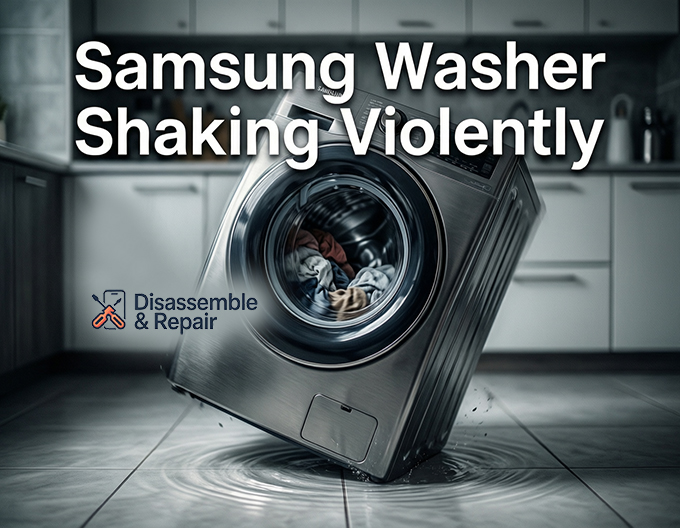
There is nothing more alarming for a homeowner than the sudden, deafening noise of a Samsung washer shaking violently during a high-speed spin cycle. If you have noticed your Samsung washer shaking violently, it is imperative to address the issue immediately, as ignoring it can lead to catastrophic damage to the appliance’s internal components and your laundry room flooring. While Samsung appliances are renowned for their engineering and Vibration Reduction Technology (VRT), they are mechanical systems subject to wear, tear, and installation errors. This guide acts as a diagnostic pathway for identifying the root cause of the vibration and implementing the necessary solutions.
Why Is My Samsung Washer Shaking Violently?
When a washing machine begins to vibrate excessively, it is essentially a physics problem: the center of gravity has shifted, or the mechanisms designed to absorb energy have failed. The severity of the shaking usually peaks during the spin cycle, where the drum rotates at speeds exceeding 1000 RPM.
The causes generally fall into three categories:
- User/Installation Error: Issues with loading or initial setup.
- Suspension Failure: Degradation of the components that hold the drum in place.
- Structural Failure: Breaking of the internal skeleton (spider arm/flange) or bearings.
By systematically checking these areas, you can often resolve the issue without purchasing a new machine.
Phase 1: Installation and Usage Checks
Before dismantling the machine to check internal components, you must rule out external factors. A significant percentage of vibration issues are caused by the environment rather than the machine itself.
The Critical Role of Leveling Legs
The foundation of a stable wash cycle relies on the leveling legs. If even one leg is not making firm contact with the floor, the machine will rock back and forth. Over time, the locking nuts on these legs can vibrate loose.
To inspect this, place a bubble level on top of the washer. Check the slope from left to right and front to back. If the machine is not level, adjust the legs by turning them clockwise or counter-clockwise until the bubble is centered. Once leveled, tighten the locking nut upward against the chassis to secure the leg in place.
Shipping Bolts: The Silent Destroyer
If you have recently moved or installed a new unit and find your Samsung washer shaking violently, check the back of the machine immediately. New washers are transported with shipping bolts designed to lock the tub in place to prevent damage during transit.
If these bolts are not removed prior to the first use, the tub cannot float on its suspension system. Instead, the energy from the spinning drum is transferred directly to the frame of the machine, causing it to jump and shake aggressively. Ensure all four bolts are removed and the holes are covered with the provided plastic caps.
Managing Unbalanced Loads
Modern Samsung washers are equipped with sensors to detect an unbalanced load. However, heavy items like bedding, rugs, or towels can clump together, creating a heavy spot in the drum. When the machine attempts to ramp up to high speed, this weight imbalance overcomes the counterweights.
Read more Samsung washing machine UE error
If the washer detects this, it may attempt to add water and agitate to redistribute the clothes. If it fails, it may shake violently before shutting down. Always wash heavy items in balanced loads (e.g., two heavy towels rather than one) to help the machine maintain equilibrium.
Phase 2: Software and Calibration
Samsung washers feature a sophisticated electronic management system. Sometimes, the hardware is fine, but the computer’s understanding of the drum’s weight is incorrect.
Utilizing Calibration Mode
After any installation, adjustment of leveling legs, or significant repair, you must run the calibration mode. This function allows the washer to measure the weight of the empty drum and set a baseline for its vibration sensors.
While the specific key combination varies by model (often involving holding the “Temp” and “Delay End” buttons simultaneously while powering on), running this mode causes the drum to rotate back and forth for a few minutes. If you skip this step, the machine may miscalculate the load weight, leading to erratic spin speeds and excessive vibration.
Phase 3: Inspecting Suspension and Dampening Systems
If the machine is level, calibrated, and the load is balanced, but the shaking persists, you are likely dealing with worn-out suspension components. These parts are “consumables” in the appliance world and typically require replacement after several years of heavy use.
Shock Absorbers (Front Loaders)
In front-loading washers, shock absorbers are attached between the outer tub and the base frame. Their function is identical to the shocks on a car: they dampen the movement of the tub during the spin cycle.
If the shock absorbers have lost their resistance, the tub will bounce uncontrollably. To test this, open the washer door and push down firmly on the bottom of the stainless steel drum. When you release it, the drum should rise and stop immediately. If it bounces up and down like a pogo stick, the shock absorbers are blown and require replacement.
Read more Samsung washing machine NF error
Suspension Springs (Top and Front Loaders)
While shock absorbers dampen movement from below, suspension springs hold the heavy tub assembly from the top. These springs prevent the tub from collapsing downward and help center it during operation.
Over time, these springs can stretch or even snap. If one spring is stretched more than the others, the tub will hang crookedly. During a high-speed spin, this misalignment causes the tub to strike the side panels of the washer cabinet, producing a loud banging noise and violent shaking. Visual inspection usually reveals if a spring is damaged or detached.
The Drive Belt Check
While less common as a primary cause for violent shaking, a worn or unevenly stretched drive belt can cause the drum to rotate inconsistently. If the belt slips or has a chunk missing, it creates a rhythmic thumping vibration. Inspect the belt for signs of fraying, cracking, or burning smells.
Phase 4: severe Internal Mechanical Failure
If you have exhausted the suspension and leveling checks, the issue may lie deep within the mechanical structure of the washer. These repairs are complex and often require a complete teardown of the appliance.
Tub Bearings Failure
The tub bearings allow the inner drum to spin smoothly within the outer tub. These metal ball bearings are protected by a seal that prevents water from entering the bearing race. Over time, the seal may fail, allowing soapy water to wash away the grease and rust the bearings.
Read more Samsung washer leaking during spin cycle
The hallmark sign of bad bearings is not just shaking, but a loud, roaring sound—often described as a jet engine taking off—that gets louder as the spin speed increases. To check this, manually spin the empty drum. It should spin quietly and smoothly. If it makes a grinding noise or feels “rough,” the bearings are shot.
The Flange Assembly (Spider Arm)
Attached to the back of the inner drum is the flange assembly, often called the spider arm. This three-pronged aluminum component connects the drum to the drive shaft.
Due to a chemical reaction between the aluminum flange, the stainless steel shaft, and detergent residue (galvanic corrosion), the spider arm can corrode and crack. When the flange creates a fracture, the drum loses its concentric rotation. It will wobble aggressively within the outer tub.
If you can lift the inner drum upwards relative to the outer tub (creating a gap at the top of the door seal) by more than a few millimeters, the flange assembly is likely broken. This is a critical failure; continuing to run a machine with a broken flange can result in the drum cutting through the outer plastic tub, flooding your home.
When to Call for Appliance Repair
Diagnosing a Samsung washer shaking violently can range from a simple five-minute leveling fix to a five-hour mechanical overhaul.
You should consider contacting a professional appliance repair technician if:
- You suspect the tub bearings or flange assembly are broken (as these require specialized tools and complete disassembly).
- You are uncomfortable removing the panels of the machine to access shock absorbers.
- The machine is still under warranty (DIY repairs may void your coverage).
Conclusion
A Samsung washer is a significant investment, and its Vibration Reduction Technology is designed to provide whisper-quiet operation. However, when physics works against you due to unlevel floors, worn shock absorbers, or a corroded flange, the silence is replaced by chaos.
By methodically checking the leveling legs, ensuring shipping bolts are removed, calibrating the electronics, and inspecting the suspension system, you can often restore peace to your laundry room. Regular maintenance, such as checking the suspension springs and ensuring balanced loads, will prolong the life of your machine and prevent the dreaded scenario of a washing machine walking across your floor.
Frequently Asked Questions
Why is my newly installed Samsung washer jumping and shaking aggressively?
The most common cause for violent shaking in a new installation is the presence of shipping bolts. These bolts are located on the back of the machine to lock the tub in place during transit. If they are not removed before use, the washer’s suspension system cannot function, causing the entire unit to vibrate and move across the floor. Ensure all four bolts are removed and replaced with the provided plastic covers.
Read more Samsung washing machine TE1 error
How do I know if my washer’s shock absorbers are failing?
You can perform a simple “bounce test.” Open the door of your front-loading washer and push down firmly on the bottom of the stainless steel drum. If the drum returns to its original position and stops immediately, the shocks are likely fine. If the drum bounces up and down several times before settling, the shock absorbers are worn out and can no longer dampen the energy of the spin cycle.
When should I run Calibration Mode on my Samsung washer?
Calibration Mode should be performed after any event that alters the machine’s physical balance. This includes initial installation, moving the machine to a new location, adjusting the leveling legs, or replacing internal components like springs or shocks. Running this mode allows the internal sensors to accurately measure the weight of the empty drum, which helps the machine manage load balance more effectively.
What does it mean if my washer makes a loud roaring noise while spinning?
A loud, roaring sound—often compared to a jet engine—is a primary symptom of tub bearing failure. This occurs when the waterproof seal fails, allowing water to rust the metal bearings. To confirm this, spin the empty drum manually with your hand; if it feels rough or makes a grinding sound, the bearings or the internal spider arm (flange assembly) are likely damaged and require professional repair.
Can washing a single heavy item cause the washer to shake?
Yes. Modern washers rely on centrifugal force, and a single heavy item (like a large rug or one heavy towel) can clump on one side of the drum. This creates a weight imbalance that the machine cannot easily redistribute. To prevent this, always wash heavy items in pairs or add a few smaller items to the load to help the machine maintain equilibrium during the high-speed spin cycle.