
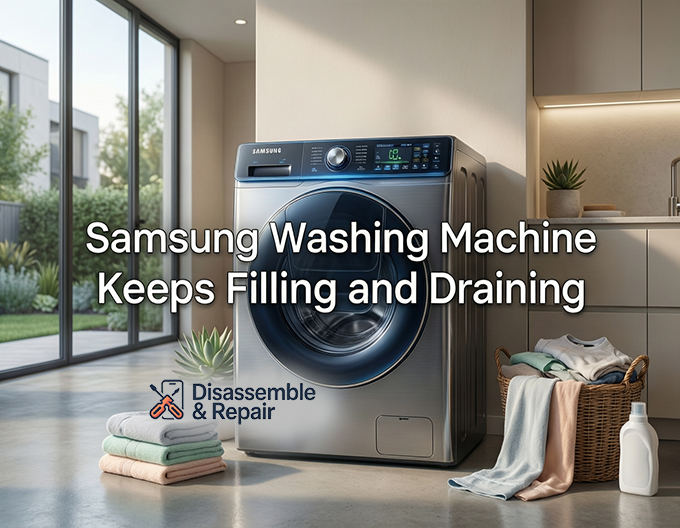
If your Samsung washing machine keeps filling and draining concurrently, it creates a frustrating cycle that wastes significant amounts of water and prevents your laundry from being cleaned. This specific issue usually indicates a discrepancy between the water intake and the drainage system, often caused by incorrect installation rather than a catastrophic mechanical failure. As a homeowner, understanding the mechanics behind this loop is essential for a quick resolution and can save you the cost of a service call.
While Samsung appliances are renowned for their reliability, the “fill and drain” loop is a common phenomenon that can affect both front-load and top-load models. To effectively diagnose the problem, one must inspect various components ranging from the physical installation of the drainage system to internal electronic sensors. This guide provides a professional, step-by-step analysis of why this occurs and how to rectify it.
Understanding Why a Samsung Washing Machine Keeps Filling and Draining
When you observe that a Samsung washing machine keeps filling and draining, it means the water entering the drum is immediately exiting through the drain hose before the wash cycle can begin. This issue generally falls into two categories: siphoning due to installation errors or component failure within the unit’s internal regulation systems.
Read more Samsung washing machine UE error
To troubleshoot effectively, you must identify when the draining occurs. Does it happen immediately as water enters? Does the machine fill to the top and then drain without agitating? Or does it happen when the machine is turned off? The answers to these questions help isolate the specific entity responsible for the fault.
The Siphon Effect: The Most Common Cause
The most prevalent reason for this continuous cycle is a phenomenon known as siphoning or the siphon effect. This is a physics-based issue rather than a mechanical breakdown. Siphoning occurs when the end of the drain hose is positioned lower than the water level inside the washing machine, or when an airtight seal is created in the drain pipe.
For a washing machine to hold water, the drain hose height is critical. Samsung specifications generally require the drain hose to be elevated between 18 and 30 inches (depending on the specific model) above the floor. If the hose is laying flat on the ground or inserted too deep into the standpipe, gravity will naturally pull the water out of the drum as fast as the water inlet valve lets it in.
Furthermore, if the drain hose is pushed too far down into the standpipe, it can displace air and create a vacuum. This vacuum sucks water out of the machine continuously. To prevent this, there must be an air gap around the drain hose where it enters the standpipe. Without this air gap, the siphoning action becomes inevitable, leading to a cycle where the machine fills indefinitely while simultaneously draining.
Malfunctioning Water Level Sensor (Pressure Switch)
If your installation checks out, the next logical suspect is the water level sensor, also known as the pressure switch. This component is the “brain” regarding water volume; it tells the control board when the tub is full so that the water inlet valve can close and the wash cycle can begin.
Read more Samsung washing machine ND error
The pressure switch operates via a pressure hose (or air dome tube) that connects the switch to the bottom of the tub. As water rises in the drum, air pressure increases inside this tube. When the pressure hits a specific threshold, the switch trips, cutting power to the inlet valves.
However, if the pressure hose is clogged with debris, kinked, or has developed a small hole, the air pressure will never rise sufficiently. Consequently, the water level sensor never sends the “stop” signal. The machine may continue to fill until it detects an overflow situation, at which point the safety protocols engage the drain pump to prevent flooding. This creates a loop: the machine fills because it thinks it is empty, and then drains because it detects an overflow, or simply drains mechanically due to over-filling.
Issues with the Water Inlet Valve
The water inlet valve is the gatekeeper of your water supply. Under normal operation, it opens electronically to let water in and closes via spring pressure and water pressure assistance when the power is cut.
If the water inlet valve is mechanically stuck in the “open” position due to calcium buildup or sediment, water will flow into the machine continuously, even if the machine is unplugged. In this scenario, if the machine is on, the water level sensor may eventually trigger the drain pump to prevent a flood, causing the fill-and-drain symptom.
Conversely, if there is insufficient water pressure entering the valve, the valve may not close fully, allowing a slow trickle that disrupts the cycle logic. However, for the specific symptom of rapid filling and draining, a valve stuck effectively open is the more likely mechanical culprit.
Electrical Failures: Control Board and Drain Pump
In more complex scenarios, the issue may stem from the control board or the drain pump itself. The control board acts as the central computer, sending voltage to components based on the cycle stage. If a relay on the control board sticks, it could continuously send voltage to the drain pump, causing it to run while the fill valves are also energized.
Alternatively, if the drain pump has failed electronically, it might run intermittently without input. While less common than siphoning issues, a faulty board requires professional diagnostics. usually, if the board detects an anomaly in filling times or water levels, it will display a specific error code on the digital display (such as 4E, nF, or LE depending on your model), which serves as a vital clue for troubleshooting.
Comprehensive Troubleshooting Steps
To resolve the issue where your Samsung washing machine keeps filling and draining, follow these systematic steps. Ensure the machine is unplugged before inspecting internal components.
Step 1: Inspect the Drain Hose Installation
The first step is to verify the physical setup of the drainage system to rule out the siphon effect.
- Check Height: Measure the vertical distance of the drain hose. Ensure the highest point of the hose is at least 18 inches but no more than 36 inches above the floor (consult your user manual for exact specs). If it is too low, use the provided plastic hose guide to secure it to the back of the machine or a laundry sink at the correct height.
- Check Insertion Depth: Ensure the drain hose is not inserted more than 6 to 8 inches into the standpipe. If it is pushed down too far, it bypasses the water line and causes siphoning.
- Verify Air Gap: Ensure there is no airtight seal where the hose enters the pipe. Do not use duct tape to seal the hose to the standpipe; air must be able to flow around the hose to break the vacuum.
Step 2: Examine the Pressure Switch and Hose
If the drain hose positioning is correct, examine the water level detection system.
- Access the Components: You will need to remove the top panel of the washing machine to locate the pressure switch (usually a round, plastic component with a hose and wires attached).
- Inspect the Pressure Hose: Follow the clear or black tube connecting the switch to the drum. Look for kinks, pinhole leaks, or disconnections.
- Check for Blockages: Remove the hose from the switch and blow through it gently. You should hear bubbling in the tub, indicating the line is clear. If there is resistance, the air dome at the bottom may be clogged with lint or detergent sludge.
- Electrical Continuity: If you have a multimeter, you can test the pressure switch for continuity, though visual inspection of the hose solves the majority of these issues.
Step 3: Test the Water Inlet Valve
If the machine fills even when unplugged, the issue is certainly the inlet valve.
- Power Down: Unplug the machine.
- Observation: If water continues to rise in the drum, the solenoid in the water inlet valve has failed mechanically.
- Action: The valve cannot be repaired and must be replaced. This is a standard part that can be swapped out by removing the rear panel.
Step 4: Reset the Control Board and Check Error Codes
Sometimes, the logic board experiences a glitch. A hard reset can clear temporary memory errors.
- Power Cycle: Unplug the washer for at least 60 seconds.
- Discharge Power: While unplugged, hold the power button for 5 seconds to discharge any residual electricity in the capacitors.
- Plug in and Test: Run a Rinse & Spin cycle.
- Monitor Display: Watch for an error code. Codes like “LE” (Low Water Level) or “4E” (Water Supply Error) can confirm if the machine detects a sensor failure vs. a mechanical leak.
Professional Maintenance and Prevention
Preventing recurrence involves regular maintenance of your laundry appliance. High-efficiency washers are sensitive to water pressure and drainage setups. Periodically checking the drain pump filter (usually located behind a small door on the front bottom of the unit) ensures that debris does not impede drainage flow or cause pump sensor errors.
Additionally, inspect your standpipe plumbing. Slow-draining plumbing can cause water to back up and trigger premature draining or overflow errors. If the water pressure in your home fluctuates significantly, it may put unnecessary stress on the water inlet valves, leading to premature failure.
Conclusion
When a Samsung washing machine keeps filling and draining, the situation requires immediate attention to prevent water damage and high utility bills. In the vast majority of cases, this behavior is attributed to the siphon effect caused by an improper drain hose height or lack of an air gap in the standpipe. Correcting the hose installation usually resolves the problem immediately.
However, if the installation is correct, the focus must shift to internal components like the pressure hose, water level sensor, or water inlet valve. By systematically checking these entities, you can isolate the fault. If the diagnostics point toward a faulty control board or if the troubleshooting steps do not resolve the issue, contacting a certified Samsung technician is recommended to avoid voiding your warranty or causing further electrical damage.
Read more Samsung washer shaking violently
Frequently Asked Questions
Why is my Samsung washer filling and draining simultaneously?
The most common cause is the “siphon effect.” This occurs when the drain hose is installed incorrectly, allowing gravity to pull water out of the machine as it fills. It can also be caused by a faulty water level sensor (pressure switch) or a clogged pressure hose that fails to signal the control board that the tub is full.
What is the correct height for the drain hose to prevent siphoning?
To ensure proper operation and prevent water from escaping prematurely, the drain hose should be elevated between 18 and 36 inches above the floor. Additionally, the hose should not be inserted more than 6 to 8 inches into the standpipe, and there must be an air gap around it to prevent a vacuum from forming.
Read more Samsung washing machine BE1 error
How can I tell if the water inlet valve is broken?
A clear sign of a mechanical failure in the water inlet valve is if the washing machine continues to fill with water even when the unit is completely unplugged. This indicates that the valve is stuck in the open position due to sediment or mechanical wear and requires replacement.
What does it mean if my washer shows an “LE” or “4E” error code?
These codes are diagnostic tools used by the Samsung control board. An “LE” code typically indicates a low water level or a potential leak, often triggered when the machine detects water escaping unexpectedly. A “4E” or “nF” code usually points to a water supply error, which may happen if the machine takes too long to fill because it is draining at the same time.
Can a clogged pressure hose cause constant filling and draining?
Yes. The pressure hose sends air pressure to the water level sensor as the drum fills. If this hose is clogged with lint, kinked, or has a pinhole leak, the sensor will never detect that the water has reached the correct level. Consequently, the machine may overfill until the safety drain pump engages, creating a continuous cycle.