

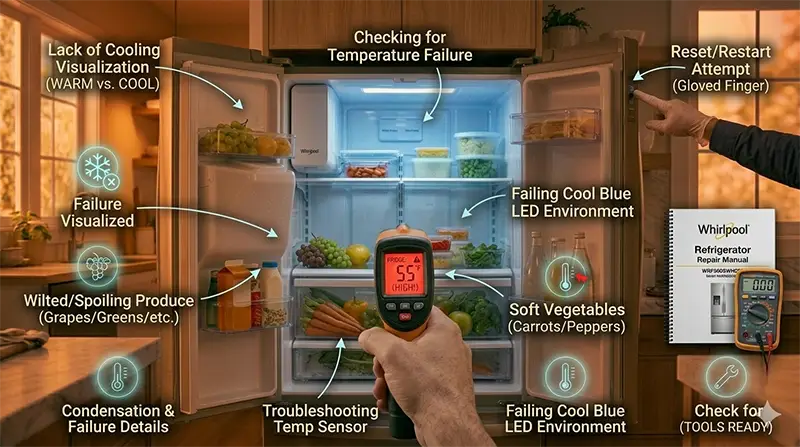
Discovering that your Whirlpool refrigerator not cooling is a frustrating experience that threatens the safety of your groceries and disrupts your daily routine. While Whirlpool appliances are renowned for their reliability, components can wear out over time, leading to temperature fluctuations or a complete loss of cooling. This technical guide aims to assist homeowners and technicians in diagnosing the underlying causes of this issue, ranging from simple maintenance tasks to complex component failures. By understanding how the internal systems interact, you can effectively isolate the problem and determine the necessary repairs.
1. Dirty or Obstructed Condenser Coils
One of the most frequent reasons for a refrigerator losing its cooling capacity is a lack of preventative maintenance regarding the Condenser Coils. These coils are typically located at the bottom or back of the unit and are responsible for dissipating the heat removed from the refrigerator’s interior.
When dust, pet hair, and debris accumulate on the Condenser Coils, they cannot release heat effectively. Consequently, the refrigerator struggles to cool down, forcing the compressor to run continuously to maintain the set temperature. Over time, this not only results in a warm fridge but can also lead to premature compressor failure.
Diagnosis and Fix:
- Locate the coils behind the bottom kick plate or at the rear of the unit.
- Visually inspect for a thick layer of dust.
- Use a refrigerator coil brush and a vacuum cleaner to thoroughly clean the coils.
- Monitor the temperature for 24 hours to see if cooling efficiency improves.
2. Malfunctioning Condenser Fan Motor
Working in tandem with the coils is the Condenser Fan Motor. This component draws air through the condenser coils and over the compressor to facilitate cooling. If the fan motor fails, the refrigerant cannot cool down sufficiently before entering the evaporator, leading to a noticeable rise in internal temperature.
Diagnosis and Fix:
- Pull the refrigerator away from the wall and remove the rear access panel.
- Listen for the sound of the fan. If the compressor is running, the Condenser Fan Motor should also be running.
- If the fan is stationary, ensure it is not obstructed by debris.
- Try spinning the fan blade by hand; if it does not spin freely, the motor bearings are likely worn out.
- Use a multimeter to test the motor for continuity. If there is no continuity, the motor requires replacement.
3. Issues with the Evaporator Fan Motor
While the condenser fan handles the heat outside, the Evaporator Fan Motor is responsible for the cold air inside. Located in the freezer compartment, this fan draws air over the Evaporator Coils and circulates it throughout both the freezer and refrigerator compartments.
Read more whirlpool refrigerator capacity cubic feet
If the Evaporator Fan Motor fails, the freezer may remain cold while the refrigerator section becomes warm because the cold air is not being circulated. A common symptom of this failure is a loud chirping or squealing noise coming from the freezer area before the fan stops completely.
Diagnosis and Fix:
- Open the freezer door and manually activate the door switch to simulate the door being closed.
- Listen for the fan motor. If it does not run, or runs with significant noise, it is defective.
- Inspect the fan blades for ice obstruction, which could indicate a defrost issue.
- If the motor windings are open (tested via multimeter), replace the motor.
4. Defrost System Failures
Modern frost-free refrigerators rely on a defrost cycle to keep the Evaporator Coils free of ice. If any component in this system fails, ice will accumulate on the coils, insulating them and preventing the transfer of heat. This eventually stops the unit from cooling entirely.
Defrost Heater Assembly
The Defrost Heater turns on periodically to melt frost from the evaporator coils. If it burns out, the frost will build up until the coils are completely blocked.
Testing: Use a multimeter to check the Defrost Heater for continuity. If the circuit is open (infinite resistance), the heater is defective and must be replaced.
Defrost Thermostat and Thermistor
The defrost thermostat (or a bi-metal thermostat) monitors the temperature of the evaporator coils. It signals the heater to turn off once the ice has melted to prevent overheating. In newer models, a Thermistor is used in conjunction with the control board to monitor temperature changes.
Testing:
- The thermostat should have continuity when it is at freezing temperatures.
- The Thermistor should change resistance values based on temperature. If the resistance does not correspond to the manufacturer’s technical chart, the thermistor is faulty.
Defrost Timer or Control Board
Older models use a mechanical Defrost Timer to switch the refrigerator between cooling and defrost modes. If the timer gets stuck in the cooling mode, frost builds up. If it gets stuck in the defrost mode, the compressor never turns on. In modern units, this function is handled by the Main Control Board.
Testing:
- Locate the timer (often in the control console or kick plate).
- Slowly turn the dial. If the compressor turns off and the heater turns on (indicated by a click), the timer might be mechanically sound but the motor driving it could be dead.
5. Air Damper Control Problems
The Air Damper Control is a mechanical or motorized door that regulates the amount of cold air flowing from the freezer into the refrigerator compartment. This component is controlled by the thermostat or the main board.
If the Air Damper Control is broken or stuck in the closed position, the freezer will maintain its freezing temperature, but the fresh food section will warm up significantly. Conversely, if it is stuck open, the fridge may freeze your food.
Diagnosis and Fix:
Read more whirlpool refrigerator wifi connectivity
- Check the airflow entering the fridge from the freezer vents.
- Inspect the damper physically. It is usually located at the top rear of the fresh food section.
- Ensure nothing is blocking the damper movement.
- If the damper motor does not respond to temperature adjustments, the assembly needs replacement.
6. Compressor and Start Components
The Compressor is the heart of the refrigeration cycle, compressing the refrigerant and circulating it through the system. If the compressor fails, the refrigerator will not cool at all, though the fans and lights may still operate. However, compressor failure is less common than the failure of its starting components.
Start Relay
The Start Relay works with the start capacitor to help the compressor motor initiate. If the relay is defective, the compressor may attempt to start but fail, often accompanied by a clicking sound.
Diagnosis and Fix:
- Unplug the refrigerator and remove the relay from the side of the compressor.
- Shake the Start Relay. If it rattles, it is internally damaged and must be replaced.
- If it does not rattle, test for continuity between the run and start terminals.
Compressor Failure
If the relay and capacitor are functioning, but the Compressor still does not run (or runs loudly and hot without cooling), it may have an internal mechanical failure or a locked rotor. Replacing a compressor is a complex, sealed-system repair that requires a certified professional.
7. Temperature Control Thermostat
The Temperature Control Thermostat sends voltage to the compressor, evaporator fan, and condenser fan motors. If this thermostat is not working properly, it may prevent the refrigerant system from running.
Diagnosis and Fix:
Read more whirlpool refrigerator reviews
- Turn the thermostat knob from the lowest to the highest setting. You should hear a distinct “click” as the contacts close.
- If there is no click and the system does not start, use a multimeter to check for continuity.
- If the thermostat lacks continuity at any setting, it should be replaced.
8. Main Control Board
If you have methodically checked the Condenser Coils, fans, defrost system, and compressor start components and found no faults, the issue may lie with the Main Control Board. This is the “brain” of the refrigerator, controlling the power supply to all other components.
Read more whirlpool refrigerator installation guide
Damage to the board can occur due to power surges or prolonged heat exposure. Inspect the board for burn marks, swollen capacitors, or damaged solder joints. Because misdiagnosing a control board is expensive, it is recommended to rule out all other entities—such as the Thermistor, Defrost Timer, and fans—before replacing the board.
Conclusion
Resolving the issue of a Whirlpool refrigerator not cooling requires a systematic approach to troubleshooting. Start with the simplest solutions, such as cleaning the Condenser Coils and ensuring proper airflow. If these maintenance steps do not resolve the issue, proceed to test the mechanical and electrical components like the Evaporator Fan Motor, Start Relay, and defrost system parts.
While many of these repairs can be performed by a handy DIY enthusiast using a multimeter, issues involving the Compressor or the sealed refrigerant system require the expertise of a licensed technician. By identifying the specific component failure, you can make an informed decision on whether to repair or replace your appliance, ensuring your kitchen remains functional and efficient.
Frequently Asked Questions
Why is my freezer cold but the refrigerator section is warm?
This common issue is typically caused by a failure in the airflow or defrost system. If the evaporator fan motor fails or the air damper is stuck closed, cold air cannot circulate from the freezer into the refrigerator compartment. Additionally, if the defrost system fails, ice can build up on the evaporator coils, physically blocking the airflow to the fresh food section.
What does a clicking sound coming from my Whirlpool refrigerator mean?
A clicking noise usually points to a problem with the compressor’s start relay. The relay is attempting to kick-start the compressor but is failing due to internal damage. You can test this by unplugging the unit and removing the relay; if it rattles when shaken, it is defective and must be replaced to allow the compressor to run properly.
How often should I clean my refrigerator’s condenser coils?
To maintain optimal cooling efficiency and prevent compressor strain, it is recommended to clean the condenser coils at least once every six to twelve months. If you have pets that shed hair, you may need to clean them more frequently. Accumulated dust and debris act as insulation, preventing the coils from dissipating heat effectively.
Can I replace a refrigerator compressor on my own?
While many electrical components like fans and thermostats can be replaced by a DIY enthusiast, compressor replacement is a complex “sealed system” repair. This requires specialized tools and a licensed technician to safely handle the refrigerant. If you suspect the compressor itself has failed, it is best to contact a professional to evaluate if the repair is cost-effective compared to buying a new unit.