

When your appliance begins flashing unexpected symbols on the digital display, having access to a reliable Whirlpool Refrigerator Error Codes List is the first step toward restoring order in your kitchen. These alphanumeric signals are not just random glitches; they are precise diagnostic messages sent from your refrigerator’s main control board to help you identify specific failures before they result in food spoilage.
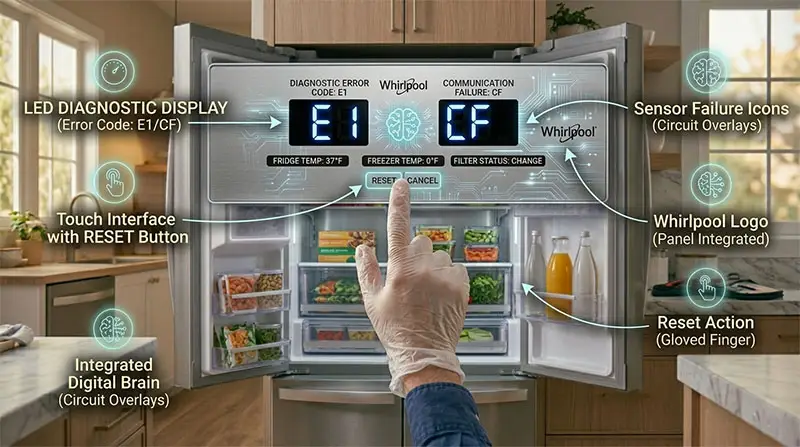
Modern appliances are sophisticated machines, particularly the popular French Door Refrigerator models, which utilize a complex network of sensors and electronics. Whether you are a DIY enthusiast looking to perform a quick fix or a homeowner trying to decide if you need a professional technician, understanding these codes is critical. This guide covers the most common errors, the components involved—from the thermistor to the ice maker—and the correct troubleshooting steps to resolve them.
The Role of the Electronic Control Board
Before diving into the specific codes, it is important to understand what generates them. The main Control Board acts as the brain of your refrigerator. It constantly monitors input from various components, including the temperature sensor, door switches, and fan motors.
When a component operates outside of its expected parameters—for instance, if the Evaporator Fan runs too slowly or the internal temperature rises dangerously high—the control board triggers an alert. This alert appears on the Digital Display as an error code. While consulting your specific User Manual is always recommended, the following list covers the universal codes found across most modern Whirlpool platforms.
Comprehensive Whirlpool Refrigerator Error Codes List
This section details the specific codes you are likely to encounter. Please note that while many codes are standard, slight variations may occur depending on the specific model year and configuration.
Power and General System Codes
PO (Power Outage)
This is perhaps the most common code users encounter. It does not necessarily indicate a mechanical failure. Instead, it alerts you that the power supply to the refrigerator was interrupted.
- Cause: A recent storm, a tripped breaker, or the unit being unplugged.
- Solution: Confirm that the refrigerator temperature is still safe (below 40°F). You can typically clear this code by pressing the “Confirm” or distinct reset button on the display.
PF (Power Failure)
Similar to PO, this code indicates a power failure occurred.
- Cause: Interruption of electricity to the unit.
- Solution: Check the Digital Display for temperature readings. If the temperature is safe, reset the alarm.
Temperature and Sensor Codes
E1 (Refrigerator Thermistor Failure)
The Thermistor is a small sensor that changes resistance based on temperature. The control board reads this resistance to determine if the fridge needs to run the compressor.
- Diagnosis: Code E1 usually means the refrigerator compartment sensor is “open” (disconnected) or shorted.
- Troubleshooting: You may need to access the sensor housing and check the wiring with a multimeter. If the sensor is faulty, the control board cannot regulate the temperature accurately.
E2 (Freezer Thermistor Failure)
This code is specific to the freezer compartment.
- Diagnosis: The Temperature Sensor in the freezer is sending faulty data to the main board.
- Troubleshooting: Similar to E1, check the wiring connections. A bad freezer thermistor can lead to soft ice cream or thawed meats.
E3 (Evaporator Fan Motor Failure)
The Evaporator Fan is responsible for circulating cold air from the freezer coils into the refrigerator compartment.
- Symptoms: The freezer may be cold, but the fresh food section is warm. You might also hear a loud noise or no noise at all when the door is closed.
- Action: Check for ice buildup blocking the fan blade. If the fan is not spinning and there is no ice obstruction, the motor likely needs replacement.
E5 (Ambient Thermistor Failure)
Some advanced French Door Refrigerator models monitor the room temperature to adjust cooling efficiency.
- Significance: If this sensor fails, the fridge may run inefficiently, leading to higher energy bills or erratic cooling cycles.
Defrost System Codes
d1 (Defrost Sensor Error)
The Defrost System prevents ice from building up on the evaporator coils. If the coils ice over, airflow stops, and the fridge warms up.
- Diagnosis: The sensor that tells the fridge when to stop the defrost cycle is malfunctioning.
- Troubleshooting: This often involves checking the bi-metal thermostat or the defrost thermistor. If this fails, the heater may stay on too long (risk of overheating) or not turn on at all (risk of ice buildup).
dr (Door Ajar)
While often a simple fix, this can appear as a code if the door switch is faulty.
- Check: Ensure nothing is blocking the door. If the door is closed but the light stays on and the code persists, the door switch or the wiring to the Control Board may be damaged.
Ice Maker and User Interface Codes
C (Ice Maker Error)
Issues with the Ice Maker are distinct from cooling issues.
- Causes: The ice maker may be jammed, the mold thermistor might be broken, or the motor module has failed.
- Action: specific sub-codes (like C1 or C2) may appear on the diagnostics mode. Check that the bail arm is down and the water supply line is not frozen.
CF (Communication Failure)
This code indicates a loss of communication between the main Control Board and the user interface (UI) board on the door.
- Diagnosis: This is often a wiring issue. The wires running through the door hinge can become frayed over time.
- Action: Inspect the wire harness at the top of the door hinge. If the wires are intact, the UI board itself may require replacement.
Component-Specific Troubleshooting
To effectively use the Whirlpool Refrigerator Error Codes List, it helps to understand the hardware behind the codes. Here is a deeper look at the critical entities involved in your refrigerator’s operation.
The Condenser Motor and Fan
While error codes for the Condenser Motor are less specific on some older models, symptoms combined with high-temperature alarms usually point here. The condenser fan cools the compressor and the condenser coils.
- Maintenance: If your fridge triggers a high-temp alarm, pull the fridge out and clean the dust off the coils and the fan. A clogged condenser forces the system to work harder, potentially triggering false sensor errors due to overheating.
The Defrost System
A failure here is often misdiagnosed as a bad compressor. If you see temperature codes or defrost codes (d1), physically inspect the back wall of the freezer.
- Visual Cue: If you see a buildup of frost resembling snow on the back panel, your Defrost System (heater, timer, or control board) has failed. The error code confirms the electrical fault, but the visual inspection confirms the physical consequence.
The Thermistor
This is the most common failure point for “E” codes. A Thermistor is relatively inexpensive and easy to replace.
- Testing: Professional troubleshooting involves removing the thermistor and placing it in a cup of ice water. Using a multimeter, you measure the resistance. If the resistance does not match the specifications in the Troubleshooting Guide or tech sheet, the part is dead.
How to Perform a Reset Procedure
Sometimes, an error code is a glitch caused by a power surge rather than a permanent part failure. Before ordering parts, perform a Reset Procedure.
- Hard Reset: Unplug the refrigerator from the wall outlet or flip the circuit breaker.
- Wait: Leave the power off for at least 5 to 10 minutes. This allows the capacitors on the Control Board to discharge fully.
- Restore Power: Plug the unit back in and listen. The compressor and fans should kick on within a few minutes.
- Monitor: Watch the Digital Display. If the code returns immediately, it is a hard failure. If it stays clear for 24 hours, it may have been a transient glitch.
Keypad Resets:
Some models allow you to clear codes by pressing specific button combinations, such as holding “Measured Fill” and “Ice Type” simultaneously for 3 seconds. Consult your User Manual for the exact combination for your specific model ID.
When to Call a Professional
While this Whirlpool Refrigerator Error Codes List empowers you to diagnose issues, there are limits to DIY repair.
You should consider calling a certified technician if:
- Sealed System Issues: If the diagnostics point to a compressor failure or a refrigerant leak (often indicated by the fridge running constantly but not cooling, without specific sensor errors).
- Control Board Replacement: Swapping a main board can be tricky. If the connections are not seated perfectly, you can short out the new board immediately.
- Safety Risks: Troubleshooting involves working with electricity and water. If you are uncomfortable using a multimeter or accessing high-voltage areas near the Condenser Motor, safety should be your priority.
Conclusion
Modern appliances are marvels of convenience, but they require a certain level of technical understanding when things go wrong. By utilizing this Whirlpool Refrigerator Error Codes List, you can effectively communicate with repair technicians, order the correct parts, or simply reset a confused system.
Always remember that the User Manual included with your appliance is the primary source of truth for model-specific diagrams and part numbers. Whether it is a simple Thermistor swap or a complex Defrost System overhaul, understanding what your refrigerator is trying to tell you is the key to extending its lifespan and keeping your food fresh.
Frequently Asked Questions
How do I clear the PO or PF error codes from my display?
The PO (Power Outage) and PF (Power Failure) codes are alerts rather than mechanical failures. To clear them, first check that the internal temperature of the refrigerator is still safe (below 40°F). Once confirmed, you can typically reset the display by pressing the “Confirm,” “Measured Fill,” or specific alarm reset button as indicated in your user manual.
What is the best way to reset my Whirlpool refrigerator if it starts glitching?
The most effective method is a “Hard Reset.” Unplug the refrigerator from the wall outlet or turn off the circuit breaker for 5 to 10 minutes. This allows the capacitors on the main control board to discharge completely. After restoring power, wait a few minutes for the compressor and fans to restart. If the error code returns immediately, it indicates a permanent part failure rather than a temporary glitch.
What does it mean if my refrigerator displays an E1 or E2 error code?
These codes refer to thermistor (temperature sensor) failures. E1 indicates an issue with the sensor in the refrigerator compartment, while E2 refers to the freezer compartment. These sensors tell the control board when to cycle the cooling system. If they fail, your fridge may stop cooling or run constantly. Troubleshooting usually involves checking the sensor wiring or replacing the thermistor itself.
Why is the CF code appearing on my French Door model?
The CF code stands for “Communication Failure.” It means the main control board and the user interface board on the door are no longer talking to each other. This is frequently caused by frayed or pinched wires located in the top door hinge. Inspect the wire harness for damage; if the wiring is intact, one of the two electronic boards may need to be replaced.
How can I tell if a d1 error is caused by a sensor or a mechanical ice buildup?
A d1 code indicates a defrost system error. You can perform a visual inspection by looking at the back wall of the freezer. If you see a heavy layer of frost or “snow” covering the vents, the defrost heater or sensor has likely failed, preventing the ice from melting away. If there is no ice but the code persists, the defrost thermistor is likely sending incorrect data to the control board.