

Whirlpool Refrigerator Defrost System Problems: Diagnosis and Repair Guide
If you are noticing frost accumulation on the back wall of your freezer or your fridge feels warm while the freezer stays cold, you are likely facing Whirlpool refrigerator defrost system problems. These issues are among the most common reasons for cooling failures in modern appliances, but they can often be diagnosed and fixed with the right tools and knowledge.
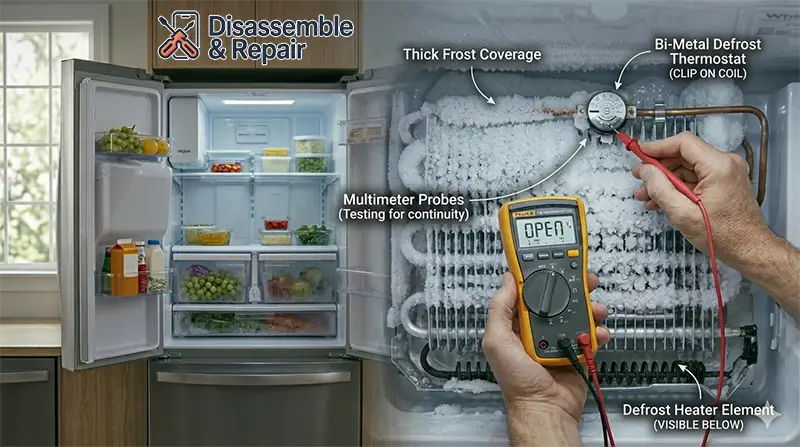
This guide provides a professional, step-by-step approach to troubleshooting the components responsible for the defrost cycle, including the defrost heater, defrost thermostat, and defrost control board.
Common Symptoms of a Defrost Failure
Before disassembling your unit, confirm that the symptoms match a defrost system failure. The most reliable indicators include:
Read more whirlpool refrigerator filter replacement
- Ice Buildup on the Back Panel: A thick layer of frost or snow on the rear wall of the freezer compartment.
- Warm Refrigerator Section: The freezer remains cold, but the fresh food compartment warms up because ice blocks the airflow.
- Noisy Operation: Ice hitting the evaporator fan motor blades can cause a loud buzzing or ticking noise.
- Water Leaking: Water pooling inside the refrigerator or on the floor often indicates a clogged drain tube.
Whirlpool Refrigerator Defrost System Problems
The defrost system is designed to melt frost off the evaporator coils periodically. When this system fails, ice accumulates until it blocks the airflow required to cool the refrigerator. The system generally consists of three main parts: a control mechanism (timer or board), a heater to melt the ice, and a thermostat or sensor to terminate the cycle.
Below is a detailed breakdown of how to test each component.
1. Diagnostic Mode and Forced Defrost
Modern Whirlpool refrigerators often use an Adaptive Defrost Control (ADC) or an electronic control board rather than a mechanical timer. Entering a forced defrost mode can help you determine if the control board is sending power to the heater.
Read more whirlpool refrigerator smart features
- For “Jazz” Control Boards: Open the fridge door. Press and hold the door switch. Simultaneously, press the “Refrigerator Temperature Down” button three times within 6 seconds. Release the door switch. The display should show “FD” (Forced Defrost). Press the button again to initiate the cycle.
- For Mechanical Timers: Locate the defrost timer, usually found behind the kick plate or in the control console. Use a flathead screwdriver to turn the advancement screw clockwise until you hear a loud click. The compressor should turn off, and the heater should turn on.
If the heater turns on during this test, the problem is likely the control board or timer itself, not the heater or thermostat.
2. Inspecting the Evaporator Fan Motor
Sometimes, cooling issues are mistaken for defrost problems. If the evaporator fan motor fails, cold air cannot circulate.
- Listen: If the fan is silent when the compressor is running (and the door switch is depressed), the motor may be dead.
- Test: If the fan is noisy, it might be hitting ice. If it is silent, unplug the fridge and test the motor windings for continuity using a multimeter.
3. Testing the Defrost Heater
The defrost heater is a resistive element located beneath the evaporator coils. Its job is to get hot enough to melt the frost.
- Access: Remove the back panel inside the freezer. You may need to melt the ice with a steamer or hair dryer (on low heat) to remove the panel safely.
- Test: Disconnect the two wires leading to the heater. Set your multimeter to the lowest Ohms setting.
- Result: A healthy heater will show a resistance reading typically between 10 and 150 ohms. If the meter reads “OL” (Open Loop) or infinity, the heater is burned out and must be replaced.
4. Testing the Defrost Thermostat
The defrost thermostat (also known as a bi-metal thermostat) acts as a safety switch. It closes the circuit to allow power to the heater only when the coils are freezing cold.
- Visual Check: Look for the thermostat clipped onto the copper tubing of the evaporator. If the plastic top is popped up or the casing is bulging, it is defective.
- Continuity Test: This component must be tested while it is cold. If it is at room temperature, it will read open (no continuity), which is normal. Test it while it is still frozen or place it in a glass of ice water for a few minutes. It should show continuity (0 ohms) when freezing.
5. Testing the Thermistor
Newer models may use a thermistor (temperature sensor) instead of a mechanical thermostat to communicate temperature data to the main control board.
Read more whirlpool refrigerator model number location
- Difference from Thermostat: Unlike a thermostat, a thermistor changes resistance gradually. You cannot perform a simple continuity test.
- Procedure: Set your multimeter to the 20k Ohms setting. Measure the resistance across the sensor’s terminals. You must consult your refrigerator’s tech sheet for the specific resistance values at different temperatures (e.g., 2.7k ohms at room temperature vs. 8k ohms in ice water).
6. Clearing a Clogged Drain Tube
If your defrost system works but you find sheets of ice on the freezer floor, your drain tube is likely clogged.
Read more whirlpool refrigerator door seal cleaning
- The Issue: During the defrost cycle, water drips into a trough and flows down a tube to a pan under the fridge. If the tube freezes, water overflows.
- The Fix: Locate the drain hole at the bottom of the evaporator area. Use hot water (applied with a turkey baster) to flush the ice blockage. You may also need to access the rear of the fridge to clean the “duckbill” check valve, which can get stuck shut with debris.
Summary of Repair Steps
- Safety: Always unplug the refrigerator before testing internal components.
- Access: Remove the freezer back panel to expose the evaporator coils.
- Diagnosis: Use a multimeter to check the heater and thermostat/thermistor first.
- Control: If the heater and sensors test good, the defrost control board or defrost timer is the likely culprit.
By systematically testing these components, you can isolate the specific cause of your Whirlpool refrigerator defrost system problems and restore your appliance to proper working order. If you are uncomfortable working with electrical components, it is always recommended to contact a certified repair professional.
Frequently Asked Questions
Why is my freezer cold but the refrigerator section is getting warm?
This is a common sign of a defrost system failure. When the system fails to melt frost off the evaporator coils, a thick layer of ice builds up and blocks the airflow that normally travels from the freezer to the fresh food compartment.
How can I tell if my defrost heater is burned out?
To check the heater, you must unplug the refrigerator and test the component for continuity using a multimeter set to the lowest Ohms setting. A functional heater will typically show a resistance reading between 10 and 150 ohms. If the multimeter displays “OL” (Open Loop), the heater is defective and needs replacement.
Why does my defrost thermostat need to be cold during testing?
The defrost thermostat is a temperature-sensitive switch that only closes the circuit when it reaches freezing temperatures. If you test it at room temperature, it will naturally show no continuity. To get an accurate reading, you must test it while it is still frosted or after submerging it in ice water for several minutes.
What causes water to leak onto the floor or pool under the freezer drawers?
Water pooling in these areas usually indicates a clogged or frozen drain tube. During a normal defrost cycle, melted ice flows down a tube to a pan under the unit. If this tube is blocked by ice or debris, the water overflows and freezes on the floor of the compartment or leaks out of the unit.
What is the difference between a defrost thermostat and a thermistor?
A defrost thermostat is a mechanical switch that is either “on” or “off” based on a specific temperature. A thermistor is an electronic sensor that provides a range of resistance values to the control board depending on the temperature. Unlike a thermostat, a thermistor cannot be tested with a simple continuity check and requires a specific resistance chart for diagnosis.
Read more whirlpool refrigerator energy consumption