

Whirlpool Refrigerator Freezer Not Cold Enough
Troubleshooting Guide: Whirlpool Refrigerator Freezer Not Cold Enough
Discovering that your frozen goods are beginning to thaw is a frustrating experience for any homeowner. Dealing with a Whirlpool refrigerator freezer not cold enough requires a systematic approach to identify whether the issue is a simple maintenance oversight or a significant component failure. This guide provides a comprehensive breakdown of the potential causes, ranging from airflow restrictions to electrical malfunctions, helping you restore your appliance to optimal performance.
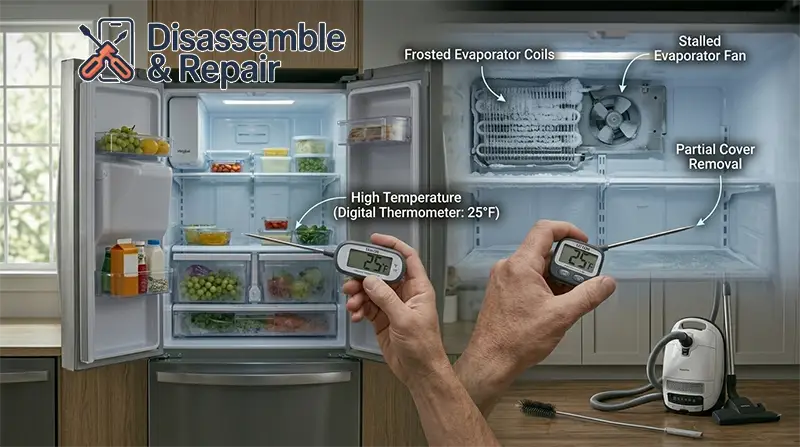
Initial Diagnostics: Why Is My Whirlpool Refrigerator Freezer Not Cold Enough?
When analyzing a Whirlpool refrigerator freezer not cold enough, it is essential to understand the cooling cycle. Your refrigerator relies on a balance of airflow, heat dissipation, and phase conversion of the refrigerant. If any single component in this chain fails, the temperature in the freezer compartment will rise, jeopardizing your food safety.
Before dismantling the unit, verify the obvious settings. Ensure the temperature controls are set correctly (typically 0°F for freezers) and that the unit has not been recently loaded with a large amount of warm food, which can temporarily spike the temperature. If settings are correct, we must investigate the hardware.
Dirty Condenser Coils
One of the most common and easily rectifiable causes for cooling issues involves the condenser coils. These coils are usually located at the bottom or back of the refrigerator and are responsible for dissipating the heat removed from the interior of the appliance.
When dust, pet hair, and debris accumulate on the condenser coils, the refrigerator cannot release heat efficiently. This forces the compressor to run continuously to maintain the set temperature. Eventually, the system becomes overworked, and the freezer temperature rises.
Solution:
Disconnect the power to the refrigerator. Remove the toe grille or move the unit away from the wall to access the coils. Use a condenser coil brush and a vacuum to thoroughly clean the debris. This simple maintenance step is often the primary fix for temperature inconsistencies.
Airflow and Fan Motor Failures
For a freezer to maintain freezing temperatures, cold air must circulate effectively. This circulation relies heavily on two specific motors: the condenser fan motor and the evaporator fan motor.
The Condenser Fan Motor
The condenser fan motor draws air through the condenser coils and over the compressor. If this fan fails, the refrigerant cannot cool down before entering the evaporator, leading to an overheated compressor and a warm freezer. You can inspect this fan by pulling the refrigerator out and removing the rear access panel. If the fan blade is obstructed or the motor does not run when the compressor is active, it requires replacement.
The Evaporator Fan Motor
Located inside the freezer compartment behind the rear wall, the evaporator fan motor draws air over the cooling coils and circulates it throughout the freezer and fresh food compartments. If you hear a loud noise coming from the freezer, or if the fan is humming but not spinning, the motor has likely failed. Without this fan, the evaporator coils will freeze over, and air circulation will stop completely, resulting in a freezer that feels cool but not freezing.
The Defrost System Malfunction
Modern frost-free refrigerators utilize a defrost system to manage ice accumulation. If this system fails, frost will build up on the evaporator coils, acting as an insulator and preventing the absorption of heat. This is a leading cause of cooling loss.
Read more whirlpool refrigerator control board replacement
The Defrost Heater
The defrost heater turns on periodically to melt frost off the evaporator coils. If this element burns out, ice will accumulate rapidly. To test this, you must access the evaporator coils in the freezer. A continuity test with a multimeter can determine if the heater has an open circuit and needs replacement.
The Defrost Timer
In older Whirlpool models, a defrost timer controls the cycles between cooling and defrosting. If the timer gets stuck in the cooling mode, the heater never turns on, causing excessive frost buildup. Conversely, if it sticks in the defrost mode, the compressor will not turn on to cool the unit. Slowly turning the timer dial manually can sometimes advance the cycle, indicating a faulty timer that needs replacing.
The Defrost Control Board
In newer electronic models, the mechanical timer is replaced by a defrost control board (often part of the main control board). If this board fails to send voltage to the heater, the result is the same: massive frost buildup and a warm freezer.
Temperature Monitoring Components
Accurate cooling depends on the appliance knowing the current temperature. This is achieved through the thermistor or a temperature control thermostat.
Thermistor Issues
The thermistor is a sensor that monitors the air temperature and sends resistance readings to the control board. Based on this data, the board adjusts the fan speeds and compressor operation. If the thermistor is faulty, it may send incorrect data, causing the refrigerator to “think” it is cold enough when it is actually warm. You can test a thermistor by measuring its resistance with a multimeter and comparing it to the manufacturer’s technical sheet for the ambient temperature.
Temperature Control Thermostat
The temperature control thermostat directs voltage to the compressor, evaporator fan, and condenser fan. If this thermostat is not functioning correctly, the refrigerant system may not run frequently enough to maintain freezing temperatures. To test, rotate the thermostat from the lowest to the highest setting; you should hear a “click.” If no click occurs and the continuity test fails, the thermostat is defective.
Electrical Start Components
If you can hear the fans running but the compressor is silent (or makes a clicking sound and shuts off), the issue may lie with the start relay.
The start relay works in conjunction with the start winding to help the compressor motor begin spinning. If the relay is defective, the compressor may fail to start, or it may attempt to start and then overload. A physical inspection is often telling; if you remove the start relay and shake it, a rattling sound usually indicates that the internal components have shattered. Replacing the start relay is an affordable and common repair that restores cooling function.
Critical System Failures
If all fans are running, the coils are clean, and the defrost system is functional, yet the freezer remains warm, you may be facing a more serious issue involving the main control board or the sealed system.
Main Control Board
The main control board is the brain of the refrigerator, governing every component from the defrost cycle to the compressor speed. If the board has a short circuit or a burnt solder joint, it may fail to send voltage to the cooling system. Diagnosing a bad board is often a process of elimination; if all other load devices (fans, compressor, sensors) are working, the board is likely the culprit.
Sealed System and Refrigerant
The most severe issue is a problem with the sealed system, specifically a refrigerant leak or a restriction. The refrigerant is the chemical substance that absorbs heat. If there is a leak, the system cannot maintain the pressure required to cool the evaporator coils.
A classic sign of a low refrigerant charge is an incomplete frost pattern on the evaporator coils. Instead of a light, even coating of frost across the entire coil surface, you may see frost on only one or two loops, or a ball of ice near the inlet. Sealed system repairs require a licensed professional, as handling refrigerant requires EPA certification and specialized equipment.
Ensuring Proper Air Circulation
Even with fully functional mechanical parts, poor air circulation can mimic a broken freezer. Whirlpool refrigerators are designed with vents that allow air to flow between the freezer and fresh food compartments.
Read more whirlpool refrigerator serial number lookup
If these vents are blocked by boxes of food, the cold air cannot cycle correctly. Ensure that items are not packed tightly against the back wall of the freezer (where the evaporator fan is located) or blocking the vents leading to the refrigerator section. Adequate spacing allows the fan to move air efficiently, ensuring uniform temperature distribution.
Conclusion
Diagnosing a Whirlpool refrigerator freezer not cold enough involves checking the airflow, cleaning the condenser coils, and verifying the integrity of electrical components like the evaporator fan motor, start relay, and defrost heater. While many of these issues can be resolved with a multimeter and some patience, complex problems involving the refrigerant or main control board may require professional intervention. By systematically ruling out these potential failures, you can identify the root cause and ensure your appliance returns to safe, freezing temperatures.
Frequently Asked Questions
What is the most common reason a Whirlpool freezer stops staying cold?
One of the most frequent causes is dirty condenser coils. When these coils accumulate dust and pet hair, they cannot dissipate heat efficiently, forcing the compressor to work harder and eventually causing the internal temperature to rise. Simply cleaning these coils with a vacuum and brush often resolves the issue.
Read more whirlpool refrigerator crisper drawer settings
How can I tell if the evaporator fan motor has failed?
The evaporator fan is located behind the back wall of the freezer. If you hear loud or unusual noises coming from that area, or if you hear a humming sound but do not feel air circulating, the motor is likely defective. If this fan fails, the freezer will not be able to maintain freezing temperatures despite the compressor running.
What does it mean if I see a lot of frost buildup on the back wall of my freezer?
Significant frost accumulation usually indicates a failure in the defrost system. This could be caused by a burnt-out defrost heater, a stuck defrost timer, or a faulty defrost control board. When frost builds up on the evaporator coils, it acts as an insulator and prevents the system from cooling the air effectively.
How do I know if my compressor’s start relay is broken?
If you hear a clicking sound coming from the back of the refrigerator and the compressor fails to start, the start relay may be the problem. A simple way to check is to remove the relay and shake it; if it makes a rattling sound, the internal components are likely shattered and the part needs to be replaced.
Can blocking the air vents really cause the freezer to warm up?
Yes. Proper air circulation is vital for maintaining the correct temperature. If large boxes or bags of food are packed tightly against the back wall or over the vents that connect the freezer to the refrigerator section, the cold air cannot move freely, leading to uneven cooling and thawing food.