

Whirlpool Refrigerator Thermostat Adjustment
Comprehensive Guide to Whirlpool Refrigerator Thermostat Adjustment
Ensuring food safety and extending the shelf life of your groceries begins with understanding the cooling capabilities of your appliance. Proper Whirlpool refrigerator thermostat adjustment is the key to preventing spoilage, avoiding frozen vegetables in the crisper drawer, and maintaining energy efficiency. While Whirlpool refrigerators are renowned for their durability and precise engineering, the user interface for temperature control can vary significantly between models. Whether you own a side-by-side model with a Digital Control Panel or a classic top-freezer unit with a manual Control Knob, mastering these settings is essential for a functional kitchen.
This guide will walk you through the technical nuances of regulating your Internal Temperature, understanding how the cooling system operates, and troubleshooting common issues related to the Cold Control Assembly.
Understanding the Cooling System Architecture
Before attempting any adjustments, it is vital to understand how your refrigerator maintains its climate. Unlike a central air conditioning system that constantly pushes cold air, a refrigerator relies on a Compressor Cycle. When the Temperature Sensor detects that the interior has risen above the set threshold, it signals the compressor to kick in.
Read more whirlpool refrigerator light not working
In most Whirlpool models, the cooling originates in the freezer section. The Evaporator Fan then circulates this chilled air into the Fresh Food Compartment. Therefore, when you adjust the Cooling Settings, you are effectively telling the system how long the compressor should run or how much airflow should be diverted from the freezer to the fridge.
If your unit utilizes a Cold Control Assembly (an analog system), it acts as an electrical switch triggered by temperature changes. In modern units, a Thermistor—a variable resistor that changes resistance with temperature—sends precise data to a control board. Understanding this distinction is important because the method of adjustment differs between mechanical and electronic systems.
Read more whirlpool refrigerator crisper drawer settings
A Step-by-Step Guide to Whirlpool Refrigerator Thermostat Adjustment
Because Whirlpool offers a diverse range of refrigeration products, identifying your specific control type is the first step. Below, we detail the procedures for the three most common configurations found in residential kitchens.
Scenario 1: Analog Dial Controls
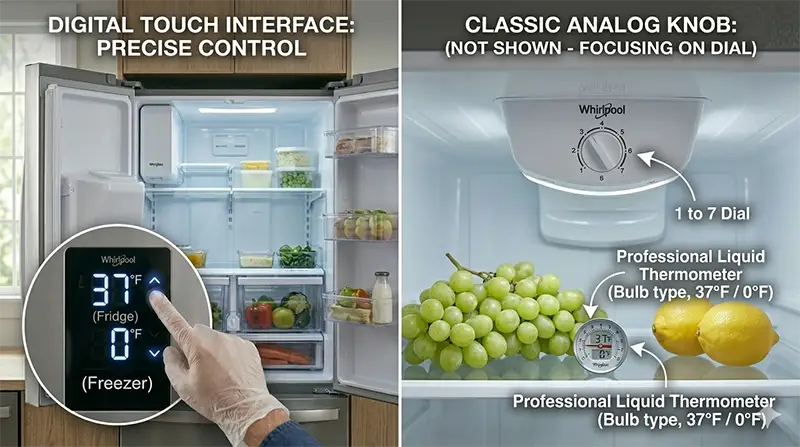
Many standard Whirlpool models feature a Temperature Control Dial located at the top and front of the refrigerator compartment.
- Locate the Dial: Look for a Control Knob often numbered 1 through 5, or 1 through 7. Occasionally, these may be labeled “Cold” to “Coldest.”
- Current Assessment: Identify the current setting. The factory default is usually the mid-point (e.g., setting 3 or 4).
- Making the Adjustment:
- To decrease the temperature (make it colder), turn the knob to a higher number.
- To increase the temperature (make it warmer), turn the knob to a lower number.
- The Wait Rule: This is the most critical step in Whirlpool refrigerator thermostat adjustment. You must allow 24 hours for the Internal Temperature to stabilize before making further changes. The Compressor Cycle needs time to adapt to the new setpoint.
Scenario 2: Digital Electronic Controls
Newer, high-end models utilize a Digital Control Panel often located on the dispenser interface or the interior door rim.
- Unlock the Panel: Some interfaces have a child lock. Press and hold the lock button for 3 seconds to activate the controls.
- Navigate Settings: Look for buttons labeled “Fridge” and “Freezer.”
- Adjusting Temperature:
- Press the “Fridge” button to cycle through the Cooling Settings.
- Unlike the dial, these usually display the target temperature.
- Set the Fresh Food Compartment to 37°F (3°C) and the Freezer Control to 0°F (-18°C).
- Confirmation: Ensure the display stops flashing, indicating the new setting is saved.
Scenario 3: Sliding Gauge Controls
Some models feature a sliding lever rather than a knob or digital button.
- Slide Adjustment: Moving the slider to the right typically engages a colder setting, while moving it to the left warms the unit.
- Airflow Balance: These sliders often control a damper that physically restricts or opens the airflow passage from the freezer. If you have separate sliders for “Air” and “Temp,” remember that the “Air” slider dictates how much cold air the Evaporator Fan pushes into the fridge section.
Optimal Temperature Benchmarks
To maximize food preservation, aim for the following Internal Temperature benchmarks:
- Fresh Food Compartment: Between 35°F and 38°F (1.6°C – 3.3°C). Anything above 40°F promotes bacterial growth; anything below 32°F will freeze your lettuce and eggs.
- Freezer: 0°F (-18°C). This ensures ice cream remains solid and meat preserves indefinitely without freezer burn.
If your refrigerator does not have a digital readout, it is highly recommended to purchase a standalone liquid or digital thermometer to place inside the unit. This provides verification that your Whirlpool refrigerator thermostat adjustment was successful.
Troubleshooting Temperature Irregularities
Sometimes, adjusting the Temperature Control Dial or digital panel yields no results. If the temperature remains inconsistent despite your adjustments, one of several internal components may be malfunctioning.
1. Blocked Air Vents
The circulation of cold air is paramount. If you have overpacked the Fresh Food Compartment, particularly in front of the vents where the Evaporator Fan blows, the temperature will rise regardless of the thermostat setting. Ensure there is at least an inch of clearance around air vents to allow for proper circulation.
2. Faulty Thermistor
In electronic models, the Thermistor is the “brain” that senses heat. If the thermistor is defective, it may send incorrect resistance readings to the main control board. Consequently, the board may not run the Compressor Cycle long enough (causing warm temps) or may run it continuously (causing freezing). A multimeter is required to test the thermistor for continuity and proper resistance values.
Read more whirlpool refrigerator parts replacement
3. Defective Cold Control Assembly
For older models, the Cold Control Assembly itself can fail mechanically. The internal contacts that close the circuit to start the compressor may carbonize or stick open. If you turn the Control Knob to the coldest setting and the compressor does not engage, the assembly likely needs replacement.
4. Evaporator Fan Failure
If the freezer is cold but the fridge is warm, the Evaporator Fan motor might be burnt out. This fan is responsible for pushing the cold air from the freezer coils into the rest of the unit. Without it, the cold air remains trapped in the freezer section.
5. Dirty Condenser Coils
While not directly part of the thermostat, dirty coils force the compressor to work harder and hotter. This can trick the system and make it difficult for the unit to reach the target temperature set by your Cooling Settings. Cleaning these coils every six months is a standard maintenance requirement.
The Relationship Between Freezer and Fridge Controls
A common misconception is that the freezer and fridge controls operate completely independently. In many Whirlpool configurations, there is only one cooling source (the freezer evaporator).
Read more whirlpool refrigerator ice maker replacement
- The Freezer Control: Often determines how cold the cooling coils get or how long the compressor runs.
- The Fridge Control: Often acts as a damper (a physical door) that regulates how much of that freezing air is allowed into the fresh food section.
Therefore, if you set the Freezer Control to its coldest setting, you might inadvertently reduce the airflow to the fridge if the damper system isn’t balanced. When performing a Whirlpool refrigerator thermostat adjustment, it is often best to adjust both compartments incrementally rather than maxing out one side.
Maintenance of Temperature Sensors
To ensure your Temperature Sensor or Thermistor reads accurately, keep the interior of the fridge clean. Spilled liquids or debris covering the sensor casing (usually a small plastic grille inside the fridge) can insulate the sensor, causing it to read the air as warmer than it actually is. This leads to the compressor running too long and freezing your food.
Conclusion
Mastering the climate inside your kitchen appliance is a blend of patience and technical understanding. A precise Whirlpool refrigerator thermostat adjustment requires identifying your control type, understanding the airflow dynamics between the freezer and the Fresh Food Compartment, and allowing sufficient time for the Compressor Cycle to stabilize.
By keeping the Evaporator Fan pathways clear, verifying temperatures with a secondary thermometer, and monitoring the health of the Cold Control Assembly, you can ensure your Whirlpool refrigerator operates at peak efficiency. Remember, small increments are the secret to success; avoid drastic swings in the Control Knob or digital settings to maintain a stable, food-safe environment.
Frequently Asked Questions
What are the ideal temperature settings for my Whirlpool refrigerator and freezer?
To maintain food safety and maximize shelf life, the fresh food compartment should be set between 35°F and 38°F (1.6°C – 3.3°C). The freezer should be set to 0°F (-18°C) to ensure food remains frozen solid and to prevent freezer burn.
On a manual control dial, does a higher number mean colder or warmer?
On Whirlpool models with a numbered control knob, higher numbers represent colder settings. For example, if your dial ranges from 1 to 7, 7 is the coldest setting and 1 is the warmest. The factory default is typically the middle number, such as 3 or 4.
How long should I wait after adjusting the thermostat to see results?
It is critical to wait at least 24 hours after making an adjustment for the internal temperature to stabilize. The compressor cycle needs this time to adapt to the new setting and circulate air throughout the unit effectively.
Why is my refrigerator still warm even though I turned the thermostat to a colder setting?
If adjustments do not change the temperature, check for blocked air vents inside the compartments. Overpacking food in front of vents prevents the evaporator fan from circulating cold air. Other possibilities include dirty condenser coils, a faulty thermistor, or a malfunctioning evaporator fan.
Read more whirlpool vs lg refrigerator
Are the freezer and refrigerator temperature controls independent of each other?
In many models, they are linked because the freezer is the primary source of cold air. The freezer control usually determines how long the compressor runs, while the refrigerator control often acts as a damper that regulates how much of that cold air is allowed into the fresh food section. It is best to adjust both incrementally for the best balance.