
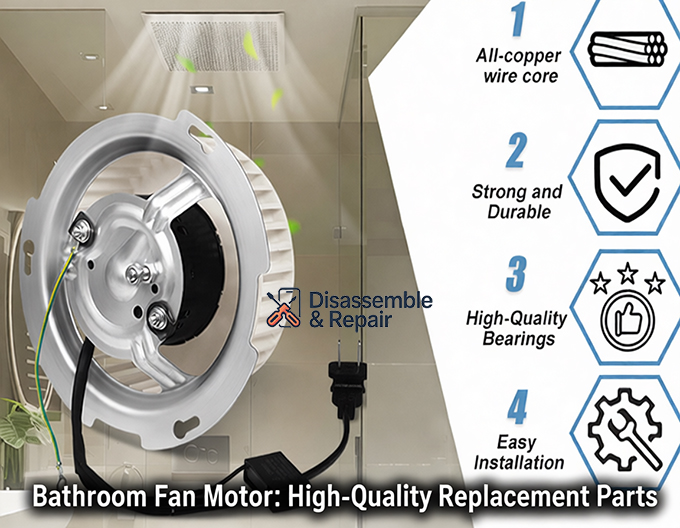
If your ventilation system is making a racket or failing to clear steam, the issue is likely the Bathroom Fan Motor. As the heart of your exhaust fan, this component is responsible for driving the blower wheel to remove moisture, odors, and humidity from your home.
Whether you are looking to troubleshoot a noisy unit, find a direct replacement, or upgrade to a whisper-quiet model, understanding the specifications and mechanics of these motors is essential for a successful repair.
Understanding Key Specifications: CFM and Sones
Before purchasing a replacement motor, you must match the performance ratings of your current unit. Two critical metrics define how well a bathroom fan performs:
- CFM (Cubic Feet per Minute): This measures the airflow volume. A higher CFM rating means the fan moves more air. Standard residential fans range from 50 to 110 CFM. A general rule of thumb is 1 CFM per square foot of bathroom area.
- Sones: This entity measures sound output. A fan rated at 4.0 Sones is about as loud as a television at normal volume, while a unit rated at 0.5 Sones is nearly silent. Upgrading your Bathroom Fan Motor often provides the benefit of significantly lower Sones.
Signs Your Bathroom Fan Motor Needs Attention
It is rare for a motor to fail without warning. Look for these common symptoms:
- Excessive Noise: Grinding, screeching, or rattling sounds often indicate worn bearings. If the shaft wiggles, the bearings are shot.
- Failure to Start: If the fan hums but the blade doesn’t spin, the capacitor may be faulty, or the motor shaft is seized.
- Poor Ventilation: If the motor runs slower than its rated RPM (revolutions per minute), it won’t generate enough suction to open the backdraft damper, leaving moisture in the room.
Components and Terminology
To perform a proper repair, you should be familiar with the following parts:
- Blower Wheel: Also known as a squirrel cage or impeller, this is the plastic or metal wheel attached to the motor shaft that physically moves the air.
- Shaft Diameter: When sourcing a universal replacement motor, you must measure the shaft diameter (commonly 7/32″ or 3/16″) to ensure your blower wheel fits securely.
- Capacitor: A small black rectangular or cylindrical component that gives the motor the torque to start spinning. Specs are measured in microfarads (µF or MFD) and voltage (VAC).
- Broan-NuTone: One of the most common manufacturers. Many generic replacement motors are designed specifically to fit Broan-NuTone mounting brackets and housings.
How to Select the Right Replacement Motor
Replacing just the motor is often cheaper and easier than tearing out the entire housing from the ceiling. Follow these steps to ensure compatibility:
- Check the Label: Remove the fan cover and look for a label on the motor plate. Note the model number, Voltage (usually 120V), Amps, and RPM.
- Verify Physical Dimensions: Measure the stack height (thickness of the metal coil section) and the length of the shaft.
- Rotation Direction: Determine if the motor spins Clockwise (CW) or Counter-Clockwise (CCW) when looking at the shaft end.
- Upgrade Kits: Brands like Broan-NuTone offer “upgrade kits” that include a new motor, blower wheel, and grille. These are designed to reduce noise (Sones) and increase airflow (CFM) without requiring drywall work.
Advanced Feature: Humidity Sensor
Modern exhaust fan setups often include a humidity sensor. This sensor detects rising moisture levels from a shower and automatically triggers the motor. If your fan runs continuously, check if the humidity sensor sensitivity needs adjustment before assuming the motor is broken.
Step-by-Step Replacement Guide

Safety Warning: Always turn off the circuit breaker before working on electrical components.
- Access the Unit: Pull down the grille and squeeze the mounting springs to remove it.
- Remove the Assembly: Most motors are mounted to a metal plate. Unplug the motor from the internal receptacle and remove the single screw or tab holding the plate in place.
- Detach the Blower Wheel: If you are keeping the old blower wheel, pull it firmly off the shaft. If it is stuck, apply a small amount of penetrating oil.
- Install the New Motor: Mount the new motor to the plate. Ensure the shaft diameter matches the wheel.
- Reassemble: Press the blower wheel onto the new shaft, reinstall the plate into the housing, and plug it in.
- Test: Turn the power back on. The fan should spin freely with minimal vibration.
Troubleshooting Tips
- Humming but not spinning: This is a classic sign of a bad start capacitor. Replacing this cheap component (usually rated 1-5 µF) can often save the motor.
- Rattling: Check the blower wheel. If it is unbalanced or hitting the housing, it will create significant noise and vibration.
- Squealing: This indicates dry or damaged bushings or bearings. While you can sometimes lubricate them with 3-in-1 oil, a replacement is usually a longer-lasting solution.
By understanding these components and specifications, you can easily restore effective ventilation to your bathroom, preventing mold growth and ensuring a comfortable environment.
Frequently Asked Questions
How do I determine the correct CFM rating for my bathroom?
A general rule of thumb is to provide 1 CFM (Cubic Feet per Minute) for every square foot of bathroom space. For example, a 70-square-foot bathroom would require a motor rated for at least 70 CFM to effectively remove moisture and odors.
What is the difference between Sones and CFM?
CFM measures the volume of airflow (how much air the fan moves), while Sones measure the sound level (how loud the fan is). If you want a more powerful fan, look for a higher CFM; if you want a quieter fan, look for a lower Sone rating, such as 0.5 to 1.0.
Why is my bathroom fan humming but not spinning?
This is often caused by a faulty capacitor, which is the component responsible for providing the torque needed to start the motor. Alternatively, the motor shaft may be seized due to dust buildup or lack of lubrication. If the shaft cannot be turned manually, the motor likely needs to be replaced.
Can I upgrade my fan to be quieter without tearing out the ceiling?
Yes. Many brands like Broan-NuTone offer upgrade kits that include a new motor, blower wheel, and grille. These are designed to fit into your existing housing, allowing you to increase CFM and decrease Sones without the need for drywall repairs or electrical rerouting.
What measurements do I need to find a universal replacement motor?
To ensure a universal motor fits, you must check the voltage (usually 120V), the shaft diameter (commonly 7/32″ or 3/16″), the rotation direction (Clockwise or Counter-Clockwise), and the “stack height,” which is the thickness of the metal coil section of the motor.