
There are few household conveniences more frustrating than discovering a load of wet laundry because of a Clothes Dryer Not Spinning. You press the start button, hear the motor hum, or perhaps hear nothing at all, and the drum remains stationary. While this issue can seem daunting, diagnosing the problem is often a logical process of elimination involving specific mechanical and electrical components.
This guide will walk you through the potential causes, necessary tools, and detailed troubleshooting steps to get your appliance back in working order.
Safety and tools preparation
Before attempting any repair, safety is paramount. Always unplug the dryer from the electrical outlet to prevent shock hazards. If you have a gas dryer, ensure the gas supply is turned off.
To effectively troubleshoot these components, you will need a few essential tools:
- Multimeter: This is critical for testing electrical continuity in switches, fuses, and motors.
- Putty knife or stiff blade: For releasing clips on the control panel or front housing.
- Screwdrivers (Phillips and flat-head): For removing panels.
- Nut drivers: Common sizes like 1/4 inch and 5/16 inch are frequently used in dryer assemblies.
Common causes for a clothes dryer Not spinning
When a dryer drum refuses to rotate, the issue usually stems from one of two categories: a mechanical failure preventing motion or an electrical failure preventing the motor from starting. By understanding the role of each component, you can narrow down the culprit effectively.
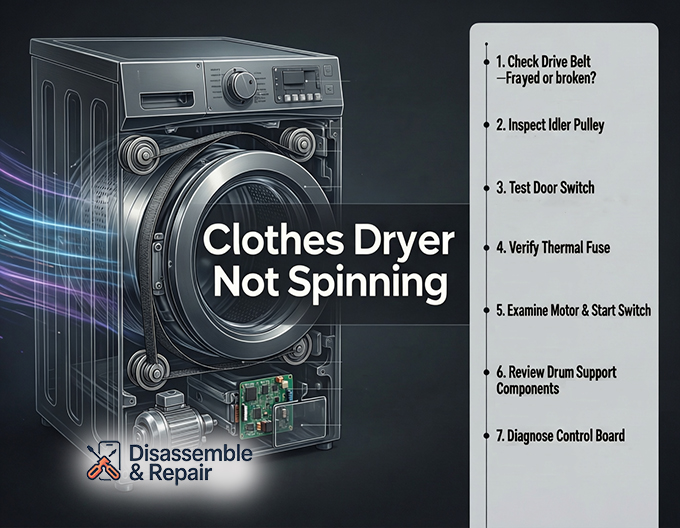
1. The drive belt
The drive belt is the most frequent point of failure. It is a long, rubber belt that wraps around the dryer drum, the idler pulley, and the drive motor pulley. Over time, this belt can become brittle, fray, or snap completely.
Symptoms:
- You can hear the motor running, but the drum is not moving.
- The drum spins very easily by hand (no resistance).
Troubleshooting:
Open the dryer door and try to spin the drum by hand. If it spins with little to no resistance, the belt is likely broken. To confirm, you will need to remove the front or top panel of the dryer. Visually inspect the belt; if it is lying broken at the bottom of the cabinet, it must be replaced.
2. The idler pulley
The idler pulley puts tension on the drive belt so that the drive pulley on the motor can grip the belt and rotate the drum. If this pulley seizes or breaks, the belt will lose tension and slip, causing the drum to stop.
Symptoms:
- A loud squealing or squeaking noise prior to failure.
- The dryer stops mid-cycle.
Troubleshooting:
Access the interior of the cabinet and locate the pulley assembly. Remove the belt from the pulley and try to spin the wheel with your finger. It should spin freely and quietly. If it wobbles, feels gritty, or does not spin, the idler pulley needs to be replaced.
3. The door switch
The door switch is a safety mechanism that prevents the dryer from operating when the door is open. If the plastic peg on the door is broken or the internal mechanism of the switch fails, the dryer will think the door is open and will not send power to the motor.
Symptoms:
- The dryer makes no sound and does not start.
- The drum light does not turn off when the peg is pressed.
Troubleshooting:
Locate the switch near the door frame. You can test this using a multimeter. Set the meter to the continuity setting (Rx1). Disconnect the wires from the switch and touch the probes to the terminals. When you press the switch button, the meter should read zero ohms (continuity). If it shows infinity (no continuity) while pressed, the door switch is defective.
4. The thermal fuse
The thermal fuse is a safety device designed to protect the dryer from overheating. It is usually located on the blower housing or near the heating element. If the dryer vent is clogged and temperatures rise too high, this fuse will blow and cut power to the drive motor or the heating element, depending on the dryer model.
Symptoms:
- The dryer is completely dead and unresponsive.
- No heat is produced (in some models).
Troubleshooting:
Locate the fuse and remove the wires. Using your multimeter, check for continuity. A functional fuse should allow current to flow through it. If the meter reads infinity, the fuse has blown and must be replaced. Note: Always clean your dryer vents when replacing a thermal fuse, as restricted airflow is the primary cause of this failure.
5. The drive motor
The drive motor is the heart of the operation, physically turning the drive pulley and the blower fan. While motors are generally durable, they can fail due to worn internal bearings, a bad start winding, or a faulty centrifugal switch.
Symptoms:
- A loud humming or buzzing sound when you press start, but the drum doesn’t move.
- The motor runs for a few minutes and then shuts off (overheating).
Troubleshooting:
If the motor hums but won’t turn, remove the belt and try to start the dryer. If the motor runs fine without the load of the drum, the issue might be a seized drum roller or idler pulley. If the motor still hums or doesn’t start, unplug the machine and test the motor windings with a multimeter for continuity, or check for obstructions in the blower wheel.
Inspecting drum support components
If the motor and belt are in good condition, the issue might be that the drum is physically stuck or experiencing too much friction. Several components support the heavy drum, and if they fail, the motor may not be strong enough to overcome the resistance.
Drum rollers and axles
Most dryers have two or more drum rollers on the rear bulkhead (and sometimes the front) that support the drum. These wheels spin on shafts. If the rubber on the rollers wears out or the bearings seize, the drum will struggle to turn.
Inspection:
Remove the drum from the cabinet. Inspect each roller. They should spin freely without wobbling. If a roller is seized or the rubber is disintegrating, replace all rollers in the set to ensure even wear.
Drum glides
On the front of the drum, many dryers use drum glides (or slides) made of plastic or nylon to support the drum on the front panel. These act as a bearing surface.
Inspection:
Check the top of the front bulkhead where the drum rests. If the drum glides are worn down to the metal, the drum will scrape against the metal housing, creating significant friction and noise. This friction can put enough load on the motor to prevent it from spinning.
Drum bearing
Some dryer designs use a drum bearing located at the center rear of the drum instead of rollers. This ball-and-socket style bearing supports the entire weight of the drum’s rear.
Inspection:
If you hear a grinding noise or if the drum is sagging, inspect the rear bearing. Wear and tear can cause the bearing to bind, stopping the rotation. If there is excessive play or visible damage, the bearing kit must be installed.
Electrical control and switching issues
If the mechanical parts move freely and the motor is functional, the problem may lie in the command chain that tells the dryer to spin.
The start switch
The start switch is the button you press to begin the cycle. It closes the circuit to the motor relay.
Troubleshooting:
If pressing the button does nothing (and you have already ruled out the door switch and thermal fuse), test the start switch for continuity. With the button unpressed, there should be no continuity. When you press the button, the multimeter should show a closed circuit.
The control board
In modern digital dryers, a control board manages all functions. If the board has a short circuit or a failed relay, it may not send voltage to the drive motor.
Troubleshooting:
Inspect the board visually for burn marks or blown capacitors. Testing a control board can be complex and often requires a voltage check while the machine is plugged in—this is dangerous and should only be performed by professionals or those with advanced electrical knowledge. If voltage is entering the board but not exiting to the motor, the board likely needs replacement.
Summary
Diagnosing a “Clothes Dryer Not Spinning” scenario requires a systematic approach. Start with the simplest solutions: check the drive belt for breakage and the door switch for continuity. If those are functional, move to the support components like the idler pulley, drum roller, and drum glides. Finally, investigate electrical components like the thermal fuse, start switch, and control board.
By isolating each of these entities and testing them with a multimeter, you can identify the failure and perform the necessary repair, saving the cost of a full appliance replacement.
Frequently asked questions
How can I tell if the drive belt is the reason my dryer isn’t spinning?
The most common sign of a broken drive belt is hearing the motor run while the drum remains stationary. You can also test this by opening the door and spinning the drum by hand; if it rotates very easily with almost no resistance, the belt has likely snapped or slipped off the pulley system.
What does it mean if the dryer makes a humming sound but the drum won’t move?
A humming or buzzing sound typically indicates that the drive motor is trying to start but is being prevented from turning. This can be caused by a seized idler pulley, worn-out drum rollers that have jammed, or an internal failure within the motor itself. It is best to remove the belt and see if the motor can spin freely on its own to isolate the problem.
Can a clogged dryer vent actually prevent the dryer from spinning?
Yes, indirectly. A clogged vent causes the dryer to overheat, which triggers the thermal fuse to blow. Once this safety device is tripped, it cuts power to the motor or the entire unit to prevent a fire. If your dryer is completely unresponsive, you should check the thermal fuse for continuity and clean your exhaust vents immediately.
How does a faulty door switch prevent the dryer from operating?
The door switch is a safety mechanism that completes the electrical circuit only when the door is firmly closed. If the switch’s internal components fail or the plastic peg on the door breaks, the dryer will “think” the door is open and refuse to send power to the motor, resulting in a dryer that won’t start or spin.
What tools are essential for diagnosing these dryer issues?
The most critical tool is a multimeter, which allows you to test electrical continuity in the door switch, start switch, and thermal fuse. Additionally, you will likely need a putty knife to release cabinet clips, as well as Phillips and flat-head screwdrivers or nut drivers (typically 1/4 inch and 5/16 inch) to remove the access panels.