
Comfee washer not draining: Troubleshooting guide
Is your Comfee washer not draining at the end of a cycle, leaving you with a tub full of soggy clothes and standing water? This is one of the most common issues owners of portable and compact washing machines face, but it is often resolvable without calling a professional technician.
When a washer fails to expel water, the culprit is usually a blockage, a positioning error, or a safety sensor malfunction within the drainage system. This guide will walk you through the diagnostic process to get your appliance running smoothly again.
Understanding the E2 error code
On most Comfee models, a drainage issue will trigger an error code on the digital display, most commonly E2. This code specifically indicates that the machine has failed to empty the water within a set timeframe. However, even if no code appears, the presence of standing water after the spin cycle confirms that the drainage mechanism has failed.
SEE MORE: How to fix Comfee washing machine error E2
Step 1: Inspect the drain hose
The most frequent cause of a Comfee washer not draining is a physical restriction in the drain hose. Because these machines are often portable and moved frequently, the hose is susceptible to damage and improper positioning.
- Check for Kinks: Inspect the entire length of the hose behind the machine. A kinked hose acts like a pinched straw, preventing the centrifugal pump from pushing water out. Straighten any bends.
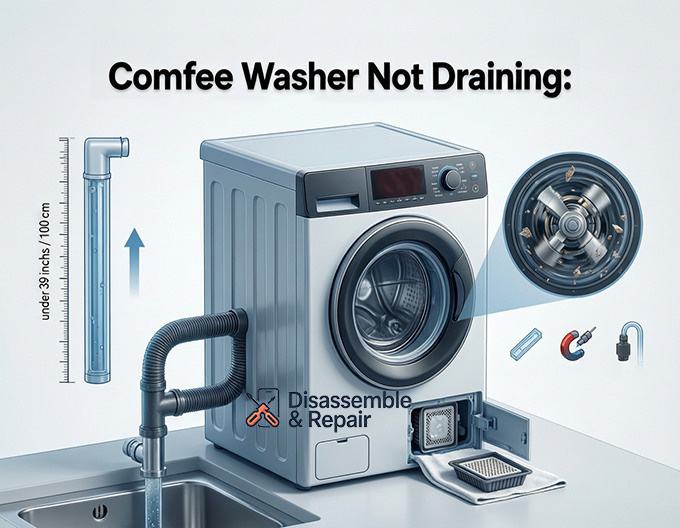
- Verify Height Requirements: The drain hose must be installed at the correct height to create a proper gravity loop. If the hose is laying flat on the floor, water may siphon out prematurely or not drain at all due to airlocks. Conversely, if the hose is too high (usually above 39 inches/100 cm), the pump may struggle to overcome gravity.
- Clear Clogs: Remove the hose from the drain pipe or sink and inspect the end for lint or debris. A physical clog here will block the flow completely.
Step 2: Clean the drain pump filter
If the hose is clear, the blockage is likely inside the machine, specifically at the drain pump filter. This component traps coins, buttons, lint, and other debris to protect the pump.
- Locate the Filter: On most Comfee units, this is located behind a small access door at the bottom right or left corner of the machine.
- Prepare for Water: Before opening, place a shallow pan or towel down, as water remaining in the tub will rush out.
- Clean the Debris: Unscrew the cap counter-clockwise. Pull out the filter and rinse it under warm water. Check the housing for any objects that might be stuck.
- Check the Impeller: While the filter is removed, look inside the housing to see the impeller (the fan-like blades of the pump). Ensure it can spin freely and is not obstructed by hair or strings.
Step 3: Test the lid switch assembly
For safety reasons, top-loading washing machines will not engage the drain or spin cycle if the lid is open. The lid switch assembly detects whether the lid is securely closed.
If the little plastic striker on the lid is broken, or if the magnetic sensor inside the cabinet is faulty, the machine will “think” the lid is open even when it is shut. If your washer agitates but refuses to drain or spin, the lid switch is a primary suspect. Try pressing down firmly on the lid; if the drain pump activates, the switch may be loose or misaligned.
Step 4: Advanced troubleshooting
If the external components are clear, the issue may lie with internal sensors or the pump itself.
The pressure awitch
The pressure switch (or water level sensor) tells the control board how much water is in the tub. It operates using a small air tube. If this tube gets clogged with sediment or pinches, the switch might report that the tub is empty when it is actually full. Consequently, the control board will not activate the drain pump because it believes there is no water to drain.
The drain pump
The drain pump in Comfee washers is a centrifugal pump designed to move fluids using rotational energy. Over time, the motor can burn out, or the plastic impeller blades can snap off. If you hear a low humming noise but no water is moving, the pump motor might be receiving power but is mechanically seized. In this case, the pump usually requires replacement.
Preventive maintenance
To prevent future draining issues:
- Check pockets for coins and tissues before washing.
- Clean the drain pump filter once a month.
- Ensure the drain hose is not crushed against the wall when pushing the machine back into place.
By systematically checking these components, you can usually resolve the issue of a Comfee washer not draining and avoid the cost of a service call.
Frequently asked questions
What does the E2 error code mean on a Comfee washer?
The E2 error code indicates that the washing machine has failed to drain the water within the required timeframe. While this is the most common code for drainage issues, you may still have a failure if you see standing water in the tub even without a code appearing on the display.
How high should the drain hose be installed?
The drain hose should be positioned with a proper gravity loop, ideally not exceeding 39 inches (100 cm) in height. If the hose is too high, the pump may not be strong enough to push the water out; if it is lying flat on the floor, it can cause airlocks or premature siphoning.
How often should I clean the drain pump filter?
For optimal performance and to prevent clogs, it is recommended to clean the drain pump filter once a month. This component is designed to catch coins, lint, and debris before they reach the pump, so regular maintenance is essential to prevent drainage failures.
Why is my washer failing to drain even though the lid is closed?
If the washer agitates but won’t drain or spin, the lid switch assembly may be faulty. The machine is programmed to stop the drainage process if it detects the lid is open. If the plastic striker is broken or the magnetic sensor is misaligned, the washer will “think” the lid is open even when it is securely shut.
What should I do if I hear a humming noise during the drain cycle?
A low humming noise usually suggests that the drain pump motor is receiving electricity but is mechanically seized. This can happen if the impeller is blocked by hair or string, or if the motor has burned out. You should check the impeller for obstructions; if it is clear and still won’t turn, the pump likely needs to be replaced.