
Discovering a Dryer Not Heating is a significant inconvenience that disrupts your daily household routine and leaves you with a pile of damp laundry. While the drum may still spin and the control panel may light up, a Dryer Not Heating indicates a failure in one of several critical systems responsible for generating or regulating thermal energy. As a Senior SEO Specialist and home appliance expert, I have compiled this comprehensive guide to help you identify the root cause of the problem.
This guide explores the mechanical and electrical components that frequently fail, ranging from simple airflow restrictions to complex internal part failures. Whether you own a gas or an electric model, understanding these entities is the first step toward a successful repair.
Initial checks: Power and Airflow
Before dismantling the appliance to check internal components, you must rule out external factors. Often, the issue is not a broken part but an environmental or power supply issue.
The circuit breaker and power supply
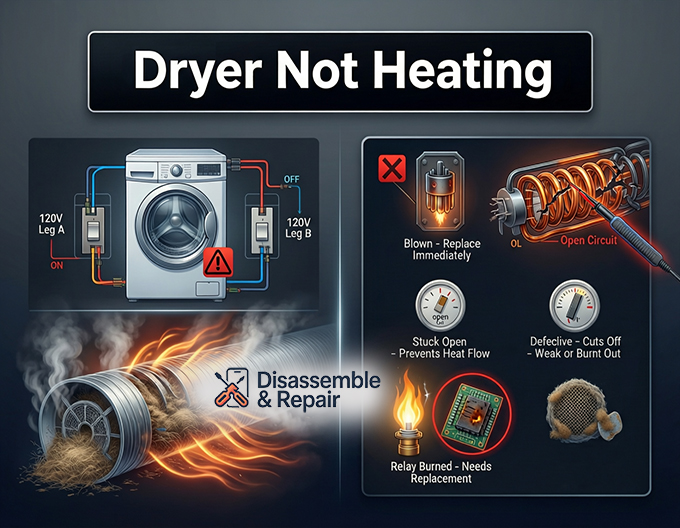
For electric dryers, the appliance requires a 240-volt power supply consisting of two 120-volt legs. It is entirely possible for a circuit breaker to trip partially, cutting off one leg of the power while leaving the other active. In this scenario, the dryer will have enough power to turn the motor and spin the drum, but the heating element will not receive the voltage required to generate heat.
Locate your home’s electrical panel and check the circuit breaker assigned to the dryer. Even if it looks like it is in the “ON” position, toggle it off and then back on to ensure both legs of power are engaged.
The lint filter and exhaust vent system
Airflow is the lifeblood of a dryer. Without proper air circulation, heat cannot move through the drum, and safety mechanisms will trigger to prevent a fire. The first line of defense is the lint filter. If this screen is clogged, it restricts air intake. However, the more insidious culprit is often the exhaust vent.
Over time, lint bypasses the filter and accumulates in the ductwork leading outside. A clogged exhaust vent traps heat and moisture inside the dryer. This not only results in clothes taking forever to dry but also causes the internal temperature to spike dangerously high, which can blow the thermal fuse. Ensure you inspect the vent hood outside your home to verify that air is escaping freely while the dryer is running.
Comprehensive guide to fixing a dryer Not heating
If your power supply is stable and your vents are clean, you are likely dealing with an internal component failure. The following sections detail the specific parts that cause a Dryer Not Heating and how to diagnose them.
The thermal fuse
The thermal fuse is the most common cause of heating failure. It is a safety device designed to protect the dryer from overheating and potentially catching fire. When the exhaust temperature exceeds a specific limit—usually caused by a blocked exhaust vent—the thermal fuse blows, breaking the electrical circuit to the heat source.
On most models, once the thermal fuse has blown, the dryer will still turn on and tumble, but it will produce absolutely no heat. The fuse is non-resetting; once it fails, it must be replaced. Before installing a new one, you must clean the venting system, or the new fuse will blow immediately.
The heating element (Electric dryers)
In electric dryers, the heating element is responsible for generating heat. It consists of a coiled wire made of nickel-chromium alloy, encased in a metal chamber. When electricity flows through the wire, it glows red hot, warming the air that the blower fan circulates through the drum.
Over time, the constant expansion and contraction caused by heating and cooling can cause the wire to break or burn out. If the wire breaks, the electrical circuit is interrupted, and no heat is produced. You can inspect the heating element visually for breaks, but a continuity test is the only way to be certain of its condition.
The high-limit thermostat
The high-limit thermostat acts as a safety backup to the main temperature control. It is usually located directly on the heating housing. Its primary function is to shut off the burner or element if the dryer overheats significantly.
If the high-limit thermostat fails while stuck in the “open” position, it will prevent voltage from reaching the heater. This component often fails because the exhaust vent is restricted, causing it to cycle on and off repeatedly until it eventually wears out.
The cycling thermostat
While the high-limit thermostat is a safety guard, the cycling thermostat is the workhorse of temperature regulation. It turns the heat source on and off to maintain the target temperature for the selected cycle (e.g., Low, Medium, High).
If the cycling thermostat is defective, it may fail to signal the heater to turn on, or it may cut the heat off prematurely. This results in clothes that are still damp or a dryer that runs cold throughout the cycle.
The igniter and gas valve solenoid (Gas Dryers)
Troubleshooting a gas dryer requires looking at a different set of components. Gas dryers use an igniter to light the gas burner. When you start the cycle, the igniter should glow white-hot. If it does not glow, the igniter itself is likely burnt out and needs replacement.
However, if the igniter glows and then fades out without a flame appearing, the issue is likely the gas valve solenoid coils. These coils open the gas valves to allow fuel to flow into the burner assembly. If the solenoids are weak, they may be strong enough to open the valve once or twice but fail as they heat up, or they may not open the valve at all.
The control board
In modern appliances, the control board is the computer brain that manages all functions. While less common than mechanical failures, a relay on the control board can burn out. If the heater relay fails, the board will not send voltage to the heating element or gas valve, even if all other components are functioning perfectly. Diagnosing a faulty control board usually involves visual inspection for burn marks or testing voltage output, which is more advanced than standard resistance testing.
The moisture sensor
The moisture sensor consists of two metal strips, usually located near the lint filter or on the back wall of the drum. These sensors detect the electrical conductivity of damp clothing. When the clothes are wet, they complete the circuit between the strips.
If the moisture sensor is coated in residue from dryer sheets or fabric softener, it may fail to detect moisture. Consequently, the control board may “think” the clothes are dry and shut off the heating cycle prematurely. While this technically shuts off the heat, it is often mistaken for a heating failure. Cleaning the sensors with a customized alcohol wipe can often resolve this.
How to perform a continuity test
To accurately diagnose which part is causing your Dryer Not Heating, you cannot rely on visual inspection alone. You must perform a continuity test using a multimeter. This test determines if a continuous electrical path exists through a part.
- Safety First: Always unplug the dryer before disassembling or testing any parts.
- Set the Multimeter: Turn your multimeter to the lowest setting for Ohms of resistance or the continuity setting (often indicated by a sound wave symbol).
- Isolate the Component: Remove at least one wire from the terminal of the part you are testing (e.g., the thermal fuse or heating element) to ensure you are not reading through other parts of the circuit.
- Touch the Probes: Touch one probe to each terminal of the component.
- Closed Circuit (Good): The meter will beep or show a reading near 0 to 50 ohms (depending on the part). This means electricity can flow.
- Open Circuit (Bad): The meter will show no change (often displaying “OL” for Open Loop) or infinite resistance. This indicates the part is broken and must be replaced.
Conclusion
Resolving a Dryer Not Heating issue requires a systematic approach to troubleshooting. By checking the simplest variables first—such as the circuit breaker, lint filter, and exhaust vent—you can often save time and money. If those are clear, moving on to internal components like the thermal fuse, heating element, or gas valve solenoid usually reveals the culprit.
Remember that while components like the cycling thermostat and high-limit thermostat regulate the system, they are susceptible to wear and tear. Always verify your findings with a continuity test before purchasing replacement parts. If you are uncomfortable working with high-voltage electricity or gas lines, it is always recommended to contact a professional appliance repair technician to restore your dryer to safe working order.
Frequently asked questions
Why is my dryer spinning and running, but not producing any heat?
This is often caused by a blown thermal fuse, which is a safety device that cuts off power to the heating system if the unit gets too hot. In electric dryers, it could also mean one half of the circuit breaker has tripped, providing enough power to turn the motor but not enough to engage the heating element. For gas models, it frequently indicates a failed igniter or worn-out gas valve solenoids.
How can I tell if my thermal fuse is blown?
A thermal fuse cannot be reset and does not usually show visible signs of damage. The only way to confirm it has failed is by performing a continuity test with a multimeter. If the multimeter shows an “Open Loop” (OL) or infinite resistance, the fuse is broken. Because a clogged exhaust vent is the primary cause of a blown fuse, you must clean your ductwork before replacing the part.
Can a clogged lint vent really stop my dryer from heating?
Yes. Proper airflow is essential for the heating system to function. If the exhaust vent is restricted, heat builds up inside the dryer cabinet. This causes safety components like the high-limit thermostat or the thermal fuse to trip to prevent a fire. Even if the safety parts haven’t blown yet, poor airflow prevents moisture from escaping, making it seem as though the dryer isn’t heating effectively.
What is the difference between an igniter and a gas valve solenoid?
These are specific to gas dryers. The igniter is a component that glows white-hot to light the gas burner; if it doesn’t glow, the igniter is likely cracked or burnt out. The gas valve solenoids are coils that open the gas valves once the igniter is hot enough. If the igniter glows and then clicks off without a flame appearing, the solenoids are usually the culprit and need to be replaced.
How do I use a multimeter to test my dryer’s heating element?
First, ensure the dryer is unplugged. Access the heating element and remove at least one of the wires connected to its terminals to prevent a false reading. Set your multimeter to the lowest Ohms setting or the continuity (beep) setting. Touch the probes to the two terminals of the element. A functional element will show a small amount of resistance (usually 0 to 50 ohms), while a broken element will show no continuity at all.