
One of the most alarming issues homeowners face is when their LG washer keeps filling with water, potentially causing significant flooring damage and wasted utilities. Whether the machine is currently running a cycle or is turned completely off, this malfunction indicates a failure in the appliance’s water control system that requires immediate attention. As a complex electromechanical device, your LG washing machine relies on a series of valves, sensors, and control boards to regulate water flow; when one component fails, the delicate balance is disrupted.
This guide provides a professional, deep-dive analysis into the electromechanical causes of overflow issues, utilizing industry-standard appliance repair troubleshooting protocols. We will examine critical components such as the water inlet valve, the pressure switch, and the main control board to help you identify the root cause and implement the correct solution.
Detailed Analysis: Why Your LG Washer Keeps Filling with Water
When diagnosing why an LG washer keeps filling with water, it is essential to distinguish between the two distinct states of the machine: filling while the machine is turned off, and filling uncontrollably during a wash cycle. This distinction is the primary indicator of which component has failed.
The Role of the Water Inlet Valve
The most frequent culprit behind this issue is a defective water inlet valve. This component acts as the gatekeeper for your washing machine, connecting the hot and cold water supply hoses to the tub. Inside the valve assembly, there are solenoid valve coils that open and close based on electrical signals from the main control board.
If the washer fills with water while it is unplugged or turned off, the failure is almost certainly mechanical. Over time, sediment buildup—calcium, rust, or debris from your home’s plumbing—can lodge itself in the valve’s diaphragm. This prevents the solenoid from closing fully, allowing a continuous trickle or steady stream of water to bypass the seal. In this scenario, the valve has lost its mechanical integrity and must be replaced, as cleaning internal solenoids is rarely a long-term fix.
Malfunctioning Pressure Switch and Water Level Sensor
If the washer only overfills during a cycle, the issue often lies with the water level sensor, also known as the pressure switch. This system determines how much water is in the drum. It operates using a pressure transducer tube (or air dome tube) that connects the tub to the sensor. As water rises in the drum, air is compressed inside this tube. The pressure switch measures this air pressure to calculate the water level.
If the pressure switch is faulty, it fails to send the “stop” signal to the water inlet valve. Similarly, if the pressure transducer tube is clogged with detergent sludge, kinked, or punctured, the air pressure will not build up correctly. The sensor will read “empty” regardless of the actual water level, causing the main control board to keep the valves open indefinitely.
The Main Control Board Factor
While less common, the main control board can be the source of the problem. This printed circuit board (PCB) serves as the brain of the appliance. It sends voltage to the water inlet valve solenoids to open them. If a relay on the control board sticks in the “closed” position, it may send continuous voltage to the water valve, forcing it to remain open even when the cycle should have advanced to agitation or draining.
Read more LG washing machine dE error
Understanding LG Error Code
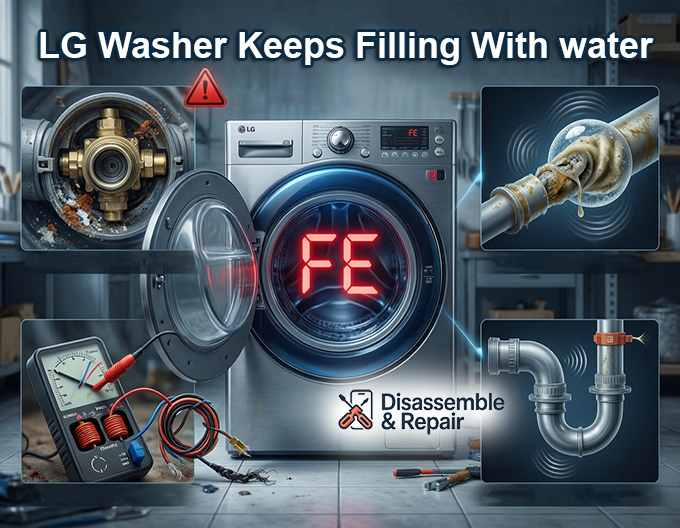
LG washing machines are equipped with sophisticated self-diagnostic systems. If the machine detects that the water level has risen too high, it will trigger the overflow protection sequence and display the LG error code FE.
The FE code stands for “Fill Error” or “Flooding Error.” When the water level sensor detects that the water height has exceeded the maximum safe limit, the main control board automatically activates the drain pump to prevent flooding. If you see the FE code, the machine is actively trying to mitigate a disaster.
However, the FE code is a symptom, not the cause. It confirms that the water level sensor is working (because it detected the overflow) but implies that the water inlet valve is not shutting off, or that the sensor is sending erratic data due to a damaged pressure tube.
Read more LG front load washing machine not filling with water
The Siphoning Effect and Drain Hose Height
A frequently overlooked cause of water level issues is improper installation of the drain system, leading to a siphoning effect. This occurs when the drain hose height is set incorrectly.
For an LG washer to function correctly, the drain hose must be installed at a specific height—typically between 30 and 96 inches from the floor (consult your specific model’s manual). If the drain hose is pushed too far down into the standpipe or if the outlet is lower than the water level in the drum, gravity can create a siphon.
In this scenario, as the washer fills, water immediately flows out of the drain hose. The pressure switch never detects the correct fill level because the water is escaping as fast as it enters. Consequently, the machine stays in the “fill” cycle indefinitely. While this looks like an overfilling issue, it is actually a flow-through issue caused by physics rather than component failure.
Step-by-Step Appliance Repair Troubleshooting
To accurately diagnose the problem, follow this professional troubleshooting workflow. Always prioritize safety by ensuring the floor is dry and handling electrical components with care.
Step 1: The Power Isolation Test
This test determines if the failure is mechanical or electrical.
- Start a cycle and let the washer fill.
- If the washer begins to overfill, unplug the machine from the wall outlet immediately.
- Observation:
- If the water stops: The issue is likely electrical. The main control board was sending a signal to the valve, or the pressure switch failed to tell the board to stop.
- If the water continues to flow: The issue is mechanical. The water inlet valve is physically stuck open. No amount of electronic resetting will fix this; the valve assembly requires replacement.
Step 2: Inspecting the Pressure System
If the water stopped when you unplugged the machine, you must investigate the water level sensing system.
- Remove the top panel of the washer (for front loaders) or the control console (for top loaders).
- Locate the pressure switch and the clear plastic pressure transducer tube attached to it.
- Check the tube for kinks, holes, or abrasions. A small pinhole will release the air pressure required to trigger the switch.
- Remove the tube from the switch and blow through it toward the tub. You should hear a bubbling sound, indicating the path to the tub is clear. If you feel resistance, sediment buildup or undissolved detergent may be blocking the air dome.
Step 3: Checking for Grounding and Electrical Continuity
If the valve and pressure switch appear functional, use a multimeter to test the electrical components.
- Test the solenoid valve coils for continuity. A reading of infinity indicates a broken circuit, while a reading of zero indicates a short.
- Inspect the wiring harness connecting the pressure switch to the main control board. Vibration during the spin cycle can sometimes chafe wires, causing intermittent shorts that confuse the control board.
Corrective Measures and Maintenance
Once you have identified the faulty component, proceed with the necessary repairs.
Replacing the Water Inlet Valve
If your diagnostic points to a stuck valve:
- Shut off the hot and cold water supply faucets.
- Disconnect the water supply hoses from the back of the washer. Have a bucket ready to catch residual water.
- Remove the cover panel to access the valve assembly.
- Disconnect the wire harnesses from the solenoid valve and remove the mounting screws.
- Install the OEM (Original Equipment Manufacturer) replacement valve. Do not use generic parts, as flow rates differ.
- Reconnect hoses and check for leaks.
Addressing Sediment Buildup
To prevent future valve failures, inspect the mesh screens located inside the water inlet ports of the washer.
Read more LG washing machine nF error
- Use needle-nose pliers to gently pull out the mesh screens.
- Rinse them under water to remove sand and mineral deposits.
- If your home has hard water, consider installing an external filter on the supply line to protect the delicate internal components of the washer.
Correcting Drain Hose Installation
If siphoning is the culprit:
- Pull the drain hose out of the standpipe.
- Measure the amount of hose inserted into the pipe. It should generally not extend more than 4 to 6 inches into the standpipe.
- Ensure the U-bend bracket is utilized to maintain the correct drain hose height.
- Verify that the connection is not airtight; there must be an air gap between the hose and the standpipe to prevent vacuum suction.
Conclusion
When an LG washer keeps filling with water, the situation requires a systematic approach to diagnosis. By isolating the problem through the power isolation test, you can quickly determine if the fault lies with the mechanical integrity of the water inlet valve or the electronic monitoring of the pressure switch and main control board.
Read more LG washing machine CL error
While clearing a clogged pressure tube or adjusting the drain hose are manageable DIY tasks, replacing a main control board or diagnosing complex wiring harnesses involves high-voltage risks. If you identify the error code FE but cannot locate a blockage or a mechanical valve failure, it is advisable to consult a certified appliance repair technician. Timely intervention not only restores the convenience of your laundry routine but also protects your home from the costly repercussions of water damage.
Frequently Asked Questions
Why does my LG washer continue to fill with water even when it is unplugged?
If your washer fills while the power is off or the cord is unplugged, the failure is mechanical. This typically means the water inlet valve is stuck in the open position, often due to sediment buildup like calcium or rust preventing the internal diaphragm from sealing. In this case, the valve assembly must be replaced.
What should I do if my washer displays the FE error code?
The FE (Fill Error) code indicates that the machine has detected a water level higher than the safe limit. When this happens, the washer will automatically trigger the drain pump to prevent a flood. You should immediately check for a faulty water inlet valve or a blockage in the pressure transducer tube that may be sending incorrect signals to the control board.
How can I determine if the overfilling is an electrical or mechanical problem?
You can perform a “Power Isolation Test.” While the machine is filling, unplug it from the wall. If the water stops immediately, the problem is electrical, likely involving the main control board or the pressure switch. If the water continues to flow while the power is disconnected, the problem is a mechanical failure of the water inlet valve.
Can the way my drain hose is installed cause the washer to fill indefinitely?
Yes. If the drain hose is pushed too far into the standpipe or is installed lower than the water level in the drum, it can create a siphoning effect. This causes water to flow out of the machine as fast as it enters. Because the water level never reaches the required height, the pressure switch never tells the machine to stop filling, leading to a continuous cycle of water flow.