
If your LG washer leaves clothes wet after spin, it is often due to a drainage failure, an unbalanced load, or a mechanical issue preventing the drum from reaching high speeds. This guide provides a comprehensive troubleshooting path to identify and fix the problem, ranging from simple maintenance tasks to replacing internal components.
Common Causes Why LG Washer Leaves Clothes Wet After Spin
When a washer fails to extract water effectively, the issue usually stems from the machine’s inability to drain water quickly or spin fast enough to wring out the fabric. The following sections detail the specific components responsible for these failures.
1. Drainage System Failures
If the water cannot exit the drum, the spin cycle will be ineffective.
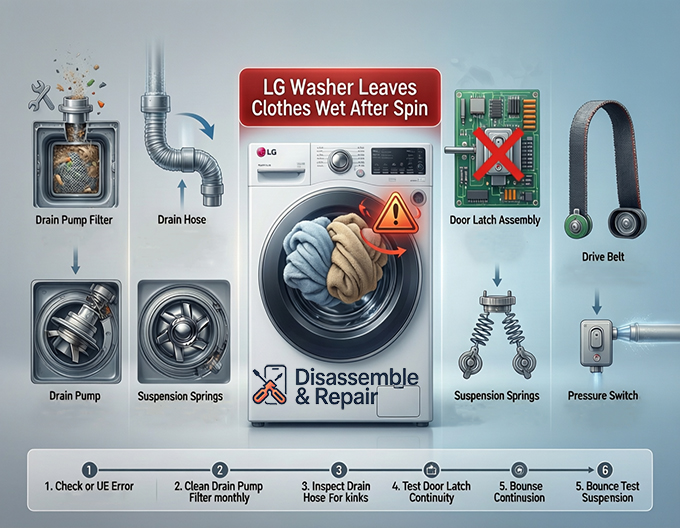
- Drain Pump Filter: This is the most common culprit. Small objects like coins, lint, or hair can clog the filter, restricting water flow. If the pump cannot evacuate water faster than the spin cycle extracts it, your clothes will remain sodden.
- Drain Hose: A kinked, crushed, or clogged drain hose prevents proper drainage. Additionally, if the hose is installed too far down the standpipe (siphoning) or the drain height is incorrect, water may flow back into the drum.
- Drain Pump: If the filter and hose are clear but the washer still doesn’t drain, the drain pump itself may have a broken impeller or a burnt-out motor.
2. Load Balancing Issues (UE Error Code)
LG washers use sensors to detect load weight and balance.
- Unbalanced Load: Washing a single heavy item (like a wet blanket) or a load that has clumped together can trigger the machine’s safety protocols. The washer will slow down the spin speed to prevent damage, leaving clothes wet. This often triggers the UE error code.
- Suspension Springs and Shock Absorbers: These components hold the tub in place and dampen vibration. If a suspension spring is broken or the shock absorbers are worn out, the tub will vibrate excessively. The motor control board will detect this instability and limit the spin speed, resulting in poor water extraction.
3. Mechanical and Electrical Faults
- Door Latch Assembly: The washer must sense that the door is securely locked to engage high-speed spinning. A failing door latch assembly might allow the washer to wash and rinse but prevent it from entering the high-RPM final spin.
- Drive Belt: On non-direct drive models, a loose or worn drive belt can slip on the pulley. The motor may be running at full speed, but the drum won’t spin fast enough to dry the clothes.
- Pressure Switch: This sensor monitors the water level. If the pressure switch is faulty, it may falsely signal the control board that the drum is full of water (preventing a spin) or empty (preventing a drain cycle).
- Motor Control Board: In rare cases, the main electronic board that controls the motor speed may fail, preventing the drum from ramping up to the necessary spin velocity.
4. User Error
- High-Efficiency Detergent: Using regular detergent or too much high-efficiency detergent creates excessive suds. The sensor detects these suds as water and adds rinse cycles or stops the spin early to prevent overflowing, leaving clothes dripping wet.
Troubleshooting and Repair Steps
Follow these steps in order, starting with the easiest solutions.
Step 1: Check for Unbalanced Loads and UE Error Code
If you see the UE code:
Read more LG washer not starting
- Pause the cycle and open the door.
- Manually redistribute the wet clothes to ensure even weight distribution.
- If washing a single heavy item, add a few towels to balance the drum.
- Ensure the washer is level on the floor.
Step 2: Clean the Drain Pump Filter
- Locate the access panel at the bottom front of the washer.
- Have a shallow pan and towels ready.
- Disconnect the small drain tube and let the residual water flow into the pan.
- Unscrew the drain pump filter counter-clockwise.
- Remove any debris, rinse the filter, and reinstall it securely.
Step 3: Inspect the Drain Hose
- Pull the washer forward to access the back.
- Ensure the drain hose is not bent or pinched behind the machine.
- Verify the hose is not inserted more than 4-6 inches into the standpipe to prevent siphoning.
Step 4: Test the Door Latch Assembly
If the door clicks repeatedly or the “Lock” light doesn’t illuminate:
- Inspect the latch for visible damage.
- If you are handy with a multimeter, check the continuity of the door latch assembly switches. A lack of continuity indicates the part needs replacement.
Step 5: Check Suspension and Damping
- Push down on the empty wash drum. It should rebound smoothly and settle quickly.
- If it bounces like a basketball, the shock absorbers are likely worn.
- Remove the top panel to inspect the suspension springs. If one is detached or broken, the tub will lean noticeably, triggering balance errors.
Step 6: Drive Belt Inspection
(For belt-driven models only)
Read more LG washing machine SUD error
- Unplug the washer and remove the rear access panel.
- Press on the drive belt. It should have very little slack (about 1/2 inch of deflection).
- If it is loose, cracked, or frayed, replace it to restore proper spin speed.
Step 7: Advanced Diagnostics (Pressure Switch & Control Board)
If all else fails, the issue may be electrical.
- Pressure Switch: A technician can test the air tube connected to the switch for blockages. If the tube is clear but the sensor readings are erratic, the switch requires replacement.
- Motor Control Board: If the motor runs but fluctuates wildly in speed without a balance issue, the board may need professional diagnosis or replacement.
Prevention Tips
- Use High-Efficiency Detergent: Always use “HE” detergent and follow the manufacturer’s recommended amount (usually 1-2 tablespoons) to prevent “sudsing lock.”
- Regular Maintenance: Clean the drain pump filter once a month.
- Load Correctly: Avoid overloading the washer, which strains the drive belt and suspension.
Frequently Asked Questions
What does the UE error code on my LG washer mean?
The UE code stands for an “Unbalanced Error.” It occurs when the washer detects that the load is not evenly distributed or is too heavy on one side. To prevent damage from excessive vibration, the machine will automatically reduce its spin speed or stop spinning, which results in clothes remaining wet at the end of the cycle.
How often should I clean the drain pump filter?
For optimal performance and to prevent drainage failures, you should clean the drain pump filter at least once a month. This prevents the buildup of lint, hair, and small objects like coins that can restrict water flow and leave your clothes sodden.
Read more LG washing machine HE error
Can using too much detergent cause my clothes to stay wet?
Yes. Using regular detergent or an excessive amount of High-Efficiency (HE) detergent creates “sudsing lock.” The washer’s sensors detect excessive suds as water and may trigger extra rinse cycles or stop the spin cycle prematurely to prevent an overflow, leaving the load dripping wet.
How can I tell if my washer’s shock absorbers are worn out?
You can perform a simple “bounce test.” Open the door and push down firmly on the empty wash drum. If the drum rebounds smoothly and settles immediately, the suspension is likely fine. If it bounces up and down several times like a basketball, the shock absorbers are worn and need to be replaced.
Why does my washer drain the water but still leave clothes soaking wet?
If the water is successfully evacuated but the clothes are still wet, the drum is likely failing to reach high-speed RPMs. This is often caused by a faulty door latch assembly that doesn’t signal a secure lock, a loose or worn drive belt (in non-direct drive models), or a failing motor control board.