
If you are facing an LG washing machine E6 error, you are likely dealing with a specific malfunction related to the appliance’s drive system or clutch mechanism. This code typically halts the wash cycle, leaving laundry wet and the machine unresponsive, often signaling that the motor is overheating or the clutch has failed to engage properly.
Understanding the technical root of this error is crucial for an effective repair. While some causes are minor and easily fixable, others may involve complex components like the Direct Drive Motor or the Main Control Board. This guide provides a detailed, professional walkthrough for diagnosing and resolving the E6 error code.
Understanding the LG Washing Machine E6 Error
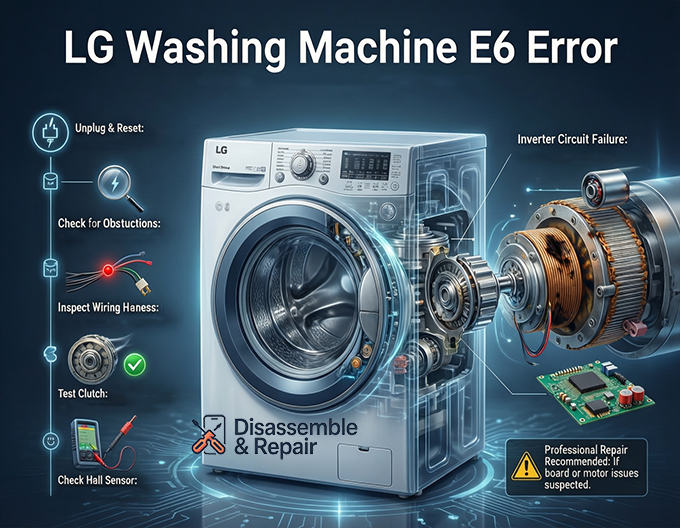
The LG washing machine E6 error is a diagnostic code that usually appears on top-loading models. It specifically indicates a problem with the Clutch Assembly or a high-current situation in the motor caused by a mechanical jam.
Unlike the “LE” error, which signifies a locked motor, the E6 code often points to the mechanism responsible for shifting the washer between agitation and spin modes. When the Main Control Board sends a signal to the clutch to engage but does not receive the correct feedback—or if it detects excessive resistance—it triggers the E6 code to prevent damage to the internal components.
The Role of the Direct Drive System
Modern LG washers often utilize a Direct Drive Motor, which eliminates the need for belts and pulleys. In this system, the Rotor Assembly connects directly to the tub. The E6 error in these units suggests that the motor is straining against an obstruction or that the clutch is stuck, preventing the Washer Drum from rotating freely.
Common Causes of the E6 Error Code
Before attempting any disassembly, it is vital to identify the potential culprits. The error is rarely random; it is usually triggered by one of the following issues:
1. Foreign Object Obstruction
The most frequent cause of an E6 error is a physical jam. Coins, buttons, underwires, or small articles of clothing can slip between the Washer Drum (the inner tub) and the pulsator (the bottom plate). This obstruction prevents the drum from spinning, causing the motor to overheat and the system to throw the error.
Read more LG washing machine iE error
2. Faulty Clutch Assembly
The Clutch Assembly is the mechanical heart of the transmission. It engages the tub for spinning and disengages it for agitation. If the clutch gears are worn, broken, or if the actuator motor fails, the washer cannot shift modes, resulting in the E6 code.
3. Wiring and Electrical Issues
A damaged Wiring Harness can disrupt communication between the motor, the clutch, and the control board. Rodent damage, corrosion, or loose connections can cause intermittent E6 errors.
4. Defective Hall Sensor (Motor Tachometer)
The Hall Sensor, also known as the Motor Tachometer, monitors the speed and position of the rotor. If this sensor fails, the Inverter on the control board cannot determine the motor’s status. While this often triggers an LE code, it can contribute to an E6 error if the board perceives the lack of data as a clutch failure.
Read more LG washing machine drum dirty residue
5. Main Control Board Failure
In rare cases, the Main Control Board itself may be the issue. If the board’s relays are stuck or its logic processor is damaged, it may falsely report an error or fail to send the necessary voltage to the clutch motor.
Step-by-Step Troubleshooting Guide
Follow these steps to diagnose and potentially fix the issue. Ensure the appliance is unplugged before touching any internal components to avoid electric shock.
Step 1: Perform an Error Code Reset
Sometimes, the E6 error is a “glitch” caused by a temporary power spike or logic confusion.
- Unplug the washing machine.
- Press and hold the Start/Pause button for 5 seconds to dissipate residual power.
- Plug the machine back in.
- Run a “Rinse + Spin” cycle to test if the code returns.
If the error persists, proceed to physical inspection.
Step 2: Inspect for Obstructions
Since a jammed tub is the most likely cause:
- Open the lid and remove all laundry.
- Use a flashlight to inspect the gap between the pulsator and the Washer Drum.
- Try to rotate the drum by hand. It should move relatively freely. If it feels stuck or makes a grinding noise, an object is likely wedged underneath.
- You may need to remove the pulsator cap and unscrew the pulsator to access and remove the foreign object.
Step 3: Check the Wiring Harness
Remove the back panel or top cover (depending on your model) to expose the motor and clutch area.
- Trace the Wiring Harness from the Main Control Board down to the motor and clutch.
- Look for pinched wires, burnt connectors, or signs of wear.
- Ensure all plugs are seated firmly. A loose connection to the clutch motor is a common trigger for the E6 error.
Step 4: Test the Clutch Assembly
If the drum spins freely by hand but the machine won’t spin during a cycle, the Clutch Assembly is suspect.
Read more LG front load washing machine not filling with water
- Observe the clutch motor during a cycle start. You should hear a distinct click or hum as it engages.
- If the clutch motor receives power (verified with a multimeter) but does not move, the assembly typically needs replacement.
- Inspect the plastic gears on the clutch for stripped teeth.
Step 5: Inspect the Stator and Rotor Assembly
If you have a multimeter and are comfortable with Appliance Repair, you can inspect the motor components.
- Remove the Rotor Assembly (the large metal saucer at the back/bottom). Check the magnets for cracks.
- Inspect the Stator (the stationary coils). Look for burnt windings or melted plastic.
- Measure the resistance of the Hall Sensor attached to the stator. If the readings are outside the manufacturer’s specifications (usually 10-15k ohms), the sensor must be replaced.
Advanced Diagnosis: The Inverter and Control Board
If the mechanical components (clutch, drum, motor) are functioning correctly, the issue may lie in the electronic control system.
The Main Control Board contains an Inverter circuit that manages the power frequency sent to the Direct Drive Motor. If this circuit overheats or fails, it cannot control the motor speed, potentially leading to E6 or motor overload errors.
- Visual Inspection: Look for blackened components or swollen capacitors on the main board.
- Replacement: Board repair is difficult; replacing the entire unit is the standard solution for a confirmed board failure.
When to Contact Professional Appliance Repair
While many users can clear a coin jam or reset the machine, diagnosing electrical faults within the Stator or replacing a Clutch Assembly can be challenging. You should consider hiring a professional if:
- You do not have the proper tools (multimeter, large socket wrenches for the rotor).
- The machine is still under warranty (DIY repairs may void it).
- You suspect the Main Control Board is the issue, as these parts are expensive and non-returnable if misdiagnosed.
Preventive Maintenance
To prevent the recurrence of the LG washing machine E6 error, adopt these maintenance habits:
- Check Pockets: Always empty pockets of coins, keys, and pins before washing. These are the primary destroyers of clutch assemblies and drain pumps.
- Avoid Overloading: Stuffing the Washer Drum beyond capacity strains the motor and clutch, leading to premature failure and overheating.
- Use High-Efficiency Detergent: Excess suds can create drag on the drum, confusing the Hall Sensor and overworking the motor.
Conclusion
The LG washing machine E6 error is a protective mechanism designed to save your appliance from severe damage. By systematically checking for jams, verifying the integrity of the Clutch Assembly, and inspecting electrical connections like the Wiring Harness, you can often resolve the issue without buying a new machine. Whether it requires a simple removal of a stray coin or the replacement of the Direct Drive Motor components, understanding these systems empowers you to make informed repair decisions.
Frequently Asked Questions
What does the E6 error code specifically mean on an LG washer?
The E6 error code indicates a problem with the clutch assembly or a high-current situation in the motor. This usually happens when the machine cannot successfully shift between agitation and spin modes, or when a mechanical jam prevents the drum from rotating, causing the motor to work too hard and overheat.
How can I perform a hard reset to clear the E6 error?
To reset the electronics, unplug the washing machine from the power outlet. Press and hold the Start/Pause button for approximately 5 seconds to dissipate any remaining electrical charge. Plug the machine back in and attempt to run a “Rinse + Spin” cycle to see if the code has cleared.
Can a simple coin cause my LG washing machine to show an E6 error?
Yes, foreign objects are the most common cause of this error. Items like coins, buttons, or bra wires can get lodged between the pulsator plate and the washer drum. This creates physical resistance that prevents the motor from turning, triggering the E6 code as a protective measure to prevent the motor from burning out.
What is the difference between the E6 error and the LE error?
While both codes involve the drive system, they point to different issues. The LE error (Locked Motor) typically signifies that the motor cannot rotate at all, often due to a heavy overload or a faulty Hall sensor. The E6 error is more specifically tied to the clutch mechanism failing to engage or the motor drawing too much current due to a mechanical obstruction.
Do I need to replace the motor if I see an E6 error?
Not necessarily. Before considering a motor replacement, you should check for physical obstructions, inspect the wiring harness for loose connections, and test the clutch assembly. In many cases, the issue is a simple jam or a faulty clutch motor rather than a failure of the main Direct Drive Motor or Stator.