
Discovering that your LG washing machine not filling with water is a major inconvenience that can disrupt your entire household routine. Whether the cycle simply refuses to start or the machine hums without introducing any water, identifying the root cause is the first step toward a solution. Modern LG appliances are sophisticated, but they rely on fundamental hydraulic and electrical principles to operate. When these systems fail, the issue is usually traceable to specific components ranging from simple clogged filters to complex electronic failures.
This guide provides a professional, step-by-step analysis of the potential issues causing your appliance to malfunction. By examining critical entities such as the water inlet valve, pressure switches, and control boards, you can determine if this is a DIY fix or if professional intervention is required.
Understanding the “IE” Error Code
Before dismantling the machine, it is vital to look for the digital diagnostic clues LG provides. In many cases of an LG washing machine not filling, the display will show an “IE” error code. This stands for “Inlet Error.”
The IE code triggers when the water level sensor does not detect the target water level within a specific time limit usually around 8 minutes. While this code confirms the symptom, it does not pinpoint the exact mechanical failure. It essentially tells you that the water supply is restricted, the valve is not opening, or the sensor itself is providing false data.
Common Causes for an LG Washing Machine Not Filling
When diagnosing this issue, it is best to start with external factors and move toward internal mechanical components. The following sections detail the most frequent culprits.
1. Water Supply Hoses and Water Pressure
The most overlooked reasons for filling issues are often the simplest. Before testing internal electronics, you must verify the external water supply.
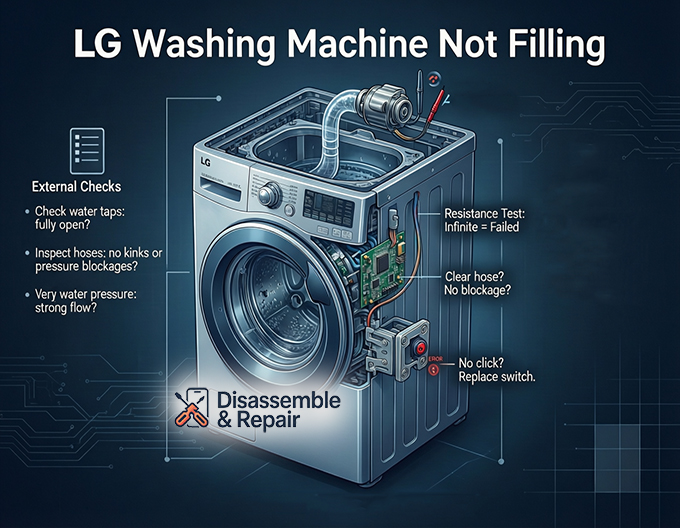
- Inspect the Hoses: Check your water supply hoses for kinks, twists, or heavy objects resting on them. A severe kink can completely restrict water flow.
- Verify Tap Status: Ensure that the hot and cold water taps behind the washer are fully open. Sometimes, vibrations can cause a valve to partially close over time.
- Check Water Pressure: Your home’s water pressure must be adequate for the inlet valve to function. If you recently had plumbing work done, debris might be clogging the lines, or the pressure might be too low to push the internal valve open.
2. Clogged Inlet Filter Screens
If your water pressure is good but the machine is still struggling, the obstruction is likely at the connection point. LG washing machines are equipped with small mesh inlet filter screens located inside the water inlet valve connections. These screens are designed to catch sediment and debris from your water pipes.
Over time, calcium deposits (in hard water areas) or sediment can clog these screens, mimicking a valve failure.
How to check:
- Turn off the water taps.
- Unscrew the supply hoses from the back of the machine.
- Use a flashlight to look inside the threaded ports.
- If the mesh looks dirty, use needle-nose pliers to gently pull the screens out and rinse them under warm water.
3. Faulty Water Inlet Valve
If the water supply is on and the filters are clean, the water inlet valve is the next primary suspect. This component acts as the gatekeeper for your washing machine. It connects to the hot and cold hoses and uses electrical solenoids to open and close internal gates, allowing water to enter the tub.
The assembly typically consists of a solenoid valve mechanism. When the cycle starts, the main control board sends a voltage signal to the solenoid. This creates a magnetic field that lifts a plunger, opening the valve.
Symptoms of failure:
- Humming noise: You hear a buzz, but no water enters. This suggests the solenoid is energized but mechanically stuck.
- Silence: If there is no noise and no water, the solenoid coils may have failed electrically (open circuit).
To confirm this, a technician would use a multimeter to check the resistance of the solenoid coils. If the reading indicates an “open line” (infinite resistance), the water inlet valve assembly must be replaced.
4. Malfunctioning Water Level Sensor (Pressure Switch)
The water level sensor, often referred to as the pressure switch, is the component responsible for telling the control board how much water is in the drum. It operates using a small air tube connected to the bottom of the tub. As water rises, air pressure increases in the tube, triggering the switch.
If this system fails, two scenarios can occur:
- False Full Reading: The sensor “thinks” the tub is already full of water. Consequently, the control board will not send power to the inlet valves to prevent an overflow.
- Tube Blockage: If the air tube is clogged with lint or debris, the pressure switch cannot detect rising water, potentially causing an overflow or an error code.
Inspection involves checking the air tube for holes or kinks and using a multimeter to test the electrical continuity of the pressure switch.
5. Door Latch Assembly or Lid Switch Issues
Modern LG washers are equipped with safety mechanisms that prevent the machine from filling or spinning if the door is not securely locked.
- Front Loaders: The door latch assembly signals the control board that the door is closed and locked. If the mechanical latch is broken or the electrical switch inside is faulty, the machine will not initiate the fill cycle because it assumes the door is open.
- Top Loaders: These utilize a lid switch. If the plastic striker on the lid is broken or the switch mechanism is defective, the machine will remain silent.
If you cannot hear the distinct “click” of the door locking at the start of the cycle, or if the “Door Lock” light does not illuminate, the issue likely lies here rather than with the water supply.
6. Issues with the Main Control Board
The main control board is the brain of the appliance. It dictates every function, from filling and washing to draining and spinning. If you have verified that the water pressure is good, the inlet valves are functional, and the sensors are working, the problem may be the board itself.
Read more LG washing machine no power no lights
In this scenario, the board fails to send the necessary voltage to the water inlet valve solenoids. This is difficult to diagnose without advanced electrical knowledge. Look for signs of burn marks on the circuit board or loose wire harnesses. If the board is not sending power, it will require replacement.
7. Premature Draining (Siphoning)
In rare cases, it may appear that the machine is not filling, when in reality, it is filling and draining simultaneously. This is often caused by improper installation of the drain hose.
If the drain hose is pushed too far down into the standpipe, or if the end of the hose is lower than the water level in the drum, a siphoning effect occurs. Gravity pulls the water out through the drain pump system as fast as it enters. Ensure your drain hose is elevated properly and there is an air gap at the standpipe.
Step-by-Step Diagnostic Workflow
To systematically resolve the issue of an LG washing machine not filling, follow this professional workflow. Always ensure the machine is unplugged before performing any disassembly or electrical testing.
Read more LG washing machine error code list
Phase 1: External Verification
- Reset the Machine: Unplug the washer for 60 seconds and plug it back in to reset the microprocessor.
- Verify Flow: Disconnect hoses at the machine end and spray into a bucket to verify strong water pressure.
- Clean Filters: Inspect the inlet filter screens for sediment.
Phase 2: Internal Component Testing
If Phase 1 fails, access the internal components (removal of the top panel or back cover is usually required).
- Test the Solenoids: Locate the water inlet valve. Set your multimeter to Ohms/Resistance. Test the terminals on the solenoid valve. A reading of infinity indicates a failed valve.
- Check the Pressure Switch: Locate the water level sensor. Ensure the clear plastic hose connecting to it is not pinched or filled with water. Blow through the hose to ensure it is clear of obstructions.
- Inspect Door Safety: Check the continuity of the lid switch or door latch assembly. If the circuit is open when the door is closed, the part needs replacement.
When to Call a Professional
While cleaning inlet filter screens is a standard homeowner maintenance task, dealing with the main control board, drain pump wiring, or swapping out a water inlet valve requires a certain level of technical aptitude.
You should consider hiring a certified LG repair technician if:
- You are uncomfortable using a multimeter to test live voltage or resistance.
- The machine is still under warranty (DIY repairs may void this).
- The error persists after replacing the inlet valve and pressure switch.
Conclusion
An LG washing machine not filling is rarely a catastrophic failure of the entire unit. In the vast majority of cases, the issue is isolated to a specific component restricting water flow or a sensor providing incorrect data. By systematically checking the water supply hoses, cleaning the inlet filter screens, and verifying the integrity of the water inlet valve and pressure switch, you can often resolve the issue without the need for a costly replacement of the entire appliance.
Regular maintenance, such as checking filter screens every few months and inspecting hoses for wear, can prevent many of these issues from recurring. If the problem leads you to the main electronics or the door latch assembly, sourcing OEM (Original Equipment Manufacturer) parts is crucial for ensuring the longevity and safety of your repair.
Frequently Asked Questions
What does the “IE” error code on my LG washing machine mean?
The “IE” code stands for “Inlet Error.” This diagnostic code is triggered when the washing machine’s water level sensor fails to detect the required amount of water within a specific timeframe, usually around 8 minutes. It indicates that water flow is either restricted, the inlet valve is not opening, or the sensor itself is malfunctioning.
Why is my LG washer humming but no water is entering the tub?
A humming or buzzing sound typically indicates that the water inlet valve’s solenoid is receiving electrical power but is mechanically stuck or blocked. This prevents the valve from opening to allow water through. If you hear this noise, you should check for clogged inlet filter screens or prepare to replace the water inlet valve assembly.
How often should I clean the inlet filter screens?
While the frequency depends on the water quality in your area, it is recommended to inspect and clean the mesh filter screens every few months, especially if you have hard water or live in an area with high sediment. Keeping these screens clear prevents the “IE” error and ensures the machine fills at the proper speed.
Can a faulty door latch stop the machine from filling with water?
Yes. Modern LG washing machines are designed with safety protocols that prevent the fill cycle from starting if the door (front loaders) or lid (top loaders) is not securely closed and locked. If the door latch assembly or lid switch is defective, the control board will not receive the “locked” signal and will refuse to initiate the water intake.
Read more How to calibrate LG front load washer
What is “siphoning,” and how does it affect the filling process?
Siphoning occurs when the drain hose is installed incorrectly, such as being pushed too far down into the standpipe or being positioned lower than the water level in the drum. This creates a gravity-fed vacuum that pulls water out of the machine as fast as it enters, making it appear as though the machine is failing to fill. Check that your drain hose has an air gap and is properly elevated.