
It can be alarming to watch your laundry appliance malfunction, especially when you see your LG washing machine water not stopping even after the tub has reached the appropriate level. This specific issue not only wastes water but can lead to potential flooding and damage to your home if left unaddressed.
If you are facing an overfilling drum or water that continues to flow even when the machine is turned off, you are likely dealing with a failure in one of the machine’s water regulation components. This guide will walk you through the technical causes—ranging from a stuck water inlet valve to a faulty pressure sensor—and provide actionable steps to diagnose and resolve the problem.
Understanding the Filling Cycle
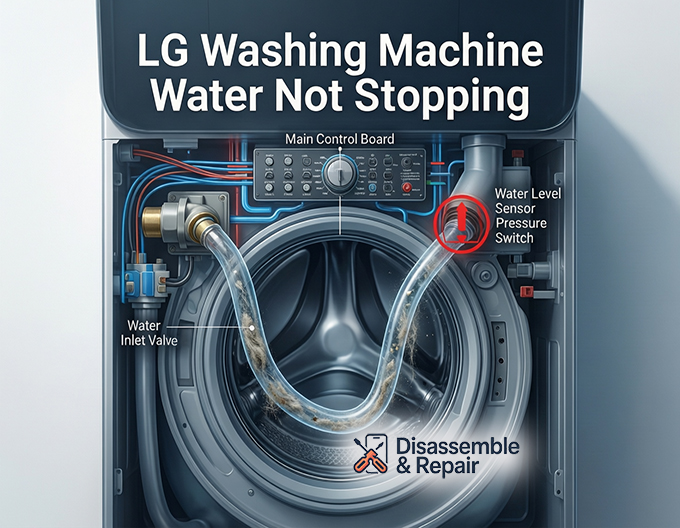
To diagnose why the water isn’t stopping, it helps to understand how your LG washer decides when to stop filling. The process involves three main components working in unison:
- The Main Control Board: The “brain” that sends an electrical signal to open the water valves.
- The Water Inlet Valve (Solenoid Valve): The physical gate that opens to let water in and closes to stop it.
- The Water Level Sensor (Pressure Switch): The device that monitors how much water is in the drum and tells the control board when the correct level is reached.
When any link in this chain breaks, the water flow may become uncontrolled.
1. The Water Inlet Valve: The Most Common Culprit
The water inlet valve is the point where your home’s water supply connects to the washing machine. It utilizes a solenoid valve—an electromagnetically operated valve—to control the flow.
Mechanical Failure
Over time, mineral deposits and debris from your water supply can build up inside the valve assembly. If a piece of sediment gets lodged in the diaphragm, or if the internal spring loses tension, the valve may physically get stuck in the “open” position.
- symptom: The machine continues to fill with water even when you unplug it from the wall. Because the valve is mechanically jammed, cutting the power does not close it.
- Solution: You must replace the water inlet valve assembly. It is not recommended to clean these valves as they are precision components; once compromised, they are prone to leaking again.
Electrical Failure
In rarer cases, the solenoid coils can fail, or the main control board might be sending a continuous voltage signal to the valve due to a short circuit, keeping it open when it should be closed.
2. The Pressure Switch and Air System
The pressure switch, also known as the water level sensor or pressure sensor, is responsible for measuring the water level. It does this via a clear tube connected to a tub pressure chamber at the bottom of the drum. As water rises, air is compressed in the chamber and pushed up the tube, triggering the sensor.
Blockages in the Tub Pressure Chamber
If the tub pressure chamber or the small hose connecting it to the sensor becomes clogged with lint, soap scum, or mold (often referred to as “gunk”), the air pressure cannot travel up to the sensor.
- Result: The sensor “thinks” the tub is empty, so it keeps telling the control board to add more water, leading to overfilling.
- Maintenance: You can often clear this by disconnecting the hose from the sensor end and blowing air through it (towards the tub) to dislodge blockages.
Faulty Pressure Sensor
If the sensor itself has failed internally, it may send erratic signals or no signal at all. This often triggers the LG FE error code (Fill Error) or the PE error code (Pressure Sensor Error).
- LG washer FE error code: Indicates the water level has gotten too high. The drain pump may automatically turn on to prevent flooding.
- LG washer PE error code: Indicates the sensor is not reporting valid data to the board.
3. Siphoning: The Silent Drain Issue
Sometimes, the issue isn’t that the water valve is stuck open, but that water is entering and leaving the machine simultaneously, confusing the sensors. This is known as siphoning.
Check Your Drain Hose Height
For the washer to hold water, the drain hose must be installed correctly. If the drain hose is pushed too far down into the standpipe or if the outlet is lower than the water level in the drum, gravity will pull water out as fast as it fills.
- Rule of Thumb: Ensure the drain hose height is correct. For most LG models, the end of the drain hose should be at least 29 inches (approx. 74 cm) off the ground but no higher than 96 inches.
- The Air Gap: There must be an air gap around the drain hose where it enters the standpipe. If you tape the hose to the pipe to create an airtight seal, the suction will siphon water out of the machine constantly.
Step-by-Step Troubleshooting
Safety First
Before testing internal components, always unplug the machine to avoid electric shock. If the machine is overfilling rapidly, turn off the water supply taps on the wall immediately.
Step 1: The “Unplug” Test
This is the easiest way to determine if you have a mechanical or electrical problem.
Read more LG washer leaking water into drum
- Start a cycle and let the water run.
- While it is filling, unplug the washing machine.
- Observation:
- If the water stops: The valve is mechanically fine. The issue is likely electrical (bad water level sensor, main control board, or wiring).
- If the water continues to flow: You have a mechanically failed water inlet valve. It is stuck open and needs replacement.
Step 2: Check for Error Codes
Look at the digital display.
- FE (Fill Error): This confirms the machine detects overfilling. If the Unplug Test stopped the water, inspect the pressure sensor and its hose.
- PE (Pressure Error): This points directly to the pressure switch. Check the wiring harness connecting to the sensor and ensure the sensor itself is not corroded.
Step 3: Inspect the Pressure Hose
Remove the top panel of the washer (usually held by screws at the back). Locate the pressure switch (a round disc with a small tube attached, usually near the top side).
- Inspect the hose for kinks, holes, or disconnection.
- Remove the hose from the switch and blow through it. You should feel air passing freely into the tub. If you feel strong resistance, the tub pressure chamber is blocked.
Step 4: Testing the Solenoid Valve (Advanced)
If you suspect an electrical fault but no error codes are present, you can test the solenoid valve coils with a multimeter.
Read more LG washing machine not filling
- Set the multimeter to verify resistance (Ohms).
- Disconnect the wire harness from the valve.
- Touch the probes to the terminals. A functional valve usually reads between 500 to 1500 Ohms (check your specific model’s manual). An “Open” (infinite) reading indicates a burnt-out coil.
Conclusion
Resolving an LG washing machine water not stopping issue requires a systematic approach. In the majority of cases, a mechanical failure of the water inlet valve is the culprit, requiring a simple part swap. However, ignoring the signs of a blocked tub pressure chamber or an improperly installed drain hose can lead to recurring overfilling issues. By isolating the problem using the “Unplug Test” and understanding the roles of the solenoid valve and pressure switch, you can restore your appliance to perfect working order.
Frequently Asked Questions
Why does my LG washer keep filling with water even after I unplug it?
If the water continues to flow while the machine is unplugged, the water inlet valve has suffered a mechanical failure. This usually means the internal valve is physically jammed open by mineral deposits or debris. Since the valve cannot close mechanically, cutting the power will not stop the water; you must turn off the water supply at the wall and replace the valve assembly.
Read more LG washing machine sound problem
What is the “Unplug Test” and how does it help diagnose the problem?
The Unplug Test is a simple way to determine if your issue is electrical or mechanical. While the machine is actively filling with water, pull the power cord from the wall. If the water stops immediately, the problem is electrical (such as a faulty pressure sensor or control board). If the water keeps running, the problem is a mechanically stuck water inlet valve.
What should I do if my LG washer displays an FE or PE error code?
An FE (Fill Error) code means the machine has detected that the water level is too high, often triggering the drain pump to prevent a flood. A PE (Pressure Error) code indicates the pressure sensor is not communicating correctly with the control board. In both cases, you should inspect the pressure sensor hose for clogs or kinks and ensure the sensor itself is functioning properly.
How can the height of the drain hose cause the machine to overfill?
If the drain hose is installed too low (less than 29 inches from the floor) or pushed too far into the standpipe without an air gap, a siphoning effect occurs. Gravity pulls the water out of the machine as it fills, preventing the water level from ever reaching the pressure sensor. This causes the machine to keep adding water indefinitely because it “thinks” the tub is still empty.
Can I fix a clogged pressure sensor hose myself?
Yes. You can often resolve “gunk” or soap scum build-up by removing the top panel of the washer, disconnecting the small clear hose from the pressure switch, and blowing air through the tube toward the tub. If you feel resistance and then a “pop” followed by clear airflow, you have likely cleared the obstruction that was preventing the sensor from detecting the water level.