
Few kitchen appliances are as essential as the microwave, making it incredibly frustrating when it malfunctions. If you find your Microwave Not Heating Food, it is crucial to understand the underlying mechanical or electrical failures before attempting a repair. This guide provides a professional breakdown of the components involved, safety protocols, and diagnostic steps to resolve the issue.
Safety warning: Read before proceeding
Before delving into the internal mechanics of your appliance, it is imperative to address safety. Microwave repair differs significantly from other household fixes. Unlike a toaster or a blender, a microwave contains a High Voltage Capacitor that can store a lethal amount of electricity even after the unit has been unplugged for days.
Do not attempt to touch internal components without performing a Capacitor Discharge.
To discharge the capacitor safely, professionals use a discharge tool (often a resistor probe) to neutralize the stored energy. Furthermore, the Magnetron and other high-voltage components generate Microwave Radiation. If the unit is reassembled incorrectly or shielding is damaged, it can pose a health hazard. If you are uncomfortable with high-voltage electricity, contact a certified Appliance Repair technician immediately.
Diagnostics: Primary causes for a microwave Not heating food
When a microwave runs—meaning the light turns on and the turntable spins—but the food remains cold, the issue usually lies within the high-voltage circuit. Below are the specific components responsible for this failure.
1. The magnetron
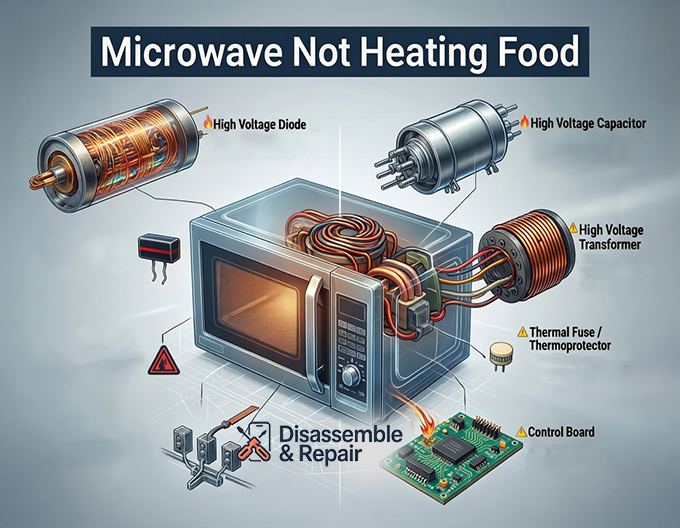
The Magnetron is the heart of the microwave. It is the vacuum tube oscillator responsible for generating the specific frequency of microwave energy that vibrates water molecules to cook food. Because the magnetron operates under extreme stress and heat, it has a finite lifespan.
When a magnetron fails, the microwave may still sound like it is running, or it might emit a loud, low-pitched humming or buzzing noise. In some cases, a “burned” electrical smell may be present. If the magnetron has burned out, it cannot be repaired; it must be replaced. A visual inspection might reveal cracked magnets or scorched terminals, but often the failure is internal.
2. High voltage diode
The High Voltage Diode acts as a specialized electrical check valve. It works in tandem with the capacitor to convert the standard alternating current (AC) output from the transformer into the direct current (DC) required by the magnetron. This effectively doubles the voltage to nearly 5,000 volts, powering the magnetron to high levels.
If the diode shorts out, the voltage will not double, and the magnetron will not receive enough power to oscillate. A shorted diode often produces a distinct burning rubber smell and can cause the microwave to hum loudly. This is one of the most common and inexpensive parts to replace when troubleshooting heating issues.
3. Door interlock switches
Microwaves are equipped with three or four Door Interlock Switch mechanisms. These are safety devices designed to ensure Microwave Radiation is not generated while the door is open. When you close the door, the latch physically depresses these switches to complete the electrical circuit.
Over time, the plastic hooks on the door latch can wear down, or the switches themselves can suffer from arcing and carbon buildup. If the specific switch dedicated to the high-voltage circuit fails, the control panel may still light up and the fan may run, but the heating components will never engage. This leads to the baffling scenario where everything seems normal, except for the lack of heat.
4. High voltage capacitor
The High Voltage Capacitor works with the diode to create the high voltage required by the magnetron. If the capacitor is defective, the entire high-voltage circuit fails to function.
A capacitor generally fails in one of two ways: it either shorts out or becomes an “open” circuit. A shorted capacitor can cause the main fuse of the microwave to blow instantly. An open capacitor, however, will allow the low-voltage functions (lights, turntable) to operate while preventing heat generation. Testing this component requires a Multimeter with capacitance capabilities, and again, requires strict adherence to discharge safety protocols.
5. High voltage transformer
The High Voltage Transformer is responsible for taking standard household voltage (120V or 240V) and stepping it up to the thousands of volts needed for the magnetron. Transformers are heavy, robust components, and while they can fail, it is statistically less common than diode or switch failures.
If the transformer shorts, it will typically produce a very loud buzzing sound and a strong burning odor. In many cases, it will trip the house circuit breaker or blow the microwave’s internal fuse. Due to the cost and complexity of replacing a transformer, this failure often necessitates replacing the entire microwave unit.
6. Thermal fuse or thermoprotector
Microwaves contain safety devices known as Thermal Fuses or cavity thermoprotectors. These are designed to cut power to the unit if it overheats to prevent fire hazards.
If a thermal fuse blows, it usually cuts power to the entire unit, making the display go dark. However, in some circuit designs, a specific cut-out might only disable the heating element while leaving the control board active. If your ventilation fan is blocked or the kitchen is extremely hot, a thermal fuse may trip. Unlike a standard fuse, a thermal fuse cannot be reset; it must be replaced once continuity is lost.
7. Control board
The Control Board is the brain of the appliance. It controls the relays that send voltage to the high-voltage transformer. If the relay on the board responsible for the heating cycle fails, no voltage will be sent to the transformer, regardless of the condition of the magnetron or capacitor.
Diagnosing a control board issue is usually a process of elimination. If all other high-voltage components test fine, the issue likely stems from the board not sending the initial signal.
Steps for professional diagnosis
To accurately identify which component is causing the failure, you will need a digital Multimeter. The primary method of testing is Continuity Testing, which determines if a continuous electrical path exists through a part.
Step 1: Preparation and discharge
Unplug the microwave and remove the outer cabinet. Immediately locate the High Voltage Capacitor and perform a Capacitor Discharge. Do not touch any terminals until this is done.
Step 2: Testing the switches
Locate the Door Interlock Switches. With the door open and closed, use your multimeter to check for continuity. The switches should alternate between having continuity (0 ohms/beep) and no continuity (infinity) as the button is depressed. If a switch shows no continuity when depressed, it is defective.
Step 3: Testing the diode
The High Voltage Diode can be tricky to test with a standard multimeter because it requires a higher voltage to “open” than the meter usually provides. However, some meters can test it on the diode setting. It should show continuity in one direction and no continuity when the probes are reversed. If it shows continuity in both directions, it is shorted. If it shows infinite resistance in both directions, it is likely open.
Step 4: Testing the magnetron
Disconnect the wires to the Magnetron. Place your multimeter probes on the two terminals. You should see a low resistance reading (usually between 2 and 3 ohms). If the reading is zero or infinity, the filament is damaged. Next, touch one probe to a terminal and the other to the metal casing of the magnetron. The meter should read “OL” (Open Loop) or infinity. If you get a reading, the magnetron is shorted to the ground and is defective.
Step 5: Testing the fuse
Locate the Thermal Fuse and the ceramic fuse. Perform a simple continuity test. If the meter does not beep or register near-zero resistance, the fuse has blown and must be replaced. Note that a blown fuse is often a symptom of a different problem (like a shorted switch or capacitor), not just the root cause.
Repair vs. Replace: Making the right decision
Deciding whether to repair a unit with a Microwave Not Heating Food depends on the cost of parts versus the age of the appliance.
- Low Cost / DIY Friendly: Door switches, high voltage diodes, and fuses are generally inexpensive and relatively easy to replace for those with electrical knowledge.
- Moderate Cost: A magnetron is a mid-range expense. If the microwave is a high-end built-in model, replacing the magnetron is cost-effective. For a cheap countertop model, it may not be worth it.
- High Cost: If the High Voltage Transformer or the main Control Board has failed, the part cost combined with labor often exceeds the price of a new microwave.
Conclusion
A microwave that spins and lights up but fails to heat is almost always suffering from a failure in the high-voltage generation circuit. Whether the culprit is a $10 High Voltage Diode or a $50 Magnetron, accurate diagnosis is key.
However, the importance of safety cannot be overstated. The presence of the High Voltage Capacitor makes this one of the most dangerous home appliances to service. If you possess the necessary tools like a Multimeter and understand how to safely perform a Capacitor Discharge, you can likely resolve the issue. If not, professional Appliance Repair is the safest route to getting your kitchen back in working order.
Frequently asked questions
Is it safe to open my microwave as long as it is unplugged?
No. Unlike many other household appliances, a microwave contains a High Voltage Capacitor that can store a lethal amount of electricity even after the unit has been unplugged for several days. You should never attempt to touch or repair internal components without first performing a proper capacitor discharge using a specialized tool.
What is the most likely cause if my microwave runs and spins but the food stays cold?
This is typically caused by a failure in the high-voltage circuit. The most common culprits are a burned-out magnetron (the part that generates heat), a shorted high-voltage diode, or a faulty door interlock switch. A failing diode often produces a loud humming noise or a burning smell, while a magnetron failure may be silent or accompanied by a buzzing sound.
Why does the microwave still turn on if the door switches are broken?
Microwaves are equipped with three or four different door interlock switches. Some of these switches control the interior light and the turntable motor, while others are dedicated strictly to the high-voltage heating circuit. If only the heating-circuit switch fails or is not properly engaged by the door latch, the microwave will appear to function normally even though it isn’t producing any heat.
How do I know if it is worth repairing my microwave or if I should buy a new one?
The decision generally depends on the cost of the failing part. Inexpensive components like door switches, high-voltage diodes, and thermal fuses are worth replacing. However, if the high-voltage transformer or the main control board has failed, the cost of the part and professional labor will often exceed the price of a brand-new microwave, making replacement the more logical choice.