
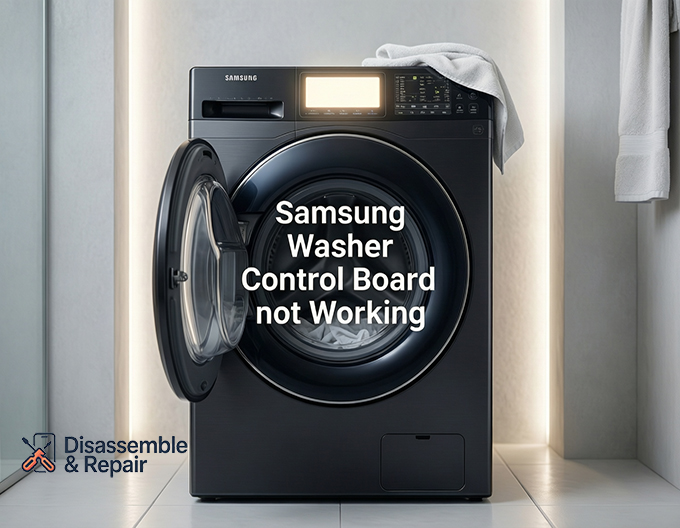
If you find your Samsung washer control board not working, it can immediately bring your household laundry routine to a frustrating halt. This central component acts as the “brain” of your appliance, sending signals to the motor, pump, and inlet valves to execute washing cycles; without it, the machine is essentially a metal box. In this guide, we will explore the symptoms of a failed Printed Circuit Board (PCB), how to use a multimeter for testing, and the steps required to replace the unit in both front load and top load washers.
Understanding the Electronic Control Module
Before diving into repairs, it is essential to understand what you are dealing with. Modern Samsung washing machines rely on a sophisticated Electronic Control Module. This is often confused with the User Interface Board, which is the component housing the buttons and display screen.
Read more Samsung washing machine NF error
While the User Interface Board accepts your commands, the main control board processes them and distributes electricity to the correct components via the wiring harness. When a Samsung washer control board not working issue arises, it is usually due to a failure in the main PCB, though communication errors between the interface and the main board are also common.
Common Symptoms of Failure
Identifying a failing control board can be tricky because the symptoms often mimic other mechanical failures. However, the following signs point directly to the PCB:
- The Washer Will Not Start: The machine has power (the outlet works), but the display is blank, or the machine refuses to initiate a cycle.
- Erratic Behavior: The washer skips cycles, stops mid-cycle, or the timer jumps unpredictably.
- Burning Smell: A distinct smell of burnt plastic or electronics often indicates a short circuit on the board.
- Non-Responsive Buttons: You press “Start” or change the cycle, but the machine does not register the input.
- Phantom Operation: The washer turns on or beeps by itself when not in use.
Why Is Your Samsung Washer Control Board Not Working?
There are several reasons why this component fails. Understanding these can help you prevent future issues after a repair.
Read more Samsung washing machine 3C2 error
- Power Surges: The most common cause is an electrical spike. If your home experiences a surge, the sensitive electronics on the PCB can be fried instantly.
- Moisture and Corrosion: Washing machines are humid environments. If the protective coating on the board fails, moisture can corrode the copper traces or damage a relay switch.
- Vibration: Over time, the aggressive spinning of the washer can loosen connections in the wiring harness or cause hairline cracks in the solder joints of the board.
- Component Failure: Individual components on the board, such as capacitors or the power supply transformer, have a limited lifespan and can fail due to age.
interpreting Samsung Washer Error Codes
Samsung washers are designed to self-diagnose. When the control board detects an anomaly, it usually displays an error code. While codes like “4E” (water supply) or “5E” (drainage) point to mechanical parts, specific codes suggest board failure:
- AC6 or AE: Communication errors between the main PCB and the inverter board.
- BE2 or BE: Often relates to a jammed button on the User Interface Board or a short in the main control.
- E-47: This frequently indicates a problem with the PCB sensing the door lock mechanism.
- 8E: Overcurrent error, often linked to the main board or MEMS sensor.
If you receive these codes and have verified that the peripheral devices (like the door lock or motor) are functional, the main control board is likely the culprit.
Diagnostic Phase: Visual Inspection and Reset
Before ordering a replacement, perform a hard reset and a visual inspection.
The Power Reset
Sometimes, the electronic control module simply experiences a “glitch” due to static electricity.
- Unplug the washer from the wall outlet.
- Hold down the “Start/Pause” button for 5 seconds to discharge any residual electricity in the capacitors.
- Wait for 5 minutes.
- Plug the washer back in and attempt to run a cycle.
Visual Inspection of the PCB
If the reset fails, you must inspect the board physically.
- Safety First: Unplug the machine.
- Access the Board: For a top load washer, the board is usually in the control console (accessible from the back). For a front load washer, remove the top panel by unscrewing the screws at the rear.
- Examine the Enclosure: Locate the plastic casing housing the PCB.
- Look for Damage: Open the casing and inspect the board for blackened areas, melted plastic, leaking capacitors (cylindrical components that may look swollen), or broken traces.
Technical Testing: Multimeter Testing and Continuity
For a definitive diagnosis, you need to move beyond visual cues. This requires multimeter testing. You will be checking for input voltage and continuity.
Warning: Testing live voltage is dangerous. If you are uncomfortable working with electricity, hire a professional. For most tests, we recommend unplugging the machine and testing for continuity and resistance first.
Testing the Fuse and Continuity
Most main control boards have a fuse. If this is blown, the board will not power up.
- Set your multimeter to the Continuity (audible beep) mode.
- Locate the fuse on the board.
- Touch the probes to both ends of the fuse.
- Result: If it beeps, the fuse is good. If there is no sound, the fuse is blown, and the board (or the fuse, if replaceable) needs changing.
Checking Power Supply Voltage
If the fuse is good, you need to ensure the board is receiving power from the wall.
- Plug in the washer (be extremely careful).
- Set the multimeter to AC Voltage.
- Locate the main power input connector on the board (refer to your specific model’s wiring diagram, usually found inside the machine casing).
- Probe the Black (Hot) and White (Neutral) wires entering the board.
- Result: You should see roughly 120V (or 240V depending on your region). If voltage is present at the connector but the board is dead, the Samsung washer control board not working diagnosis is confirmed: the internal power supply of the board has failed.
Testing Output Signals
If the board turns on but won’t spin the drum, the relay switch responsible for the motor might be stuck.
- Unplug the washer.
- Locate the motor relay on the board.
- Check the soldering points of the relay on the back of the PCB for cracks.
- You can also test the wiring harness output for continuity to ensure the wire hasn’t snapped between the board and the motor.
Main Control Board Replacement Guide
If your testing confirms the board is dead, main control board replacement is the only viable solution. Repairing the micro-electronics on the board itself is generally not feasible for DIYers.
Tools Needed
- Phillips head screwdriver
- Flathead screwdriver (for prying clips)
- Camera (to take photos of the wiring)
- New Main Control Board (ensure the part number matches exactly)
Step-by-Step for Top Load Washer
- Disconnect Power: Unplug the unit.
- Remove Control Panel: Remove the screws securing the rear console panel. Slide the panel forward or tilt it back to reveal the components.
- Document Connections: This is crucial. Take a clear photo of the wiring harness connections. There are many color-coded wires, and mixing them up will damage the new board.
- Disconnect Wires: Press the locking tabs on the wire connectors and pull them loose. Do not pull by the wires themselves.
- Remove Board: Unscrew the mounting screws holding the PCB casing. Remove the old board.
- Install New Board: Place the new board in position and secure it.
- Reconnect Wires: Refer to your photo and reconnect the wiring harness.
- Reassemble: Close the console and secure the screws.
Step-by-Step for Front Load Washer
- Disconnect Power: Unplug the unit.
- Remove Top Panel: Remove the two screws at the back of the machine holding the top lid. Slide the lid back and lift it off.
- Locate the Board: The board is usually mounted to the side wall or the back panel near the top.
- Document and Disconnect: Take photos of the connections. Unplug the wire connectors. Note that some connectors are “keyed” (shaped specifically) so they only fit in the correct slot, but documentation is still vital.
- Remove Sensor Tube: On some models, the water level pressure switch tube is attached near the board casing. Unclip it carefully.
- Swap Boards: Release the plastic tabs holding the PCB casing, remove the old unit, and snap the new one in.
- Reassemble: Reconnect wires, replace the top panel, and plug the machine in.
Calibration and Testing
After a main control board replacement, you often need to calibrate the washer so the new brain understands the mechanical limits of the machine.
- Calibration Mode: For many Samsung models, hold “Temp” and “Delay End” simultaneously for 3 seconds until “Cb” appears on the display.
- Press “Start”.
- The drum will rotate back and forth for a few minutes to weigh the drum and set vibration sensors.
- Once finished, the machine will turn off or display “En” / “End”.
Repair vs. Replace: Is It Worth It?
When facing a Samsung washer control board not working scenario, the cost is a major factor.
- Cost of Part: An OEM Samsung control board typically ranges from $150 to $300.
- Labor: If you hire a technician, add another $150 to $200.
- Machine Age:
- Under 5 years: It is usually worth repairing, as the rest of the mechanical parts (motor, bearings) likely have plenty of life left.
- Over 10 years: If the repair cost approaches 50% of the price of a new washer, it is better to replace the entire machine. Older machines may soon suffer from bearing failure or pump issues, making the board investment a waste.
Preventive Maintenance for Control Boards
To extend the life of your new electronic control module:
- Use a Surge Protector: Plug your washer into a surge protector rated for appliances. This protects the sensitive PCB from voltage spikes.
- Avoid Overloading: Consistently overloading the washer strains the motor, which draws more current through the board’s relays, leading to overheating.
- Manage Humidity: Ensure your laundry room is well-ventilated to prevent moisture buildup on the electronic components.
Conclusion
A Samsung washer control board not working is a significant issue, but it is not always a death sentence for your appliance. By distinguishing between the User Interface Board and the main PCB, identifying error codes, and performing proper multimeter testing, you can accurately diagnose the problem. While replacing the main control board requires patience and attention to detail regarding the wiring harness, it is a manageable DIY project that can save you hundreds of dollars compared to buying a new machine. Always prioritize safety, discharge power before working, and ensure you purchase the exact part number for your specific model.
Frequently Asked Questions
How can I tell if my Samsung washer needs a new control board or just a reset?
If your washer is acting erratically or refuses to start, you should perform a power reset before assuming the board is dead. Unplug the machine and hold the “Start/Pause” button for 5 seconds to discharge residual electricity, then wait 5 minutes before plugging it back in. If the display remains blank, the buttons are unresponsive, or you smell burnt plastic after the reset, the control board likely needs to be replaced.
What is the difference between the User Interface Board and the Main Control Board?
The User Interface Board is the component that houses the buttons, dials, and display screen where you select your settings. The Main Control Board, often called the PCB or Electronic Control Module, is the “brain” hidden inside the machine’s chassis. It receives the commands from the interface board and distributes power to the motor, pumps, and valves to execute the cycle.
Read more Samsung washer leaking when draining
Are there specific error codes that indicate a control board failure?
Yes, while many codes indicate mechanical issues, several point toward electronic or communication failures. Codes such as AC6 or AE (communication errors), BE or BE2 (shorted buttons or board shorts), E-47 (PCB door lock sensing error), and 8E (overcurrent/sensor errors) are strong indicators that the main control board is malfunctioning.
Do I need to calibrate my washer after installing a new control board?
Yes, most Samsung washers require calibration so the new board can accurately sense the drum weight and vibration limits. To do this, hold the “Temp” and “Delay End” buttons simultaneously for 3 seconds until “Cb” appears on the screen, then press “Start.” The drum will rotate for a few minutes to complete the setup.
How can I protect a new control board from failing in the future?
The most effective way to protect your control board is to plug the washer into a high-quality surge protector designed for appliances, which guards against electrical spikes. Additionally, avoid consistently overloading the machine, as this puts extra strain on the board’s relays, and ensure your laundry room is well-ventilated to prevent moisture and corrosion from building up on the electronics.