
There is nothing more inconvenient than a laundry cycle finishing only to discover your Samsung washer not spinning fast enough to extract the water. This damp result usually points to specific mechanical or electrical failures within the appliance, ranging from simple user errors to complex component breakdowns. As a Senior SEO Specialist and appliance expert, I have compiled a detailed guide to help you identify the root cause and resolve the issue professionally.
Why Is My Samsung Washer Not Spinning Fast?
When a washing machine fails to reach high RPM (Revolutions Per Minute), it is a safety or mechanical response. Modern Samsung washers use sophisticated sensors to protect the unit from damage. If the system detects an imbalance, a drainage failure, or a motor issue, it will restrict the spin speed.
Below, we break down the critical entities and components that contribute to this problem, ordered from the most common and easiest fixes to more complex repairs.
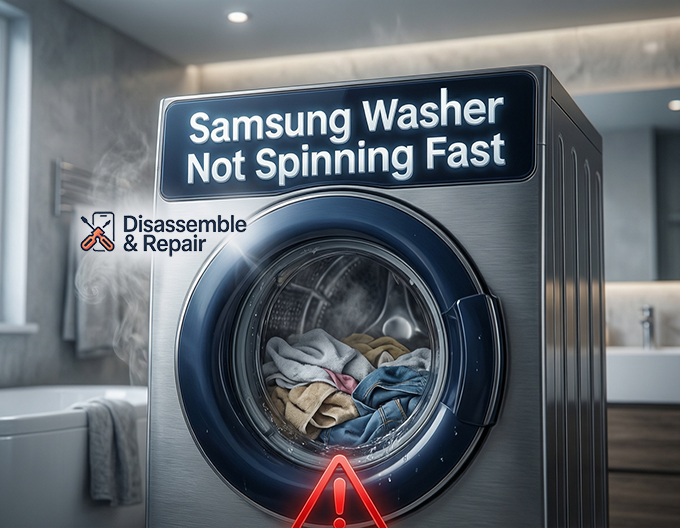
1. Unbalanced Load and the “DC” Error
The most frequent reason for a slow spin cycle is an unbalanced load. If you are washing heavy items like bedding, towels, or jeans, they can clump together on one side of the drum. This creates a dangerous oscillation that prevents the drum from spinning rapidly.
Samsung washers are equipped with sensors that detect this wobble. If the load is not distributed even, the machine will attempt to add water and re-agitate to balance the clothes. If this fails, the washer may display the Error code DC (or UE/Ub depending on the model) and stop spinning or spin very slowly.
The Fix:
- Pause the cycle.
- Manually redistribute the wet laundry evenly around the agitator or drum plate.
- If washing a single heavy item, add a few towels to balance the weight.
- Restart the spin cycle.
2. Drainage Issues: The Drain Pump and Hose
A washer cannot spin fast if there is still water in the tub. The weight of the water makes high-speed spinning physically impossible and dangerous for the motor.
Read more Samsung washing machine NF error
The drain pump is responsible for expelling water from the tub. If the pump is clogged with debris (coins, lint, or small socks) or has failed mechanically, the water level will not drop, preventing the spin cycle from engaging fully. Similarly, a kinked or clogged drain hose will restrict water flow.
Furthermore, the pressure switch (or water level sensor) monitors how much water is in the drum. If the pressure switch is faulty or the air tube connected to it is blocked, it may send a false signal to the motor control board indicating that the washer is full of water, even if it is empty. The board will then prevent the high-speed spin to avoid damage.
The Fix:
- Inspect the drain hose for kinks or blockages.
- Clean the debris filter located at the bottom front of front-load models.
- Listen to the drain pump; a humming sound without water flow indicates a jam or failure.
3. Suspension Rods and Dampers
If your load is balanced but the machine still violently shakes or refuses to spin up, the suspension rods may be worn out. In top-loading Samsung washers, these rods act as shock absorbers, holding the tub in place. Over time, the springs lose their tension.
When suspension rods fail, the tub bangs against the cabinet frame during the ramp-up phase of the spin cycle. The washer’s vibration sensor detects this excessive movement and immediately cuts power to the motor or slows it down to prevent the machine from “walking” across the room.
The Fix:
- Press down on the tub when the washer is empty. It should rebound smoothly and stop. If it bounces up and down like a pogo stick, the suspension rods likely need replacement.
4. Door Latch Assembly
Modern washers have a safety mechanism that requires the door or lid to be securely locked before high-speed spinning begins. The door latch assembly sends a signal to the main control board confirming the unit is sealed.
If the latch is mechanically broken or the electrical switch inside it has failed, the machine might agitate (wash) but will refuse to enter the spin cycle. In some cases, the lock engages, but the sensor fails to report it, leaving the machine in a limbo state where it drains but does not spin fast.
5. Drive Belt and Motor Issues
For Samsung washers that utilize a belt-drive system (common in some top loaders and older front loaders), the drive belt connects the motor to the drum pulley. If the belt becomes stretched, worn, or greasy, it will slip. The motor may be running at full speed, but the friction required to turn the heavy drum is lost, resulting in a drum that spins lethargically.
More serious is a failure of the drive motor itself. While less common, the motor can develop dead spots or worn brushes (in brushed motors). However, in many modern Samsung units, a component called the Hall sensor (or rotor position sensor) is the culprit. The Hall sensor monitors the speed and direction of the stator and rotor. If this sensor malfunctions, the control board loses track of the motor’s speed and will halt the spin cycle to prevent errors.
6. Motor Control Board
The motor control board is the brain of the operation. It dictates the voltage sent to the motor and interprets data from the Hall sensor, pressure switch, and door latch. If the board has a short circuit, a blown capacitor, or a corrupted chip, it may fail to send the necessary voltage to ramp up the motor speed. This is usually a last-resort diagnosis after checking all other mechanical components.
Essential Maintenance: Calibration Mode
One of the most overlooked solutions for a Samsung washer not spinning fast is the calibration feature. Whenever you move your washer, change the suspension rods, or even if the machine just seems “off,” you must run a calibration cycle.
Calibration mode allows the washer to measure the weight of the empty drum to set a baseline. Without this baseline, the weight sensors cannot accurately determine load size, leading to constant balancing errors and slow spin speeds.
How to Calibrate (General Samsung Steps):
- Remove all laundry from the tub.
- Power off the washer.
- Hold down the Temp and Delay End buttons simultaneously (buttons vary by model, check your manual).
- While holding the buttons, press the Power button. The washer should turn on and display “Cb” or “CLB”.
- Press the Start/Pause button.
- The drum will rotate back and forth for a few minutes.
- Once finished, the display will show “0” or “End” and turn off.
Advanced Troubleshooting Steps
If the basic checks and calibration do not resolve the issue, follow this professional workflow to isolate the faulty component.
Step 1: Diagnostic Mode & Error Codes
Most Samsung washers have a diagnostic mode. Consult your technical sheet (usually taped inside the machine casing). This mode allows you to test the drive motor spin capability independently of a wash cycle. If the motor spins fast in diagnostic mode but not in a regular cycle, the issue is likely a sensor input (like the pressure switch) rather than the motor itself.
Step 2: Inspecting the Hall Sensor
If you are comfortable with multimeters, you can test the Hall sensor.
- Unplug the washer.
- Access the motor (usually at the back or bottom).
- Visually inspect the sensor on the stator for cracks or corrosion.
- Check for resistance readings according to your specific model’s tech sheet. An inconsistent reading indicates a need for replacement.
Step 3: Checking the Drive Belt
Remove the back panel or look under the unit. Press on the drive belt. It should be tight with very little slack. If you see black rubber dust on the floor or casing, the belt is disintegrating and slipping. Replacing the belt is an inexpensive and effective fix.
Step 4: Evaluating the Drain System
If the washer hums but doesn’t drain, remove the drain pump. Check the impeller (the little fan blades inside). If the impeller spins freely on its shaft with no resistance, it may be broken. It should have a magnetic “bouncy” resistance. Also, blow through the drain hose to ensure no blockage exists in the plumbing or the hose itself.
When to Contact a Professional
While many of these issues can be resolved by a handy homeowner, certain symptoms require professional intervention. You should call a certified technician if:
- Electrical Burning Smell: This could indicate a fried motor control board or wiring harness short.
- Loud Grinding Noise: This often points to a tub bearing failure, which is a major repair requiring the complete disassembly of the washer.
- Voltage Issues: If you suspect the outlet or the main control board is delivering incorrect voltage to the drive motor, dealing with live electricity is hazardous.
Conclusion
A Samsung washer that refuses to spin at high speeds is almost always triggering a safety protocol to prevent damage. By systematically checking the load balance, ensuring the drain pump is clearing water, inspecting the suspension rods, and verifying the integrity of the drive belt and Hall sensor, you can pinpoint the issue.
Always remember to run the Calibration mode after any adjustments. Troubleshooting these entities logically will save you time and money, restoring your appliance to peak performance.
Read more Samsung washer drain hose leaking
Frequently Asked Questions
What do the “DC” or “Ub” error codes mean during the spin cycle?
These codes indicate an unbalanced load. If the washer detects that clothes—especially heavy items like towels or bedding—are clumped on one side of the drum, it will restrict the spin speed to prevent damage. To fix this, pause the machine and manually redistribute the laundry evenly before restarting the cycle.
Why is my washer draining water but still refusing to spin at high speeds?
If the water has drained but the speed remains low, the issue may be a faulty pressure switch or a malfunctioning Hall sensor. The pressure switch might be sending a false signal that the tub is still full of water, while a faulty Hall sensor prevents the control board from accurately monitoring the motor’s speed, causing it to halt the spin as a safety precaution.
Read more Samsung washing machine IE error
How do I know if my suspension rods need to be replaced?
You can perform a “bounce test” by pressing down firmly on the empty washer tub. If the tub rebounds smoothly and stays still, the rods are likely fine. If the tub bounces up and down several times like a pogo stick, the suspension rods have lost their tension and can no longer stabilize the drum during high-speed spins.
What is Calibration mode and why is it important?
Calibration mode allows the washer to weigh the empty drum and set a baseline for its sensors. This is a critical step to perform after moving the appliance or replacing internal parts. Without proper calibration, the weight sensors may provide inaccurate data, leading to frequent balance errors and a refusal to reach maximum RPM.