
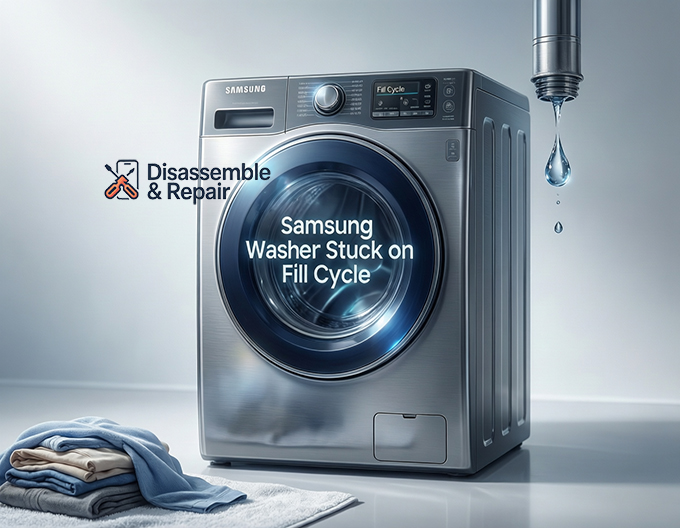
A Samsung washer stuck on fill cycle can be a frustrating ordeal, leaving your laundry soaking wet or delaying your chores indefinitely. Whether your machine is continuously taking in water without advancing or filling and draining simultaneously, this issue usually stems from a specific set of mechanical or sensor failures.
In this guide, we will troubleshoot the problem step-by-step, examining the critical components like the water inlet valve, pressure switch, and installation setups that often trigger this malfunction.
Read more Samsung washing machine no power
Why Is Your Samsung Washer Stuck on Fill Cycle?
When a washer refuses to move past the filling stage, it typically falls into one of three categories: it is siphoning water out as fast as it enters, it is overfilling because a valve is stuck, or it thinks it hasn’t reached the correct water level due to a sensor error. Identifying which symptom matches your situation is the first step toward a fix.
1. The Siphon Effect and Drain Hose Height
One of the most common reasons for a Samsung washer stuck on fill cycle is an installation error known as the siphon effect. If your drain hose height is too low, or if the hose is pushed too far into the standpipe, gravity may pull water out of the drum as it fills.
Read more Samsung washing machine UE error
- The Symptom: You hear water entering the drum and the pump running, but the water level never rises.
- The Fix: Ensure your drain hose is installed correctly. The hose must have a loop that sits at least 18 to 24 inches (depending on your model) above the floor. If the hose is airtight in the standpipe, it creates a vacuum that sucks water out. Pull the hose back so there is an air gap, preventing the siphon.
2. Faulty Water Inlet Valve
The water inlet valve is the gatekeeper that controls hot and cold water flow into your machine. It relies on a solenoid valve—an electromagnetic component that opens and closes to let water in.
- The Symptom: The washer fills when it’s turned off, or it fills to the point of overfilling during a cycle.
- The Cause: If the solenoid fails mechanically, it may get stuck in the “open” position. Alternatively, debris in the valve screen can prevent it from closing fully.
- The Fix: You can test the valve for continuity using a multimeter. If the solenoid shows infinite resistance or the valve leaks when the machine is unplugged, the entire valve assembly requires replacement with new appliance repair parts.
3. Issues with the Water Level Sensor System
The water level sensor (also called a pressure switch or transducer) tells the control board how much water is in the drum. It does this by measuring air pressure through a clear tube called the pressure transducer tube.
- The Symptom: The washer stops filling but won’t agitate, or it continues filling until an error code appears.
- The Cause:
- Clogs: Debris or sediment can block the pressure transducer tube, trapping air and giving false readings.
- Leaks: A crack in the tube causes air to escape, so the sensor never detects that the water level is rising.
- Sensor Failure: The switch itself may be electrically dead.
Troubleshooting Samsung Error Codes
Modern front load washer and top load models are equipped with self-diagnostic systems. If your machine is stuck filling, you may see specific Samsung error codes on the display:
- nF / 4C / 4E: These indicate a “No Fill” or slow fill error. The machine isn’t detecting water entering fast enough. This often points to a clogged mesh filter on the water inlet valve or a closed supply tap.
- OE / OC / 0E: These stand for “Overflow Error.” This occurs when the water level sensor detects too much water. The pump will usually turn on automatically to drain the tub. This strongly suggests a bad water inlet valve or a faulty pressure switch.
Step-by-Step Repair Guide
If you are comfortable performing a DIY repair, follow these steps to diagnose the specific component causing the issue.
Step 1: Check the Pressure Transducer Tube
Before buying parts, inspect the air tube connecting the tub to the pressure switch.
- Unplug the washer.
- Remove the top panel (for front loaders) or the console/rear panel (for top loaders).
- Locate the clear plastic tube running from the tub to the sensor.
- Check for kinks, holes, or blockages. Disconnect the tube from the sensor and blow through it to clear any sediment.
Step 2: Test the Water Level Sensor
If the tube is clear, the pressure switch might be the culprit.
- Set your multimeter to the Ohms (resistance) setting.
- Disconnect the wire harness from the sensor.
- Test the terminals. A functional sensor should show a specific resistance reading (consult your specific model’s tech sheet, often found inside the machine cabinet). If it reads open (infinity) or zero when it shouldn’t, replace it.
Step 3: Inspect the Water Inlet Valve
If water enters the machine even when the power is disconnected, the mechanical seal inside the water inlet valve has failed.
- Turn off the water supply faucets.
- Remove the supply hoses and check the mesh filter screens inside the valve ports. Clean them if they are clogged with sediment.
- If screens are clean but the washer overfills, replace the valve assembly.
Step 4: Evaluate the Control Board
If the valve and sensor test fine, the main control board might be failing to send the “stop filling” signal. This is less common but possible. Look for burnt components or loose wire connections on the board. If the board is not sending voltage to the valves but they open anyway, the valve is mechanically bad. If the board sends voltage continuously, the board itself may have a stuck relay.
Conclusion
A Samsung washer stuck on fill cycle is rarely a fatal issue for the appliance. By systematically checking the drain hose height to prevent siphoning, testing the water inlet valve for mechanical failure, and ensuring the pressure transducer tube is clear, you can solve the problem without calling a professional. Always remember to unplug your machine before handling internal appliance repair parts to ensure your safety during the repair process.
Frequently Asked Questions
Why is my Samsung washer filling and draining at the same time?
This is typically caused by the “siphon effect,” which occurs when the drain hose is installed incorrectly. If the hose is pushed too far into the standpipe or is positioned lower than 18 to 24 inches above the floor, gravity pulls the water out of the drum as it enters. To fix this, ensure there is an air gap in the standpipe and that the hose is properly looped at the correct height.
What do the error codes 4C, 4E, or nF mean?
These codes indicate a “No Fill” or slow fill error. This means the washer is not detecting water entering the tub at the required speed. The most common causes are a closed water supply tap, a kinked inlet hose, or clogged mesh filters inside the water inlet valve ports that need to be cleaned.
Read more Samsung washing machine OE error
How can I tell if the water inlet valve is faulty?
A major sign of a mechanical failure in the water inlet valve is if the washer continues to fill with water even when the machine is unplugged from the power outlet. If the machine only overfills when it is turned on, the issue could be an electrical failure in the solenoid or a problem with the water level sensor.
What is the pressure transducer tube and how does it affect the fill cycle?
The pressure transducer tube is a clear plastic hose that connects the tub to the water level sensor. As water rises in the tub, it pushes air up the tube to trigger the sensor. If this tube is clogged with detergent buildup or has a small leak, the sensor will never receive the signal to stop the water flow, causing the machine to get stuck on the fill cycle.