
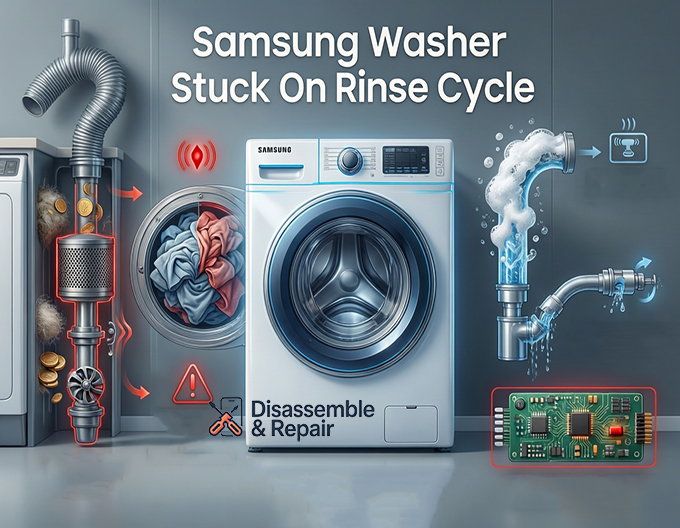
Encountering a situation where your Samsung washer stuck on rinse cycle can be incredibly frustrating, leaving you with soaking wet clothes and a machine that refuses to advance to the spin stage. This common issue often stems from drainage obstructions, sensor malfunctions, or load balancing problems that prevent the appliance from completing its programmed sequence. As a complex appliance, a modern washer relies on a series of checks and balances; if one component fails to report the correct status, the cycle halts indefinitely.
In this guide, we will explore the mechanical and electrical causes behind this malfunction. We will analyze the critical entities involved, such as the drain pump and pressure switch, and provide professional-grade solutions to restore your appliance to working order.
Read more Samsung washing machine 5E error
Why Is My Samsung Washer Stuck on Rinse Cycle?
To understand why a Samsung washer stuck on rinse cycle occurs, one must understand the machine’s logic. Between the rinse and spin phases, the washer must successfully perform two actions: drain the water completely and balance the load for high-speed spinning.
If the machine cannot detect that the water has left the drum, or if it detects that the drum is wobbling dangerously, it will not engage the high-speed spin. Instead, it may continuously add water to attempt to rebalance the load, or simply pause the timer while the pump runs indefinitely. The root cause usually falls into one of three categories: drainage restrictions, load imbalances, or component failure.
1. Drainage System Failures
The most frequent reason a washer hangs during the rinse cycle is the inability to evacuate water. If the pressure sensor detects water remaining in the tub, the main control board will prevent the spin cycle to avoid damage.
Inspecting the Drain Hose and Filter
Before dismantling the machine, begin with the external components. The drain hose is responsible for carrying wastewater out of the machine. If this hose is kinked, crushed behind the machine, or clogged with lint, the water flow will be restricted. Additionally, ensure the hose is not inserted too far into the standpipe, as this can create a siphoning effect where water flows back into the washer as fast as it is pumped out.
Next, locate the drain filter (often called the debris filter) usually found behind a small door at the bottom front of the unit. This filter catches coins, buttons, lint, and other debris. If the filter is clogged, the pump cannot circulate water effectively.
- Place a towel and a shallow tray under the filter door.
- Unscrew the filter counter-clockwise.
- Remove any debris and rinse the filter under warm water.
- Reinstall securely.
The Drain Pump
If the hose and filter are clear, the drain pump itself may be the culprit. Over time, the impeller inside the pump can break, or the motor can burn out. Listen to the machine; if you hear a humming noise but no water is moving, the pump motor may be seized. Alternatively, if there is complete silence when the machine should be draining, the pump may not be receiving power. A multimeter can be used to test the pump for continuity. If the reading indicates an open circuit (infinity), the drain pump must be replaced.
2. Load Balancing and Suspension Issues
Samsung washers utilize sensitive software to protect the machine from self-destruction during high-speed spins.
Unbalanced Load
An unbalanced load is a primary cause for a washer getting stuck. When washing heavy items like bedding, jeans, or towels, the wet fabric can clump on one side of the drum. As the washer attempts to spin, it detects this imbalance. The machine’s logic dictates that it should stop spinning, fill with water again, and agitate slowly to redistribute the clothes.
If the machine repeats this “rinse and attempt to spin” process multiple times, it will appear stuck.
Read more Samsung washer leaking when draining
- Solution: Pause the cycle, open the door, and manually redistribute the wet clothes. Remove some items if the drum is overpacked.
Suspension Rods and Springs
If you consistently face unbalanced load errors even with small loads, the physical suspension system may be worn out. Weak suspension rods allow the tub to bang against the cabinet, triggering the vibration sensor to halt the cycle.
3. Water Supply and Sensor Malfunctions
Sometimes, the issue is not that the water won’t leave, but that it won’t stop entering, or the machine is confused about the water level.
Water Inlet Valve Failure
The water inlet valve controls the flow of hot and cold water into the unit. If the solenoid inside the valve fails in the “open” position, water will trickle or rush into the drum continuously. Even if the drain pump is working, the washer may detect rising water levels during the spin cycle and revert to the rinse logic to handle the excess water. If you see water entering the drum when the machine is off or during the spin cycle, the water inlet valve requires replacement.
Pressure Switch Problems
The pressure switch (or water level sensor) tells the control board how much water is in the drum. It operates via a small air tube connected to the bottom of the tub. As water rises, air pressure increases in the tube, triggering the switch.
- Blockage: If the air tube is clogged with “gunk” or suds, the pressure switch may read “full” even when the drum is empty.
- Failure: If the switch is electrically defective, it may send erratic signals, causing the washer to hang in the rinse cycle because it believes it has not finished draining.
Suds Detection
Modern Samsung washers feature suds detection logic. If you use non-HE (High Efficiency) detergent or use too much detergent, excess foam is created. The pressure sensor interprets the air pockets in the foam as water difficulty. The machine will display an error (often “Sud” or “5UD”) and pause the cycle to allow the bubbles to dissipate. This can extend the rinse cycle significantly or cause it to stall completely.
4. Electronic and Control Failures
If the mechanical systems are functioning correctly, the issue may lie within the machine’s “brain.”
Door Latch Assembly
The door latch is a safety interlock. The washer will fill and agitate with a faulty latch in some modes, but it will arguably never enter a high-speed spin if the lock switch is not engaging correctly. If the main PCB does not receive the “Locked” signal, it will abort the spin and may remain stuck trying to drain or rinse.
Control Board and PCB
The Control board (or main PCB – Printed Circuit Board) governs all timing and component activation. If a relay on the PCB controlling the drain pump or motor has fused or burned out, the cycle cannot advance. Furthermore, software glitches can occur due to power surges. Physical inspection of the PCB might reveal burn marks or swollen capacitors, indicating a need for board replacement.
5. Diagnostic Steps and Solutions
Before ordering parts, perform these diagnostic steps to reset the system and identify specific faults.
Interpreting Error Codes
When the washer gets stuck, it may eventually time out and display an error code on the digital screen. Common codes related to rinse/spin stalls include:
- 5C / 5E / nd: Drainage error. (Check filter, hose, and pump).
- Ub / UE: Unbalanced load error. (Redistribute laundry).
- Sud / 5UD: Excess suds detected. (Run a clean cycle without detergent).
- 4C / 4E: Water supply error (Check inlet valve and screens).
Performing Calibration Mode
One of the most overlooked solutions for a Samsung washer is calibration mode. Whenever you move the washer, adjust the legs, or change a part, you must recalibrate the weight sensors. If the weight sensor is uncalibrated, the machine may think an empty drum is full, causing it to skip the spin cycle.
- Remove all laundry from the drum.
- Power off the washer.
- Hold the “Temp” and “Delay End” buttons simultaneously (buttons vary by model; consult your manual), then press the Power button.
- The display should show “Cb” or “CLB”.
- Press Start. The drum will rotate back and forth for a few minutes.
- Once finished, the machine displays “End” or “0”. Try a rinse and spin cycle again.
When to Call a Professional
While many issues causing a Samsung washer to get stuck on the rinse cycle can be resolved by cleaning the drain filter or checking the drain hose, some problems require professional intervention.
If you have diagnosed the issue as a main PCB failure, or if replacing the drain pump and pressure switch did not resolve the problem, the electrical fault may be deeper in the wiring harness. Additionally, replacing a water inlet valve or door latch involves working with live electricity and water, which poses safety risks.
If your machine is still under warranty, avoid opening the cabinet, as this may void your coverage. Instead, contact Samsung support with the specific error codes you have observed.
Conclusion
A Samsung washer stuck on rinse cycle is rarely a mystery; it is a symptom of a specific safety protocol or component failure. By systematically checking the drainage path, ensuring the load is balanced, and verifying the integrity of the pressure switch and inlet valves, you can isolate the problem. Regular maintenance, such as running self-clean cycles to prevent suds detection errors and keeping the debris filter clean, will prevent most of these issues from recurring. Always start with the simplest fixes—rebalancing the load and running calibration mode—before investing in replacement parts.
Frequently Asked Questions
Why does my Samsung washer keep adding time to the rinse cycle or restarting it?
This usually happens because the machine detects an unbalanced load. If the clothes are clumped on one side, the washer cannot safely enter the high-speed spin. It will add more water to agitate and redistribute the laundry. To fix this, pause the machine and manually spread the wet clothes evenly around the drum.
What should I do if my washer displays a “5C” or “5E” error code?
These codes indicate a drainage problem. You should first check the drain hose for any kinks or clogs. Next, clean the debris filter (drain filter) located behind the small access door at the bottom front of your washer. If the filter is clear and the hose is straight, your drain pump may be faulty and require replacement.
How can using too much detergent cause the washer to get stuck?
If you use non-HE detergent or excessive amounts, it creates too many suds. Samsung’s suds detection logic will pause the cycle (often displaying “Sud” or “5UD”) to allow the foam to dissipate. The pressure sensor can mistake thick foam for water, preventing the machine from advancing to the spin stage.
Read more Samsung washing machine ND error
When should I perform Calibration Mode on my washer?
You should run calibration mode whenever you move the appliance, adjust its leveling legs, or replace a mechanical part like a suspension rod. Calibration helps the weight sensors accurately detect the load size. To start it, hold “Temp” and “Delay End” while powering on the machine, wait for the “Cb” code, and press Start.
Is it normal for my washer to stay on the rinse cycle if the door isn’t locked?
No, the washer requires a “Locked” signal from the door latch assembly to proceed to the high-speed spin for safety reasons. If the latch is faulty or the main control board doesn’t receive the signal that the door is secure, the machine may continue to drain or rinse indefinitely without ever reaching the final spin stage.