
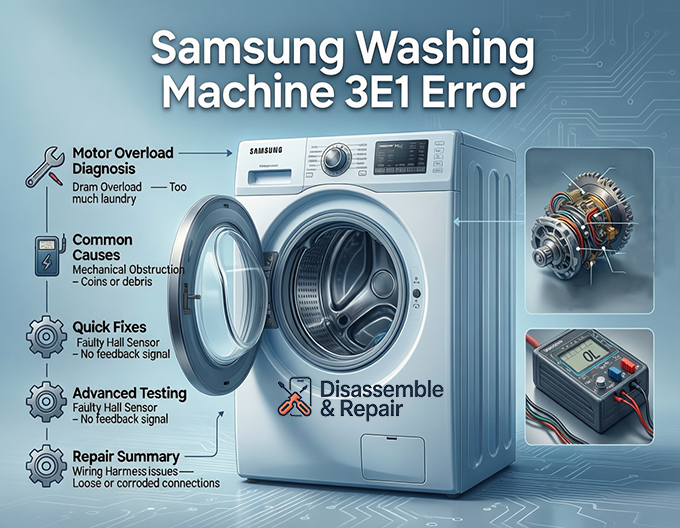
If you are facing a Samsung washing machine 3E1 error, it typically indicates a motor overload or a failure in the motor’s ability to rotate effectively. This specific code often appears when the washing machine detects that the drum is struggling to turn due to too much laundry, a mechanical obstruction, or a malfunction in the drive system components like the Hall Sensor or Drive Motor.
As a Senior appliance technical writer, I have compiled this detailed guide to help you diagnose and fix the 3E1 error. We will cover everything from basic resets to advanced multimeter testing of the Rotor and Stator.
What is the Samsung Washing Machine 3E1 Error?
The Samsung washing machine 3E1 error is part of the “3E” family of error codes, which all relate to motor drive faults. While a standard “3E” code generally points to a motor defect, the specific “3E1” suffix often highlights an Motor Overload condition.
Read more Samsung washer dryer not drying clothes
Technically, this means the Main Control Board has attempted to drive the motor, but the feedback signal from the Motor Tachometer (or Hall Sensor in direct drive models) indicates that the motor is not turning at the commanded speed or is stuck.
Read more Samsung washing machine LC2 error
Common Causes
- Drum Overload: Putting too many heavy items (like wet towels or bedding) into the drum.
- Mechanical Obstruction: A coin, wire, or “broken spider arm” jamming the drum.
- Faulty Hall Sensor: The sensor fails to report the motor’s position or speed to the main board.
- Wiring Harness Issues: Loose or corroded Electrical Connections preventing signal transmission.
- Motor Failure: Worn Carbon Brushes (universal motors) or bad windings in the Inverter Motor.
Initial Troubleshooting: Quick Fixes
Before disassembling your machine, perform these non-invasive checks.
1. The Reset Procedure
Sometimes, the error is a temporary glitch in the Main Control Board.
- Turn off the washing machine.
- Unplug the power cord from the wall outlet.
- Wait for 5–10 minutes to allow the capacitors on the board to discharge.
- Plug it back in and restart a Rinse+Spin cycle to see if the code clears.
2. Check for Load Imbalance
An overloaded drum puts immense strain on the Drive Motor.
- Open the door and remove half the laundry.
- Redistribute the remaining clothes evenly.
- If the machine is empty and still shows Samsung washing machine 3E1 error, the issue is likely mechanical or electrical.
3. Spin the Drum Manually
With the machine empty and off, put your hand inside and spin the drum manually.
- Smooth Rotation: The bearings and mechanical drive are likely fine. The issue is electrical.
- Grinding or Stuck: You may have a mechanical jam (coins between the tubs) or seized bearings. This physical resistance triggers the Drum Overload error.
Advanced Diagnostics: Testing Electrical Components
If the basic steps fail, you will need a multimeter to test the internal components. Safety Warning: Always unplug the machine before accessing internal parts.
Diagnosing Direct Drive (Inverter) Motors
Most modern Samsung front loaders use an Inverter Motor attached directly to the back of the tub. This system consists of a Rotor and Stator.
Step 1: Inspect the Wiring Harness
Remove the back panel. Locate the motor assembly. Check the Wiring Harness connecting the motor to the main board. Look for:
- Vibration damage (chafing wires).
- Loose plugs at the motor or the Main Control Board.
Step 2: Motor Resistance Test (Stator)
You need to test the resistance of the Stator windings to ensure they are not open or shorted.
- Disconnect the wire connector from the Stator.
- Set your multimeter to the lowest Ohms (Ω) setting.
- Measure the resistance between the three pins (Pin 1-2, Pin 2-3, Pin 1-3).
- Expected Value: You should see a consistent reading, typically between 5Ω and 15Ω (often around 9-10Ω for many models).
- Diagnosis: If one reading is “OL” (Open Loop) or significantly different from the others, the Stator is faulty and needs replacement.
Step 3: Hall Sensor Check
The Hall Sensor monitors the speed and position of the rotor. A failure here is a top cause of the 3E1 error.
- Visual Check: Ensure the sensor is securely clipped onto the Stator.
- Resistance Check: This can be tricky as values vary by model. However, a common check on the sensor pins (often labeled Vcc, Gnd, Signal) involves checking for shorts. If you measure infinite resistance (Open) or zero resistance (Short) across signal pins where there should be some impedance (often in the kΩ range), the sensor is likely dead.
- Note: The most reliable test for a Hall Sensor is checking for voltage pulses (0V to 5V) while manually rotating the drum, but this requires live voltage testing and is recommended only for professionals.
Diagnosing Universal Motors (Belt Driven)
Older models or some top loaders use a universal motor connected to the drum via a belt.
Read more Samsung washer not spinning
Step 1: Check Carbon Brushes
Worn brushes are the #1 cause of motor errors in non-inverter machines.
- Remove the motor from the machine.
- Unscrew the plastic brush holders on the side of the motor.
- Inspection: If the carbon rod is shorter than 1cm or the spring is not pushing it firmly against the commutator, replace the brushes.
Step 2: Tacho Generator Test
The Tacho Generator (or Tachometer) is a small coil on the back of the motor that acts like a Hall Sensor.
- Locate the two wires coming from the Tacho coil (usually at the rear of the motor).
- Measure resistance across these two wires.
- Expected Value: A healthy coil typically reads between 40Ω and 70Ω (approx. 60Ω is standard).
- If the reading is infinite, the coil is broken, preventing the Main Control Board from sensing speed, thus triggering the 3E1 error.
Checking the Main Control Board
If the Drive Motor, Hall Sensor, and Wiring Harness all test fine, the fault may lie with the Main Control Board (PCB).
- Access the PCB (usually located behind the front fascia or top panel).
- Visual Inspection: Look for burn marks, swollen capacitors, or melted silicone around the motor driving circuit (IPM module).
- Connections: Reseat all connectors. Vibration often shakes these loose over years of service.
- If visual damage is present, board replacement is required.
Summary of Repair Steps
To clear the Samsung washing machine 3E1 error, follow this logical path:
- Reset the machine to rule out software glitches.
- Unload laundry to ensure no Drum Overload.
- Spin the drum by hand to check for mechanical jams.
- Inspect the Wiring Harness for continuity.
- Measure the Motor Resistance (Stator windings or Carbon Brushes).
- Test the Hall Sensor or Tacho Generator values.
- Replace the faulty component or the Main Control Board if all else fails.
By systematically testing these entities, you can isolate the root cause of the 3E1 error and restore your appliance to working order without unnecessary part replacements.
Frequently Asked Questions
What does the 3E1 error code mean on a Samsung washing machine?
The 3E1 error code indicates a motor overload condition. This happens when the main control board detects that the motor is struggling to turn at the correct speed or is completely stuck. It is usually caused by too much laundry, a mechanical obstruction, or a faulty sensor.
How do I quickly reset my Samsung washer to clear the 3E1 code?
To perform a reset, power off the machine and unplug it from the wall outlet. Wait for 5 to 10 minutes to allow the electrical charges in the control board to dissipate. Plug the machine back in and start a Rinse+Spin cycle to see if the error has cleared.
Can I fix the 3E1 error without replacing parts?
Yes, in many cases the error is caused by a temporary overload. Try removing some laundry to reduce the weight and ensure the clothes are distributed evenly. Additionally, check the drum for small objects like coins or debris that might be physically jamming the rotation.
Read more Samsung washing machine HE error
What is a Hall Sensor and how does it relate to this error?
The Hall Sensor is a component in direct-drive motors that monitors the speed and position of the drum. If this sensor fails or has a loose wiring connection, it cannot send accurate feedback to the control board, which often results in the 3E1 error code even if the motor is technically functional.
When should I call a professional for a 3E1 error?
If you have reset the machine, reduced the load, and checked for obstructions but the code persists, the issue is likely electrical. If you are not comfortable using a multimeter to test motor resistance, stator windings, or the Hall Sensor, it is best to contact a qualified technician.