
Dealing with a Samsung washing machine 3E2 error can be frustrating, especially when it halts your laundry routine mid-cycle. This specific error code indicates a motor driving error, typically signaling a communication breakdown between the PCB control board and the motor’s sensors. Unlike general drainage or door lock errors, the 3E2 code requires a more technical approach to diagnose, involving components like the Hall sensor, Inverter motor, and Wiring harness.
This guide provides a professional, step-by-step approach to troubleshooting and fixing the 3E2 error, designed for users who want to understand the root cause and potential solutions.
Understanding the 3E2 Error Code
The Samsung washing machine 3E2 error is part of the “3E” family of codes, all of which relate to the machine’s motor. However, the “2” suffix adds specificity. While a standard 3E might imply a general motor overload, a 3E2 error specifically points to a defect in the motor’s driving signal.
In modern Samsung washers equipped with a Digital Inverter Motor, the machine relies on precise feedback to know the drum’s position and speed. This feedback is provided by a Hall sensor (or Tacho generator in older models). If the PCB control board sends a signal to the motor but receives irregular or no feedback from the sensor, the system triggers the 3E2 safety stop to prevent damage.
Read more Samsung washing machine UE error
Key Components Involved
- Drive Motor / Inverter Motor: The heart of the machine that spins the drum.
- Hall Sensor: A small magnetic sensor mounted on the motor stator that monitors speed and rotation.
- PCB Control Board: The main computer that sends power and commands to the motor.
- Wiring Harness: The collection of wires connecting the board to the motor and sensors.
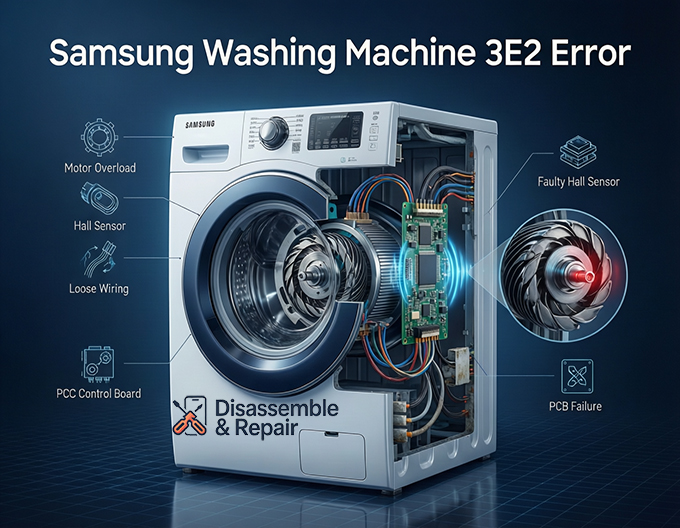
Common Causes of the 3E2 Error
Before disassembling your machine, it is helpful to understand what usually triggers this fault:
Read more Samsung washing machine BE2 error
- Motor Overload: Putting too much laundry in the drum can physically prevent the motor from spinning, causing the sensor to report a “locked” status.
- Faulty Hall Sensor: If this sensor fails, the board cannot “see” the motor spinning, even if the motor is working perfectly.
- Wiring Issues: Vibrations can cause the Wiring harness to loosen or chafe, breaking the electrical path (continuity) between components.
- PCB Failure: In rare cases, the inverter board itself may be damaged and unable to drive the motor.
Samsung Washing Machine 3E2 Error Troubleshooting Steps
Follow these steps to diagnose and potentially resolve the issue.
Step 1: Perform a Hard Reset
Electrical glitches can sometimes cause false error codes.
- Turn off the washing machine.
- Unplug the power cord from the wall outlet.
- Wait for at least 10 to 15 minutes. This allows the capacitors on the PCB control board to discharge and the system to reset.
- Plug the machine back in and run a “Rinse + Spin” cycle with an empty drum.
- If the error clears, it was likely a temporary glitch or overload.
Step 2: Mechanical Inspection
Rule out physical obstructions before testing electronics.
- Open the door and spin the drum by hand.
- It should rotate relatively freely with a slight magnetic resistance (characteristic of an Inverter motor).
- If the drum feels stuck, grinds, or makes a loud noise, you may have a mechanical issue with the bearings or the spider arm, rather than an electrical 3E2 error.
Step 3: Check Connections and Wiring
Loose connections are a frequent culprit.
- Safety First: Ensure the machine is unplugged.
- Remove the back panel of the washing machine to access the motor (usually located at the bottom rear for direct drive models).
- Inspect the Wiring harness connecting the motor to the main board. Look for any visible damage, burn marks, or loose plugs.
- Disconnect and reconnect the plugs on the motor and the Hall sensor to ensure they are seated firmly.
Step 4: Advanced Testing with a Multimeter
If the error persists, you will need a Multimeter to test the electrical integrity of the components.
Continuity Test for Wiring Harness
To ensure wires aren’t broken internally:
Read more Samsung washing machine 4C error
- Set your multimeter to the Continuity mode (often symbolized by a sound wave icon).
- Test each wire in the harness running from the motor to the control board.
- Touch one probe to the motor-end connector and the other to the board-end connector.
- You should hear a beep or see a reading close to 0 ohms. If you get no reading (OL or Open Loop), the wire is broken and the harness needs replacement.
Testing the Motor Windings
- Set the multimeter to Ohms (Resistance).
- Locate the main power connector on the motor (usually 3 wires).
- Measure the resistance between each pair of pins (Pin 1-2, Pin 2-3, Pin 1-3).
- You should see a consistent reading, typically between 5 to 15 ohms (consult your specific model’s manual for exact values).
- If any reading is “Open” (infinite resistance) or “Short” (0 ohms), the Drive motor stator is faulty.
Testing the Hall Sensor
The Hall sensor is the most likely suspect for a 3E2 error.
- With the machine powered on (carefully), you can test for voltage at the sensor connector.
- You should typically see a supply voltage (often 10-15V DC) and a pulsing signal voltage when the drum is rotated by hand.
- If there is no voltage or the signal doesn’t change when the motor spins, the Hall sensor is likely dead and requires replacement.
When to Replace the PCB Control Board
If the motor, Hall sensor, and wiring all pass the multimeter tests, the issue likely lies with the PCB control board. specifically the inverter circuit responsible for driving the motor. Physical signs of failure include:
- Burnt components or smell of burning plastic near the board.
- Bulging capacitors.
- Visible scorch marks on the board’s casing.
Replacing the PCB is a more expensive repair, so ensure you have ruled out the cheaper sensors and wiring first.
Conclusion
The Samsung washing machine 3E2 error is a protective measure designed to save your motor from damage, but it often points to a minor sensor or wiring fault rather than a dead motor. By systematically checking the load balance, inspecting the Wiring harness, and testing the Hall sensor with a Multimeter, you can often identify the problem without purchasing a new machine. Always remember to prioritize safety by unplugging the unit before touching any internal components.
Frequently Asked Questions
What is the difference between a 3E and a 3E2 error code?
While both codes relate to the motor, the 3E code is a general motor error often caused by overloading. The 3E2 error is more specific, indicating a defect in the motor’s driving signal or a communication failure between the motor’s Hall sensor and the PCB control board.
Can a simple reset fix the 3E2 error code?
In some cases, yes. A “hard reset” involves unplugging the machine for 10 to 15 minutes to allow the electrical components to discharge. This can clear temporary electronic glitches or errors caused by a momentary motor overload. However, if the error persists after a reset, it usually points to a hardware issue like a faulty sensor or damaged wiring.
Read more Samsung washer not working after cleaning filter
What is a Hall sensor and how does it affect my washing machine?
A Hall sensor is a small component mounted on the motor that monitors the speed and position of the drum. It sends this information back to the main control board. If the sensor is faulty, the board cannot confirm that the motor is spinning correctly, and it will trigger the 3E2 error as a safety precaution.
How do I know if the 3E2 error is caused by a mechanical problem?
You can perform a quick manual check by spinning the drum with your hand while the machine is off. It should rotate relatively smoothly with only slight magnetic resistance. If the drum is completely stuck, makes a loud grinding noise, or feels extremely heavy, the problem is likely a mechanical failure (such as broken bearings or a damaged spider arm) rather than an electronic 3E2 error.
Is it expensive to fix a 3E2 error?
The cost depends on the root cause. Fixing a loose wiring harness or replacing a Hall sensor is relatively inexpensive and can often be done as a DIY project. However, if the troubleshooting leads to a faulty Inverter Motor or a failed PCB control board, the repair will be more costly due to the price of these major components.