
If you are facing a Samsung washing machine BC error, it typically signals a critical malfunction preventing the appliance from starting its cycle. This code often points to a complex issue within the motor drive system or the appliance’s power communication, requiring a systematic approach to diagnose and resolve.
Understanding the Samsung Washing Machine BC Error
The Samsung washing machine BC error (sometimes displayed as bC, bE, or Eb depending on the model) is generally associated with a failure in the motor’s power supply or control circuit. While in some specific models it can indicate a stuck button on the control panel, the presence of components like the BLDC motor and Inverter circuit in your diagnosis suggests the fault likely lies in the drive system.
Technically, this error often means the Main PBA (Printed Board Assembly) has detected a startup failure or an irregularity in the electrical signals sent to the drum’s motor. This safety mechanism halts the machine to prevent damage to the internal electronics.
Read more Samsung washing machine 3C error
Common Causes of the BC Error
- Motor Malfunction: The BLDC motor (Brushless Direct Current motor) may be unable to initiate drum rotation due to internal resistance or mechanical binding.
- Inverter Circuit Failure: The Motor control board relies on an Inverter circuit to convert electrical power into the precise frequency needed to drive the motor. If this circuit fails, the motor cannot spin.
- Sensor Issues: The Hall sensor (or tachometer), which monitors the speed and position of the rotor, might be sending incorrect data to the main board.
- Electrical Instability: Sudden Voltage fluctuations in your home’s power supply can trigger the machine’s safety protocols, throwing a BC code.
- Wiring Faults: A damaged or loose Wire harness connecting the motor to the main PCB can disrupt communication.
Step-by-Step Troubleshooting Guide
Before calling an Appliance technician, you can perform several checks to isolate the issue. Always ensure the machine is unplugged before inspecting internal components.
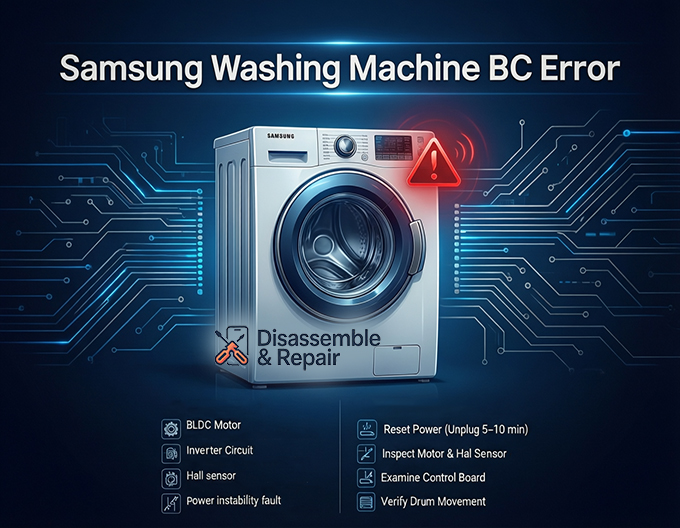
1. Perform an Error Code Reset
A simple electronic glitch caused by Voltage fluctuations can sometimes trigger a false positive.
- Action: Unplug the washing machine from the power outlet.
- Wait: Leave it disconnected for at least 5 to 10 minutes to discharge the capacitors on the Main PBA.
- Test: Plug it back in and attempt to start a cycle. If the Samsung washing machine BC error clears, it was likely a temporary power spike.
2. Inspect the BLDC Motor and Hall Sensor
If the reset fails, the issue may be physical.
- Access: Remove the back panel of the Front load washing machine to locate the motor.
- Check Connections: Ensure the Wire harness connecting to the motor is secure. Vibrations during spin cycles can loosen these connectors over time.
- Hall Sensor Test: The Hall sensor is mounted on the motor assembly. If you have a multimeter, check for continuity. A faulty sensor cannot report drum rotation speed to the board, causing the system to lock up immediately.
3. Examine the Motor Control Board
The Motor control board (often integrated into the Main PBA on newer models) drives the system.
- Visual Inspection: Look for signs of burn marks or blown components around the Inverter circuit area (usually near large capacitors or heat sinks).
- Triac Check: The “Triac” is a component responsible for switching current to the motor. If the BC error persists immediately upon power-up, this component on the board may have shorted.
4. Verify Drum Movement
Manually rotate the drum with your hand when the machine is off.
- Resistance: It should spin freely. If there is significant resistance or a grinding noise, the BLDC motor bearings or the drum spider may be physically broken, preventing the motor from starting and triggering the error.
When to Call a Professional
If you have inspected the Wire harness, confirmed the drum spins freely, and reset the power but the code remains, the fault likely lies within the Main PBA or a defective Inverter circuit.
Diagnosing board-level failures requires advanced tools. An experienced Appliance technician will be able to test the voltage outputs of the inverter and determine if the entire control board requires replacement. Attempting to repair the electronic board without proper knowledge can lead to further damage to the BLDC motor.
By understanding the role of the Hall sensor and power circuits, you can accurately diagnose the Samsung washing machine BC error and decide whether a simple reset or a professional repair is necessary.
Read more Samsung washer not draining
Frequently Asked Questions
What does the BC error code mean on a Samsung washing machine?
The BC error (which may also appear as bC, bE, or Eb) indicates a malfunction in the motor’s power supply or control circuit. It typically means the main control board has detected that the motor is unable to start properly or that there is an irregularity in the electrical signals required for drum rotation.
How do I perform a reset to clear the BC error?
To reset the machine, unplug it from the power source and wait for at least 5 to 10 minutes. This allows the electrical charge in the control board’s capacitors to dissipate. Plug the machine back in and start a new cycle; if the error was caused by a temporary voltage fluctuation, the code should clear.
Read more Samsung washing machine NF error
Can a BC error be caused by something other than a faulty motor?
Yes. While the BLDC motor is often involved, the error can also be triggered by a faulty Hall sensor (which monitors motor speed), a failed inverter circuit on the control board, or even loose wiring in the harness connecting these components. In some models, a stuck button on the control panel may also trigger this code.
What should I check if my washer drum doesn’t move and displays this code?
With the power off, try to rotate the drum by hand. If it spins freely, the problem is likely electronic, such as a faulty sensor or control board. If the drum is difficult to turn or makes a grinding noise, there may be a mechanical failure in the motor bearings or the drum assembly itself.