
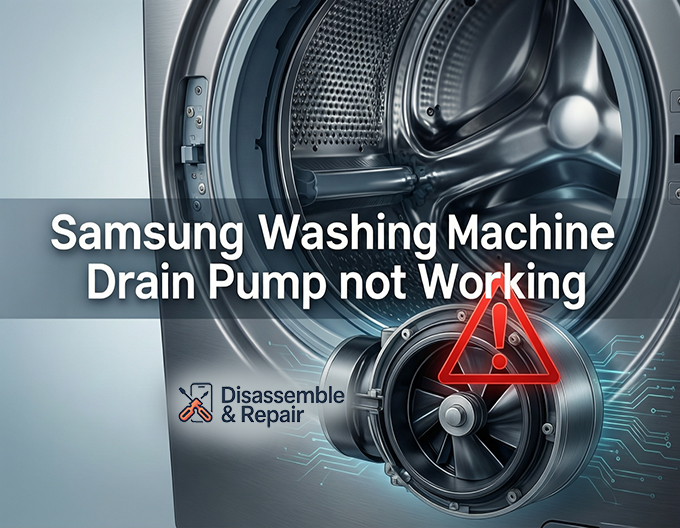
Is your Samsung washing machine drain pump not working, leaving you with a drum full of soapy water and a pile of soaking wet clothes? This common issue can bring your laundry routine to a halt, often accompanied by error codes like 5E or ND flashing on the display.
While a non-draining washer is frustrating, it doesn’t always signal a catastrophic failure. From a simple blockage in the debris filter to a faulty drain pump motor, many causes are fixable without a professional repair service. This guide will walk you through the diagnosis and repair process, ensuring you can get your machine back to its drain cycle in no time.
Understanding the Error Codes
Before grabbing your toolbox, look at the digital display. Samsung washers are designed to tell you exactly what is wrong through specific error codes.
- 5E (or 5C, SE): This is the most common code associated with drainage problems. It signifies a “Water Drain Error,” meaning the machine failed to drain the water within a set time limit.
- ND Error Code: This stands for “No Drain.” It is functionally similar to the 5E code and indicates that the washer senses water remaining in the tub after the drain cycle should have completed.
If you see these codes, the machine’s logic board has attempted to power the pump but hasn’t seen the water level drop. This points directly to a blockage, a kink, or a mechanical failure.
Step 1: Safety and Emergency Draining
WARNING: Before performing any maintenance, always unplug the washing machine to avoid electrical shock.
Read more Samsung washing machine TE2 error
If your washer is full of standing water, you must manually drain it before inspecting components.
For Front Load Washers:
- Locate the debris filter access door at the bottom front of the machine.
- Open the door and find the small black emergency drain hose.
- Place a shallow bowl or towel under the hose.
- Remove the cap from the hose and let the water drain. You may need to empty the bowl multiple times.
For Top Load Washers:
Most top loaders do not have a front-access drain hose. You may need to carefully bail out water with a bucket or use a wet/dry vac. Alternatively, detach the drain hose from the wall pipe and lower it into a bucket on the floor; gravity should help empty the tub.
Step 2: Checking for Blockages
The most frequent culprit for a Samsung washing machine drain pump not working is a physical obstruction. Small items like coins, socks, or lint can clog the system.
Inspecting the Debris Filter (Front Load)
The debris filter protects the pump impeller from foreign objects.
- After draining the water via the emergency hose, turn the large round filter cap counter-clockwise.
- Pull the filter out. You might find coins, hair clips, or accumulated lint.
- Rinse the filter under warm water and clean the housing with a damp cloth.
- Check the pump impeller inside the housing. It should spin freely with a slight magnetic resistance. If it feels stuck or gritty, debris might be wrapped around the shaft.
Inspecting the Drain Hose
A simple kink can prevent water from flowing.
- Pull the washer forward and check the drain hose for twists or bends.
- Ensure the hose is not pushed too far down into the standpipe. If it is airtight or submerged, it can cause siphoning issues.
- If accessible, disconnect the hose and run water through it to ensure it isn’t clogged with lint.
Step 3: Testing the Drain Pump Motor
If the filter and hoses are clear, the issue might be the pump itself. You can test the electrical integrity of the drain pump motor using a multimeter.
- Access the Pump:
- Front Load: Typically accessible by removing the back panel or the bottom front panel.
- Top Load: Usually requires removing the back panel to access the pump at the bottom of the tub.
- Disconnect Wires: Locate the drain pump and carefully unplug the wire harness connected to it.
- Measure Resistance: Set your multimeter to the Ohms (Ω) setting. Touch the probes to the pump’s terminals.
- A reading of infinity (or OL) means the motor windings are open (broken).
- A reading of zero suggests a short circuit.
- A healthy pump typically reads between 10 to 20 ohms (or sometimes 150-250 ohms depending on the specific model type). Consult your machine’s tech sheet for the exact value.
- Replace if Necessary: If the motor tests bad or if the impeller is physically broken (wobbly or separated from the shaft), the entire drain pump assembly needs replacement.
Step 4: The Pressure Switch Factor
Sometimes the pump is working perfectly, but the washer thinks it is empty or full when it isn’t. This is the job of the pressure switch (also called the water level sensor).
The pressure switch uses a small air tube connected to the tub to detect water levels.
- Tube Blockage: If the tube is clogged with “gunk,” air cannot travel up to the switch. Inspect the tube for cracks or blockages.
- Switch Failure: If the switch is faulty, it may not send the signal to activate the drain cycle. You can test the switch for continuity with a multimeter, but often replacing this inexpensive part is the easiest diagnostic step if the pump and filter are ruled out.
Summary Checklist
If your Samsung washing machine drain pump is not working, follow this logical path:
- Clear the Water: Remove standing water to prevent spills.
- Check Codes: Confirm 5E or ND error codes.
- Clean Filter: Check the debris filter for coins and lint.
- Inspect Hoses: Straighten kinks and clear clogs in the drain hose.
- Test Components: Use a multimeter to check the drain pump motor and pressure switch.
By systematically eliminating these issues, you can often save the cost of a service call and get your laundry moving again.
Frequently Asked Questions
What do the error codes 5E, 5C, or ND mean on my Samsung washer?
These codes all point to a drainage failure. 5E (which can also appear as 5C or SE) is the standard “Water Drain Error,” indicating the machine didn’t drain within the allotted time. The ND code stands for “No Drain” and signifies that the water level sensor still detects water in the tub after the drain cycle has finished.
How can I manually drain the water if the machine won’t do it?
If you have a front-load washer, use the small emergency drain hose located behind the access panel at the bottom front of the unit. If you have a top-load washer, you can usually drain it by detaching the drain hose from the wall and lowering it into a bucket on the floor, allowing gravity to pull the water out.
How do I know if the drain pump is actually broken or just clogged?
First, check the debris filter and the pump impeller for physical obstructions like coins or lint. If the impeller is clear but the pump still won’t run, you can test it with a multimeter. A functioning pump typically shows a resistance reading between 10 and 20 ohms (or up to 250 ohms depending on the model). A reading of infinity (OL) or zero indicates a failed motor that needs replacement.
Can a problem with the water level sensor affect the drain pump?
Yes. The pressure switch (water level sensor) tells the machine how much water is in the tub. If the pressure switch is faulty or if its air tube is clogged with gunk, the machine may “think” it is still full of water even if the pump is working, or it may fail to trigger the pump at the right time.
Where is the debris filter located on a Samsung washing machine?
On most front-load models, the debris filter is located at the bottom front of the machine behind a small access door. Most top-load Samsung washers do not have an externally accessible debris filter; in those cases, you must check the drain hose or access the pump from the back or bottom of the machine to check for clogs.