
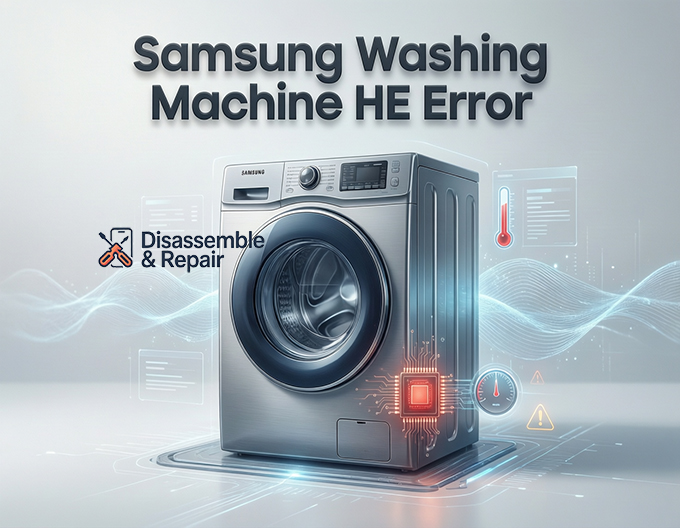
Encountering a Samsung washing machine HE error mid-cycle can be a significant inconvenience, bringing your laundry routine to a sudden halt. This specific error code serves as a critical alert from your appliance’s diagnostic system, indicating that there is a malfunction related to the water temperature control or heating components. Unlike simple door latch errors or drainage issues, the HE code involves the thermal dynamics of the machine and requires a systematic approach to diagnose safely and effectively.
As a Senior appliance technical writer, I have compiled this detailed guide to help you understand what this error means, the specific components involved, and how to troubleshoot the issue using professional methods.
Understanding the HE Error Code
The “HE” code on a Samsung washer stands for “Heating Error.” It signifies that the machine’s main computer—the Control board—has detected a temperature anomaly inside the drum. This error appears when the water is either too hot (overheating) or not heating up at all within a specific timeframe.
Depending on your specific model, particularly if you own a Front-load washer, the error might display as HE, hE, HE1, HE2, or HE3. While they all point to the heating system, they indicate slightly different behaviors:
- HE / HE1 (Overheating): The Water temperature sensor detects that the water has become dangerously hot (usually above 212°F or 100°C) or the heating element has turned on when it shouldn’t have.
- HE2 (Heater Malfunction): The water is not heating up. The system attempts to engage the heater, but the temperature sensor does not register a rise in temperature.
- HE3 (Steam Cycle Issue): This is specific to models with a Steam cycle. It indicates a malfunction in the steam generation heater.
Common Causes Behind the Samsung Washing Machine HE Error
To effectively repair the appliance, one must understand the entities responsible for regulating heat. The Samsung washing machine HE error is rarely a random glitch; it is usually caused by the failure of a tangible component.
Read more Samsung washer door lock keeps clicking
1. Defective Heating Element
The Heating element is the most common culprit. Much like the element in an electric kettle or oven, this component converts electrical energy into heat. Over time, the constant expansion and contraction can cause the internal filament to break. If the element cannot generate heat, the water remains cold, triggering an HE2 error. Conversely, if the element shorts out, it might stay on continuously, leading to Overheating and an HE1 error.
2. Faulty Thermistor (Temperature Sensor)
The Thermistor is the device responsible for reading the water temperature and reporting it to the Control board. It works by changing its electrical resistance based on temperature. If the thermistor is defective, it may send false data to the computer—telling it the water is boiling when it is cold, or vice versa. If the control board cannot get an accurate reading, it shuts down the cycle for safety.
3. Wiring Harness and Connectivity Issues
Even if the components are functional, they cannot operate without a solid electrical connection. Vibrations from the spin cycle can sometimes loosen the Wiring harness connectors. Furthermore, wires can become damaged or corroded, interrupting the flow of electricity or sensor data.
4. Control Board Failure
The Control board is the brain of the washer. It sends voltage to the heater and reads resistance from the thermistor. If a relay on the board gets stuck “closed,” it might send continuous power to the heater, causing runaway temperatures. If the board fails to send voltage, the water will never heat.
Safety First: Preparing for Troubleshooting
Before attempting any diagnostics, safety is paramount. You will be dealing with high-voltage components and water.
- Disconnect Power: Unplug the washer from the Power supply immediately. Never work on a live machine.
- Turn Off Water: Shut off the water supply valves to prevent accidental leaks if you need to move the machine.
- Drain the Unit: If the machine stopped full of water, use the emergency drain hose located behind the small door on the bottom front of the unit.
Step-by-Step Diagnostic Process
To pinpoint the exact cause of the Samsung washing machine HE error, you will need a Multimeter. This tool allows you to measure Resistance (Ohms) and check for Continuity within the electrical circuits.
Step 1: Accessing the Components
On most Samsung front-load washers, the heating assembly is located at the bottom of the tub. You will typically need to remove the back panel or, in some designs, the front panel. Once open, locate the heating element—it usually looks like a metal plate with two wire terminals sticking out, located at the bottom of the drum assembly. The thermistor is usually embedded directly next to or inside the heating assembly.
Step 2: Inspection of Wiring
Visually inspect the Wiring harness connecting the heater and the thermistor to the main computer. Look for:
- Burnt or melted wire insulation.
- Loose connectors that wiggle easily.
- Corrosion (green or white buildup) on the terminals.
If the wiring looks compromised, repairing the harness may resolve the error without needing new parts.
Step 3: Testing the Heating Element
This is the definitive test for an HE2 error.
- Set your Multimeter to the lowest Resistance (Ohms) setting (usually 200 Ohms).
- Remove the wire connectors from the heating element terminals (label them to ensure they go back in the right place).
- Touch one probe to each terminal of the element.
- Reading Analysis:
- Healthy: A functional heating element usually reads between 10 and 30 Ohms.
- Faulty (Open Loop): If the meter shows “OL” (Open Loop) or infinity, the internal filament is broken. The element must be replaced.
- Faulty (Short): If the reading is near 0 Ohms, the element may be shorted.
You should also test for a “short to ground.” Place one probe on a heater terminal and the other on the metal casing of the element/washer. You should see no continuity (“OL”). If you get a reading, the element is shorted to the frame and is dangerous.
Step 4: Testing the Thermistor
If the heating element tests fine, the issue likely lies with the Thermistor.
Read more Samsung washing machine not spinning but making noise
- Locate the sensor (usually a small plug near the heater).
- Disconnect the wire harness.
- Set your multimeter to a higher resistance setting (usually 20k or 40k Ohms, as thermistors have higher resistance).
- Measure across the two pins of the thermistor.
- Reading Analysis:
- Samsung thermistors generally read around 10,000 to 12,000 Ohms (10k-12k) at room temperature (approx. 70°F or 20°C).
- If the reading is significantly off (e.g., zero or infinity), the sensor is dead and requires replacement.
Step 5: Checking the Steam Heater (If Applicable)
If your error is specifically HE3, you are dealing with a Steam cycle failure. The steam heater is a separate component, often located at the top of the machine or within a specialized duct. The testing procedure is identical to the main heating element: check for resistance. If the steam heater shows an open loop (infinity), it is the cause of the HE3 code.
When to Suspect the Control Board
If you have verified that the heating element has the correct resistance, the thermistor is reading accurately at room temperature, and the wiring harness is intact, the diagnosis shifts to the Control board.
A control board issue is difficult to test with a standard multimeter without advanced schematics. However, visible signs of failure often include:
- Burn marks on the circuit board, specifically near the heater relays.
- Bulging capacitors.
- Melted solder joints.
If all mechanical components pass their tests, replacing the main PCB (Printed Circuit Board) is the final step in resolving the Samsung washing machine HE error.
Preventing Future Heating Errors
While component failure is sometimes inevitable due to age, certain maintenance habits can prolong the life of your heating system:
- Use High-Efficiency (HE) Detergent: Excess suds can create air pockets around the heating element, causing it to overheat and burn out prematurely. Always use the correct amount of HE detergent.
- Hard Water Management: If you live in an area with hard water, limescale can build up on the heating element and the Water temperature sensor. This coating acts as an insulator, forcing the heater to work harder and making the sensor less accurate. Occasional descaling cycles can help.
- Avoid Overloading: Overloading the washer puts stress on all electrical components, including the power regulation systems on the control board.
Conclusion
The Samsung washing machine HE error is a protective mechanism designed to prevent damage to your clothes and your home. While the flashing code can be alarming, breaking down the problem into its core entities—the Heating element, Thermistor, and Control board—makes the troubleshooting process manageable.
By utilizing a Multimeter to check for Continuity and Resistance (Ohms), you can pinpoint whether the failure is a simple sensor issue or a burnt-out heater. However, if you are uncomfortable working with high-voltage electronics or if the diagnosis points toward a complex mainboard failure, it is highly recommended to contact a professional appliance repair technician. Proper diagnosis ensures that your washer returns to optimal performance, delivering the clean, safe laundry you expect.
Frequently Asked Questions
What exactly does the HE error code mean on my Samsung washer?
The HE code stands for “Heating Error.” It indicates that the washing machine’s main control board has detected an issue with the water temperature regulation. This could mean the water is overheating (HE1), failing to heat up at all (HE2), or there is a malfunction in the steam generation system (HE3).
Can I still use my washing machine if it displays an HE error?
It is not recommended to continue using the machine once this error appears. The HE code is a safety feature designed to protect your clothes from heat damage and prevent the appliance from electrical failure. Most Samsung washers will automatically stop the cycle when this error is triggered. You should unplug the unit and diagnose the issue before attempting another wash.
Read more Samsung washing machine OE error
What is the most common cause of the HE2 error?
The most frequent culprit for an HE2 error is a defective heating element. Over time, the internal filament of the heater can break or burn out, preventing it from warming the water. However, it can also be caused by a faulty thermistor (temperature sensor) that isn’t accurately reporting the water temperature to the control board.
How can I tell if the heating element or the thermistor is the problem?
The most reliable way to distinguish between the two is by using a multimeter to test for resistance. A functional heating element typically shows a resistance between 10 and 30 Ohms. A healthy Samsung thermistor should read between 10,000 and 12,000 Ohms (10k-12k) at room temperature. If either component shows “OL” (Open Loop) or a reading far outside these ranges, that specific part is likely faulty.
Read more Samsung washing machine DE1 error
Can hard water cause an HE error?
Yes, hard water can contribute to heating errors. Limescale and mineral deposits can build up on the surface of the heating element and the thermistor. This buildup acts as an insulator, making the heating element work harder to warm the water and preventing the sensor from getting an accurate temperature reading, which may eventually lead to component failure.