
Encountering a sudden interruption during a laundry cycle is inconvenient, particularly when the digital display flashes the Samsung washing machine HE1 error. This specific fault code is a critical alert from your appliance indicating that the water temperature has risen abnormally high or that the sensors responsible for monitoring heat are malfunctioning. Unlike drainage or spin errors, the HE1 code involves the electrical heating components and requires a systematic approach to diagnose and resolve safely.
In this technical guide, we will explore the root causes of this overheating issue, the role of specific components like the NTC sensor and heating element, and how to perform a multimeter test to pinpoint the failure.
Understanding the Samsung Washing Machine HE1 Error
The Samsung washing machine HE1 error is technically classified as an overheating error. In standard operation, your front load washer uses an internal heater to raise the water temperature to the level specified by the wash cycle. The appliance is equipped with overheating protection protocols to prevent damage to clothes or the machine itself.
When the HE1 code appears, the main control board has detected that the water temperature has exceeded safe limits (often above 100°C or boiling point) or that the temperature sensor is reporting data that implies such extreme heat. This triggers an immediate shutdown of the heating element and pauses the cycle to prevent hazards.
It is important to distinguish this from the HE2 error, which typically indicates the water is not heating at all. HE1 specifically points to a “runaway” heating situation or a sensor short circuit.
Primary Causes of the HE1 Error
To effectively fix the issue, one must understand the interplay between the various electrical entities within the washer. The error usually stems from one of the following sources:
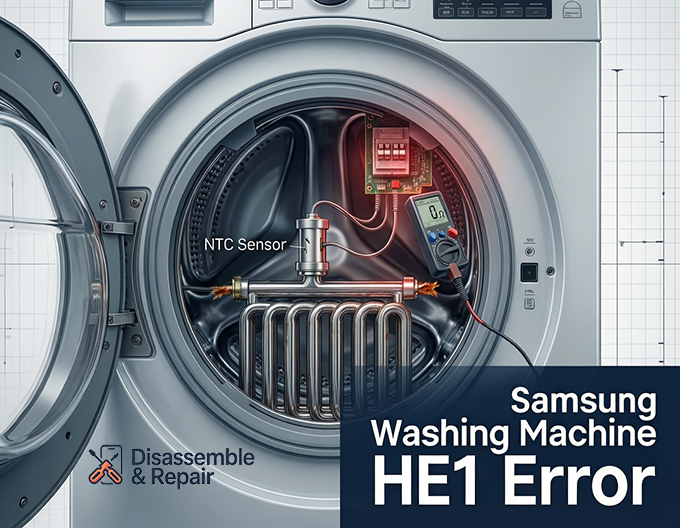
1. Defective NTC Sensor (Thermistor)
The water temperature sensor, often referred to as a thermistor or NTC sensor (Negative Temperature Coefficient), is responsible for monitoring the water’s heat. As the temperature rises, the electrical resistance (Ohms) of the NTC sensor decreases. If the sensor is faulty and its internal resistance drops to zero or reads incorrectly, the main control board interprets this as extreme overheating, triggering the error.
2. Malfunctioning Heating Element
The heating element is the component that physically warms the water. In some failure modes, the element can short-circuit to the casing or ground. This can bypass the relay controls, causing the heater to stay on continuously, regardless of the cycle stage, leading to actual overheating.
3. Wiring Harness and Electrical Connector Issues
Over time, the vibration of a front load washer can cause wear and tear on the wiring harness. If the wires connecting the thermistor to the control board are pinched, stripped, or shorted, or if an electrical connector has corroded, the signal sent to the logic board will be corrupted.
4. Stuck Relay on the Main Control Board
The main control board (PCB) contains relays that act as switches to turn the heater on and off. If the heater relay gets “stuck” in the closed (on) position, the heating element will receive continuous power, causing the water to boil and triggering the overheating protection logic.
Safety Precautions Before Troubleshooting
Dealing with heating circuits involves working with high-voltage components. Before attempting any diagnostics, adhere to these strict safety rules:
- Disconnect Power: Unplug the washing machine from the wall outlet. Turning it off at the button is not sufficient when testing internal electrical components.
- Water Supply: Turn off the water supply taps to prevent leaks during disassembly.
- Drainage: Ensure the drum is empty. If the machine stopped mid-cycle with water inside, use the emergency drain hose (usually located behind the filter cover at the bottom front) to drain the water manually.
- Protective Gear: Wear insulated gloves and work in a dry environment.
Step-by-Step Diagnostic Guide
To clear the Samsung washing machine HE1 error, you will need a Phillips screwdriver, a multimeter, and possibly a socket wrench set.
Step 1: Accessing the Heating Assembly
On most Samsung front load washers, the heating element and sensors are located at the bottom of the tub. You will typically need to remove the back panel of the machine.
- Move the washer away from the wall.
- Remove the screws securing the rear metal cover.
- Locate the heating assembly at the bottom of the outer tub. You will see a metal bracket with electrical terminals and a small probe (the thermistor) embedded nearby or integrated into the heater base.
Step 2: Visual Inspection
Before using tools, inspect the wiring harness. Look for any signs of burned wires, melted insulation, or loose connections at the electrical connector plugs. If the wires look damaged, repairing the harness may resolve the issue without replacing parts.
Step 3: Performing a Multimeter Test on the NTC Sensor
The most common culprit for the HE1 error is the thermistor.
Read more Samsung washing machine IE error
- Set your digital multimeter to measure resistance (Ohms), usually at the 20k or 200k setting.
- Disconnect the wire plug from the NTC sensor terminals.
- Place the multimeter probes on the two terminals of the sensor.
- Reading Analysis: At room temperature (approx. 20°C / 68°F), a functional Samsung thermistor should typically read between 10,000 and 15,000 Ohms (10kΩ – 15kΩ), although some models may range up to 40kΩ.
- Fault Criteria: If the meter reads 0 Ohms (short circuit) or Infinity (open circuit), or if the resistance is drastically lower than the specification for your specific model, the sensor is defective and causing the false overheating report.
Step 4: Testing the Heating Element
If the sensor tests okay, check the heating element.
- Disconnect the wires attached to the heater terminals.
- Set the multimeter to the lowest Ohms setting (e.g., 200 Ohms).
- Measure the resistance between the two main terminals of the heater. A healthy element usually shows resistance between 15 and 30 Ohms.
- Ground Test: Switch the multimeter to the highest resistance setting. Place one probe on a heater terminal and the other on the metal casing of the heater (ground). The reading should remain infinite (no continuity). If you get a reading, the element is “leaking” electricity to the ground, which can cause erratic heating and errors.
Step 5: Checking the Thermal Fuse
Some models are equipped with a thermal fuse or safety thermostat inline with the heater. This is a failsafe device designed to blow if temperatures get too high.
- Check for continuity across the thermal fuse.
- If the multimeter shows no continuity (infinite resistance), the fuse has blown due to a previous overheating event and must be replaced. Note that a blown fuse often results from a stuck relay or bad sensor, so simply replacing the fuse without finding the root cause may result in a repeat failure.
Diagnosing Main Control Board Issues
If the thermistor, heating element, and wiring harness all pass the multimeter test, the issue likely lies with the main control board.
A stuck relay on the PCB is difficult to test without advanced electronics knowledge. However, a strong indicator of a board failure is if the washing machine begins heating the water immediately after being turned on, even before a cycle is started, or if the water becomes scalding hot regardless of the temperature setting. In this scenario, the board is sending constant power to the heater, bypassing the sensors. Replacing the main control board is generally required to fix this specific variation of the Samsung washing machine HE1 error.
Repair vs. Replacement Considerations
Once you have identified the faulty component, you must decide whether to repair or replace the unit.
- Thermistor Replacement: This is an inexpensive repair. The part is generally affordable, and the labor is straightforward.
- Heating Element Replacement: Moderately priced. If the machine is under 5 years old, this is a worthwhile repair.
- Main Control Board: This is a high-cost part. If your washing machine is older than 7-8 years, the cost of the board plus labor might approach the cost of a new appliance.
Summary
The Samsung washing machine HE1 error is a protective mechanism designed to ensure your safety by stopping the machine when overheating is detected. While it can be alarming, it is often caused by a small, replaceable component like the NTC sensor.
By systematically checking the resistance (Ohms) of the sensor and heater using a multimeter test, and inspecting the wiring harness and electrical connector integrity, you can often diagnose the issue at home. However, if the diagnostic points toward the main control board or if you are uncomfortable working with electrical components, contacting a certified Samsung technician is the recommended course of action.
Regular maintenance, such as checking for limescale buildup on the heating element and ensuring your machine is connected to a stable power source, can help prevent future heating errors and extend the lifespan of your front load washer.
Frequently Asked Questions (FAQ)
What is the difference between HE1 and HE2 errors on a Samsung washer?
The Samsung washing machine HE1 error indicates an overheating condition (water is too hot or sensor is shorted), whereas the HE2 error typically indicates a failure to heat (open circuit in the heater or sensor).
Can I reset the HE1 error without tools?
You can attempt a hard reset by unplugging the washer for 5 to 10 minutes. This may clear a glitch in the main control board. However, if a component like the thermistor is physically broken, the error will return as soon as the cycle attempts to heat water.
Read more Samsung washing machine TC error
Where is the NTC sensor located?
In most Samsung front load washers, the NTC sensor is located directly next to or integrated into the base of the heating element at the bottom rear of the tub.
Read more Samsung washer blinking not starting
Is it safe to use the washer with an HE1 error?
No. The machine forces a stop because it believes the water is dangerously hot. Ignoring this or bypassing the error can lead to damaged clothing, melted internal plastic components, or fire hazards.
What should the resistance of a Samsung washer heating element be?
When performing a multimeter test, a healthy Samsung heating element should display a resistance (Ohms) reading between 15Ω and 30Ω.
Frequently Asked Questions
What is the difference between the HE1 and HE2 error codes on a Samsung washer?
The HE1 error indicates an overheating condition, meaning the water has become too hot or the sensor is reporting extreme temperatures. In contrast, the HE2 error typically signals that the machine is failing to heat the water at all, often due to an open circuit in the heater or sensor.
Can I clear the HE1 error code with a simple reset?
You can attempt a hard reset by unplugging the washing machine from the power outlet for 5 to 10 minutes. While this may clear a temporary electronic glitch in the main control board, the error will likely reappear if a component like the NTC sensor or heating element is physically defective.
Where is the NTC sensor located in a Samsung washing machine?
In most Samsung front-load models, the NTC sensor (thermistor) is located at the bottom rear of the outer tub. It is usually found directly next to or integrated into the base of the heating element assembly.
Is it dangerous to continue using the washer if it shows an HE1 error?
Yes, it is unsafe to bypass or ignore this error. The HE1 code is a safety protocol designed to prevent the water from boiling. Operating the machine in this state can lead to damaged laundry, melted plastic components, or potential fire hazards.
What resistance reading should I expect when testing a healthy heating element?
When performing a multimeter test on the heating element terminals, a functional Samsung heater should typically show a resistance reading between 15 and 30 Ohms. If the reading is significantly different or shows no continuity, the element likely needs to be replaced.