
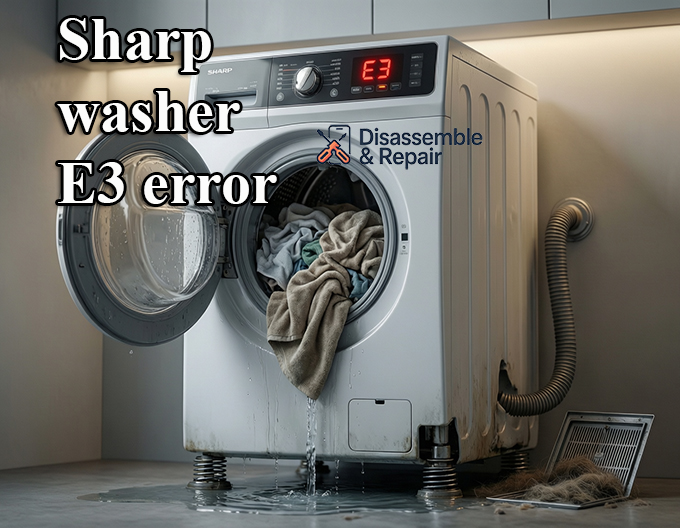
If your laundry routine has been interrupted by a flashing code, you are likely dealing with the Sharp washer E3 error. This specific fault code generally triggers during the spin cycle or draining phase, signaling that your machine is unable to complete its safety checks or drain properly.
While Sharp washing machines are known for their durability, the E3 code is a common hiccup that can affect both top-load and front-load models. In most Sharp top-load washers, this error points to a drainage issue or a safety switch malfunction caused by an open lid or an unbalanced load. Understanding these triggers is key to clearing the code and getting your appliance back to work.
What Does the Sharp Washer E3 Error Mean?
The Sharp washer E3 error typically indicates one of two primary problems, depending on your specific model:
- Drainage Failure: The machine cannot drain water fast enough or at all. This is the standard definition for many user manuals, where “E3” equates to “Drain hose is too high” or “Drainage blocked.”
- Lid or Spin Safety Fault: For many top-load models (like the ESX series), E3 appears when the spin cycle fails to start. This is often due to the washing machine lid being open, a faulty door lock switch, or the tub hitting the safety lever due to an unbalanced load.
Because the symptoms for these issues overlap (the machine stops before spinning), you must inspect the physical components to pinpoint the root cause.
Common Cause 1: Drainage System Issues
If your washer is full of water and refuses to spin, the drainage hose is the first place to look. The machine’s pressure sensor (water level sensor) will prevent the spin cycle from starting if it detects water remains in the tub.
Check the Drainage Hose
- Positioning: For top-load washers, gravity plays a huge role. Ensure the drain hose is not laid flat on the floor if your model requires a high loop, or conversely, ensure it isn’t raised too high (above 1 meter) if the pump is weak.
- Blockages: Inspect the hose for kinks, bends, or clogs. Lint and small coins often get stuck here, triggering the E3 code.
- Frozen Hose: In colder climates, residual water in the hose can freeze, blocking the flow.
Inspect the Drain Filter
Most modern washers have a debris filter near the bottom pump.
- Locate the filter door.
- Place a towel underneath to catch water.
- Unscrew the filter and clean out any lint, coins, or hair.
- Reinstall firmly and test the spin cycle.
Common Cause 2: Lid and Door Lock Switch Failures
For top-load washers, the washing machine lid is a critical safety component. If the machine “thinks” the lid is open, it will immediately throw the Sharp washer E3 error to prevent injury during high-speed spinning.
The Door Lock Switch
The door lock switch (or lid switch) is a small mechanism usually located under the top deck, near the hinge or the front lip.
- Mechanical Failure: The plastic tab on the lid that pushes the switch may be broken.
- Electrical Failure: Over time, the contacts inside the switch can corrode. If you hear the lid click but the machine doesn’t start, the switch might be faulty.
- Testing: If you are comfortable with basic repairs, you can use a multimeter to check the switch for continuity. If it shows no continuity when the lid is closed, the switch must be replaced.
Common Cause 3: Unbalanced Load and Suspension
An unbalanced load is a frequent culprit for spin cycle errors. If wet clothes bunch up on one side of the drum, the violent shaking trips a safety lever, which then displays E3 (or sometimes E4 on different models).
Improper Laundry Distribution
- Heavy Items: Washing a single heavy blanket or towel can cause a severe imbalance.
- Tangled Clothes: Long items like jeans or sheets can wrap around the agitator.
- Solution: Open the lid, redistribute the laundry evenly around the drum, and restart the spin cycle.
Suspension Springs
If your machine bangs loudly before stopping with an E3 error, your suspension springs may be worn out. These springs hold the tub in place and absorb vibration.
- Symptoms: The washer tub sits lower than usual or bounces excessively even with small loads.
- Fix: Inspect the four suspension rods (in top-loaders). If one is broken or lacks tension, the tub will lean, hitting the safety switch and triggering the error. All four should typically be replaced at once to maintain balance.
Leveling Legs
A washing machine must be perfectly flat to spin correctly.
- Check the leveling legs at the bottom of the unit.
- If the machine rocks when you push on a corner, adjust the legs until it is stable and lock the nuts against the frame.
Advanced Troubleshooting
If the drainage is clear, the lid switch is working, and the load is balanced, the issue may lie deeper in the machine’s electronics.
Pressure Sensor (Water Level Switch)
The pressure sensor tells the control board how much water is in the tub. If this sensor is clogged with sludge or malfunctioning, it may send a false signal that the tub is full, preventing the spin cycle and causing an E3 error.
- Check: Remove the small clear tube attached to the sensor and blow through it to clear any obstructions.
Main PCB (Control Board)
The Main PCB is the brain of the washer. If it fails to send voltage to the drain pump or receive a signal from the door switch, the E3 error will persist.
- Visual Inspection: Look for burnt components or loose wire harnesses connecting to the board.
- Replacement: replacing the main PCB is expensive and should usually be done by a professional technician after all other possibilities are ruled out.
Summary Checklist
To resolve the Sharp washer E3 error quickly, follow this order of operations:
- User Manual: Consult your specific model’s manual to confirm if E3 refers to “Drain” or “Lid.”
- Reset: Unplug the washer for 5 minutes to reset the electronics.
- Balance: Redistribute the laundry load.
- Drain: Check the drainage hose and filter for blockages.
- Lid Switch: Listen for the door lock switch click; bypass or replace if faulty.
- Suspension: Press down on the tub to check for weak suspension springs.
By systematically checking these components, you can often fix the error without the need for a service call, ensuring your Sharp washer returns to efficient operation.
Frequently Asked Questions
What is the most common cause of the Sharp washer E3 error?
The most common cause depends on your washer type. For top-load models, it is usually an open lid or an unbalanced laundry load. For front-load models, it typically indicates a drainage failure caused by a clogged filter or a kinked drain hose.
Can I fix the E3 error without calling a technician?
Yes, many E3 errors are user-serviceable. You can often resolve the issue by redistributing wet clothes more evenly in the drum, cleaning the debris filter, or ensuring the drain hose is positioned at the correct height. Always try unplugging the machine for five minutes to reset the system before seeking professional help.
Why does my washer show an E3 error even when the lid is closed?
If the lid is closed but the error persists, the door lock switch or lid sensor may be faulty. This component tells the machine’s computer that it is safe to spin; if the sensor is broken or the plastic tab on the lid is snapped, the machine will trigger the E3 code as a safety precaution.
How often should I clean the drain filter to prevent E3 errors?
To prevent drainage-related E3 errors, it is recommended to clean your washer’s debris filter every 2 to 3 months. Removing lint, coins, and hair from the filter ensures that water can exit the tub quickly enough to satisfy the machine’s pressure sensors.