
Encountering a Sharp washer E6 error can be a frustrating interruption to your laundry routine, often signaling a specific malfunction within the machine’s internal components. This fault code typically points towards an issue with the heating system, though the specific cause can vary depending on whether you own a front-load or top-load model.
Understanding the Sharp Washer E6 Error
In the majority of modern Sharp washing machines, particularly front-loading models, the Sharp washer E6 error is explicitly defined as a heater error or a heating element failure. Modern appliances rely on complex electronic monitoring to ensure wash cycles run efficiently and safely. When the machine detects that the water temperature is not rising as expected within a set timeframe, or if it senses an open circuit in the heating circuit, it triggers the E6 fault code.
However, appliance diagnostics are rarely one-dimensional. While the heater is the primary suspect, the error indicates a failure in the logic chain required to heat water. This chain involves the control board, the thermistor (temperature sensor), and the safety mechanisms that prevent the heater from activating dry. Therefore, resolving the issue requires a systematic inspection of several interlinked components rather than a single part replacement.
Primary Cause: The Heating Element and Thermistor
The most direct cause of this error is a burnt-out heating element. Over time, the resistive wire inside the heating element can break or degrade due to mineral deposits (limescale) from hard water. When the control board sends voltage to the heater but detects no current draw (or infinite resistance), it halts the cycle and displays E6.
Closely related to the heater is the thermistor. This small sensor monitors the real-time temperature of the water. If the thermistor is faulty and sends incorrect resistance values to the main PCB (Printed Circuit Board), the machine may “think” the heater isn’t working even if it is. A multimeter is essential here to test both the heating element for continuity and the thermistor for the correct resistance specifications found in your user manual.
The Critical Role of Water Level Detection
One of the most overlooked aspects of a heater error is its dependency on the water level system. The machine is programmed with a safety interlock: the heater must never turn on unless the drum is filled with water to a safe level. If the heater were to activate without water, it would overheat and potentially cause catastrophic damage.
This is where the water level sensor and pressure switch come into play.
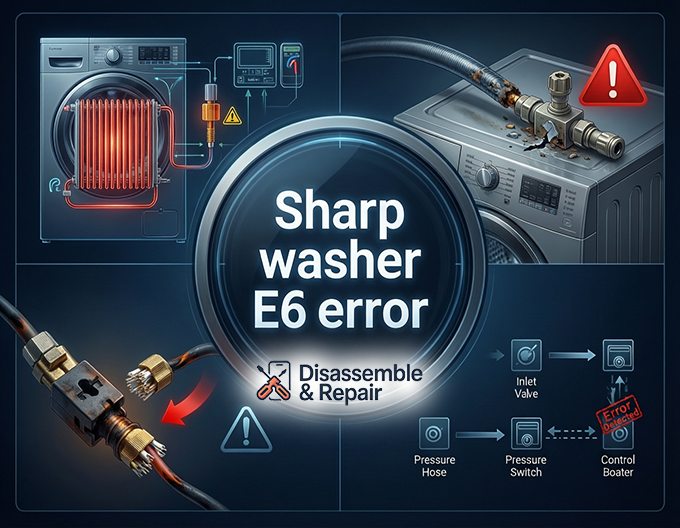
- The Inlet Valve: The cycle begins with the inlet valve opening to allow water to enter the drum.
- The Pressure Hose: As water rises, air pressure builds up in the pressure hose connected to the tub.
- The Pressure Switch: This air pressure activates the pressure switch (or water level sensor), signaling the control board that the correct water level has been reached.
If the pressure switch is faulty or if the pressure hose is clogged or leaking, the machine may fail to register the water level. Consequently, the control board will refuse to energize the heating circuit. In some sophisticated diagnostic algorithms, if the machine attempts to heat but cannot verify the water presence, it might throw an E6 error instead of a water level error, confusing the user. Therefore, verifying that the pressure switch is functioning correctly is a vital step in troubleshooting an E6 code.
Wiring and Connections
Before replacing expensive components, it is crucial to inspect the wiring harness. Washing machines vibrate significantly during operation, particularly during the spin cycle. These vibrations can cause electrical connectors to loosen or wires to chafe against the metal chassis.
Trace the wires from the control board down to the heating element and the thermistor. Look for any signs of scorching, corrosion, or physical damage. A simple loose connection at the heater terminal can trigger the Sharp washer E6 error just as easily as a failed component. Ensuring the wiring harness is secure and intact is often the simplest fix.
Diagnostic Steps for the E6 Error
If your machine is displaying this fault code, follow these professional troubleshooting steps. Always unplug the machine before attempting any repairs to avoid electric shock.
1. Consult the User Manual
Your specific model’s user manual is the ultimate authority. While E6 is generally a heater fault, some top-load models might use E6 to indicate a motor or door lock issue. Confirm the definition for your specific model number.
2. Reset the Machine
Sometimes, a momentary power spike can cause a logic glitch. Unplug the washer for at least 5 minutes. Press and hold the Start/Pause button for 5 seconds to discharge any residual power, then plug it back in. Run a test cycle.
3. Check the Heater and Thermistor
Access the back of the machine (on front loaders) to locate the heating assembly at the bottom of the tub.
- Heating Element: Disconnect the wires and use a multimeter to measure resistance. A healthy element usually reads between 20 and 30 ohms. If it reads infinity (open circuit), it must be replaced.
- Thermistor: Measure the resistance of the temperature sensor. This value varies by temperature (usually around 20k to 50k ohms at room temperature, but check the manual). If the value is static or zero, the sensor is dead.
4. Inspect the Pressure System
Locate the pressure switch at the top of the machine under the lid or top panel. Ensure the pressure hose connecting it to the tub is not kinked, cracked, or blocked with debris. Blow through the hose to ensure it is clear. If the switch relies on a diaphragm, listen for a clicking sound when you blow gently into the sensor port (for mechanical switches).
5. Evaluate the Drainage System
While less likely to cause a heater error directly, a poor drainage system can retain water, confusing the sensors. Ensure the drain filter is clean and the pump is operational.
When to Seek Professional Help
Modern washing machines are high-voltage appliances with complex electronics. If you have checked the basic connections and the error persists, or if you are uncomfortable using a multimeter to test live circuits, it is time to contact a professional for appliance repair.
A qualified technician can test the control board relays, which may have fused or failed, preventing voltage from reaching the heater. Replacing a main PCB is a delicate task that requires specific programming in many Sharp models. Additionally, if the inlet valve is failing to fill the machine fast enough, it could be timing out the cycle, which a technician can quickly diagnose.
Conclusion
The Sharp washer E6 error is a protective mechanism designed to prevent operation when the heating system is compromised. While the heating element and thermistor are the usual culprits, the intricate relationship between the heater, the control board, and the water level sensor means the root cause can sometimes be elusive. By systematically checking the wiring harness, pressure switch, and heater continuity, you can often isolate the problem. However, for internal electronic failures or complex disassembly, relying on professional appliance repair services ensures the safety and longevity of your machine. Regular maintenance, such as checking the pressure hose and keeping the machine clean, can help prevent these faults from occurring in the future.
Frequently Asked Questions
What does the E6 error code mean on a Sharp washing machine?
On most Sharp models, particularly front-loaders, the E6 error indicates a heating system failure. This means the machine’s control board has detected that the water is not reaching the required temperature within the allotted time or that there is an open circuit in the heating system.
Can I fix the E6 error by resetting the machine?
Sometimes a temporary electronic glitch or power surge can trigger the code. You can attempt a reset by unplugging the washer for at least 5 minutes. While it is unplugged, press and hold the Start/Pause button for 5 seconds to discharge any remaining electricity. If the code returns after you plug it back in and start a cycle, the problem is likely a hardware component that needs repair.
Is the heating element the only part that causes this error?
No. While a burnt-out heating element is a primary suspect, the E6 error can also be caused by a faulty thermistor (temperature sensor), a malfunctioning water level pressure switch, or damaged wiring. Because the heater is not allowed to turn on unless the machine confirms there is enough water, a blockage in the pressure hose can also indirectly trigger this fault.
How can I tell if the heating element is actually broken?
The most reliable way to check the heating element is by using a multimeter to test for continuity. After unplugging the machine and accessing the element, disconnect the wires and measure the resistance. A functional element typically reads between 20 and 30 ohms. If the meter shows infinite resistance, the element has an internal break and must be replaced.
Does the E6 error mean the same thing for all Sharp models?
While E6 is widely recognized as a heater fault in front-loading machines, diagnostic codes can vary. In some top-loading models, E6 might point to a different issue, such as a motor problem or a door lock malfunction. It is always best to cross-reference the code with the specific model number found in your user manual.