
The Sharp washer H1 error is a specific fault code that typically indicates a malfunction within the machine’s heating system. If your washing machine stops mid-cycle or refuses to heat water properly, this code serves as a diagnostic signal alerting you to a failure in the thermal control components.
What Does the Sharp Washer H1 Error Mean?
The Sharp washer H1 error generally points to an issue with the heating element or the water temperature sensor. In modern front load washing machine models, the main control board continuously monitors the water temperature. If the sensor detects that the water is not heating up within a specific timeframe, or if the temperature rises abnormally fast (suggesting a sensor fault), the system triggers the H1 fault code.
This error effectively locks the machine to prevent overheating or electrical damage. While the specific definition can vary slightly between model series, it is almost exclusively related to the thermal regulation system.
Common Causes of the H1 Fault Code
Understanding the root cause is essential before attempting any repairs. The following components are most frequently responsible for this error:
1. Faulty Heating Element
The heating element is the component responsible for heating the water. Over time, calcium buildup or electrical fatigue can cause the element to fail. If the element breaks internally (an “open circuit”), it cannot generate heat, prompting the error.
2. Defective Thermistor (NTC Sensor)
The Thermistor, also known as an NTC sensor (Negative Temperature Coefficient), measures the water temperature. It sends resistance data to the control board. If the sensor gives incorrect readings or fails completely, the machine cannot regulate heat and will display the error.
3. Damaged Wiring Harness
Vibration during the spin cycle can sometimes loosen connections. A damaged or disconnected wiring harness between the heater, sensor, and the main PCB (Printed Circuit Board) can result in a loss of signal.
4. Control Board Malfunction
Although less common, the control board itself may have a blown relay or a logic fault that prevents it from sending power to the heater or reading the sensor data.
How to Troubleshoot the Sharp Washer H1 Error
Diagnosing this issue requires a systematic approach. You will need a multimeter to perform accurate tests on the internal components.
Safety Warning: Always unplug the washing machine from the power socket and turn off the water supply before disassembling any part of the appliance.
Step 1: Preliminary Inspection
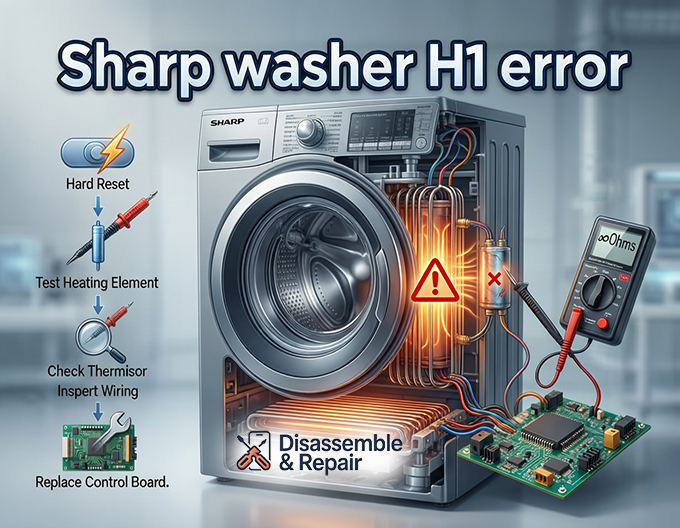
Before opening the machine, try a hard reset. Unplug the washer for 5 minutes and plug it back in. Run a cycle. If the Sharp washer H1 error persists, inspect the wiring harness visually.
- Remove the back or bottom panel (depending on your model) to access the heater assembly.
- Check for burnt wires, loose connectors, or corrosion on the terminals connecting to the heating element and sensor.
Step 2: Testing the Heating Element
The heating element is usually located at the bottom of the drum. To test it:
- Disconnect the wires attached to the heater terminals.
- Set your multimeter to the resistance (Ohms) setting.
- Place the probes on the two heater terminals.
- Perform a resistance measurement. A healthy element usually reads between 20 and 50 Ohms.
- If the reading is infinite (open circuit), the element is dead and must be replaced.
- Perform a continuity test between each terminal and the earth (ground) tag. There should be no continuity. If there is, the heater has an earth leak.
Step 3: Inspecting the Thermistor (NTC Sensor)
The water temperature sensor is often embedded in or near the heating element.
- Remove the sensor connector.
- Measure the resistance across the sensor terminals.
- At room temperature (around 20°C or 68°F), a standard NTC sensor often reads between 6kΩ and 20kΩ (check your specific service manual for exact values).
- If the reading is zero (short circuit) or infinite (open circuit), the sensor is faulty.
Step 4: Checking the Thermal Fuse
Some models include a thermal fuse as an extra safety layer to prevent overheating. If this fuse blows, it cuts power to the heater. Test it for continuity; if it does not beep, it needs replacement.
NOTE: You might also want to check out how to fix the Sharp washing machine’s H2 error code—it’s one of the most common issues you’ll likely run into while using your machine.
When to Replace the Control Board
If the heating element, thermistor, and wiring all pass their tests, the issue likely lies with the control board. Look for visible signs of damage, such as blackened components or swollen capacitors. Replacing the board is a more complex and expensive repair, often requiring a professional technician.
Summary
The Sharp washer H1 error is a clear indicator of a heating system failure. By systematically testing the heating element for continuity and verifying the NTC sensor’s resistance, you can identify the faulty component. Regular maintenance, such as descaling your machine, can prolong the life of these thermal components and prevent future errors.
Frequently Asked Questions
What does the H1 error code mean on a Sharp washing machine?
The H1 error code indicates a fault within the washing machine’s heating system. It usually means the water is not reaching the required temperature within a set timeframe or that the temperature sensor is sending abnormal readings to the control board.
Can I fix the H1 error by resetting my washing machine?
You can attempt a preliminary “hard reset” by unplugging the washer from the power source for about five minutes and then plugging it back in. While this might clear a temporary logic glitch, the error will likely reappear if there is a physical hardware failure, such as a burnt-out heating element or a faulty sensor.
Which components are most likely causing the H1 fault?
The most common culprits are a faulty heating element (due to calcium buildup or electrical failure), a defective NTC sensor (thermistor) that cannot accurately measure temperature, or damaged wiring between these components and the main control board.
How can I test if the heating element is broken?
After unplugging the machine and accessing the heater, you can use a multimeter to measure its resistance. A functional heating element typically shows a reading between 20 and 50 Ohms. If the multimeter shows an infinite reading (open circuit), the element is dead and needs to be replaced.
Is it safe to repair the H1 error myself?
If you have experience using a multimeter and basic tools, you can diagnose the issue yourself. However, always ensure the machine is completely unplugged and the water supply is turned off before starting. If the problem lies within the main control board, it is often best to consult a professional technician.