
Whirlpool Refrigerator Dimensions
The Ultimate Guide to Whirlpool Appliance Measurements
When designing a new kitchen layout or upgrading your household appliances, finding the exact Whirlpool Refrigerator Dimensions is a mandatory step for a seamless installation. Securing the proper measurements guarantees that your appliance functions safely, operates efficiently, and integrates flawlessly into your home’s unique aesthetic. Far too often, homeowners select a beautiful appliance based entirely on its features and finish, only to discover on delivery day that it does not properly fit their designated space. In this comprehensive, professional guide, we will explore the critical sizing factors you need to consider, break down the standard measurements across various configurations, and explain exactly how to measure your space to guarantee a perfect fit.
Why Understanding Whirlpool Refrigerator Dimensions Matters
Kitchens are highly functional spaces that rely on precise spatial planning. A refrigerator is typically the largest appliance in the room, making its footprint central to your overall kitchen flow. If you do not adhere to proper sizing guidelines, you risk structural blockages, restricted pathways, and inadequate ventilation, which can ultimately shorten the lifespan of the unit.
Furthermore, having accurate measurements allows you to navigate the vast appliance market with confidence. By matching the appliance specifications directly with your Standard Cutout Dimensions, you eliminate the guesswork. You will know exactly how much space you have available to accommodate the refrigerator’s width, the depth of the unit, and the required clearance for the doors to open fully without striking adjacent cabinetry or walls.
Understanding Whirlpool Refrigerator Dimensions by Model Style
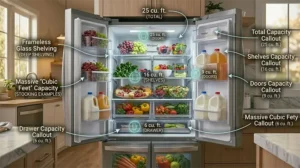
Whirlpool manufactures a wide variety of refrigeration units, each tailored to different consumer needs, household sizes, and kitchen layouts. Because the internal volume—measured in Cubic Feet—dictates the overall exterior bulk, different styles carry distinct dimensional profiles.
French Door Refrigerator
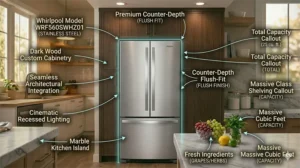
The French Door Refrigerator has become an industry favorite due to its elegant design and highly accessible layout. These models place the most frequently used fresh foods at eye level while utilizing a pull-out drawer for frozen goods at the base. Standard Whirlpool French door models typically range from 30 to 36 inches in width. Heights usually fall between 68 and 70 inches, and standard depths range from 32 to 36 inches. Because these models feature two half-width doors that open outward from the center, they are excellent for kitchens with narrow walkways. However, you must still account for the necessary clearance to fully extend the wide lower freezer drawer.
Side-by-Side Refrigerator
A Side-by-Side Refrigerator divides the appliance vertically, with the freezer on one side and the refrigerator on the other. This design provides convenient, top-to-bottom access for both fresh and frozen items. Whirlpool’s side-by-side units generally span 33 to 36 inches in width and hover around 69 to 71 inches in height. Because the doors are relatively narrow, this style requires less swing space than a traditional full-width door, making it highly suitable for kitchens with tighter clearances or prominent kitchen islands.
Read more whirlpool refrigerator warranty claim
Bottom Freezer and Top Freezer Models
For more traditional kitchen layouts or more compact spaces, Bottom Freezer and Top Freezer configurations remain incredibly popular.
A Top Freezer unit is the classic standard, known for its reliability and excellent energy efficiency. These models are generally more compact, with widths ranging from 24 to 33 inches, making them ideal for smaller kitchens or secondary spaces like garages. Their heights typically measure between 61 and 68 inches.
Conversely, a Bottom Freezer model flips this traditional layout, placing the fresh food compartment at the top and a swing door or pull-out drawer at the base for frozen items. These units usually share similar width dimensions with top freezer models (between 29 to 33 inches) but tend to be slightly taller, often reaching up to 70 inches. When planning for these single-door configurations, it is absolutely essential to measure your surrounding space to ensure the wide, full-length door can open completely.
Read more whirlpool refrigerator temperature too high
The Importance of Counter-Depth vs. Standard Depth
When evaluating your options, one of the most significant design choices you will face is deciding between a standard depth and a Counter-Depth unit. Understanding the difference between these two profiles is crucial for achieving your desired kitchen aesthetic.
Standard depth refrigerators are designed to maximize internal storage capacity, typically offering a larger amount of Cubic Feet. Because of this expanded volume, they often protrude six to eight inches past the edge of your standard kitchen countertops. While this extra space is fantastic for large households requiring massive food storage, the protrusion can disrupt the visual lines of a custom kitchen.
A Counter-Depth refrigerator, on the other hand, is specifically engineered to sit nearly flush with your cabinetry. The Case Depth (the depth of the refrigerator box itself, excluding the doors and handles) is usually around 24 to 25 inches, matching standard kitchen cabinets. This creates a highly desirable, built-in, custom look without the premium price tag of a true built-in appliance. While you will sacrifice some interior storage volume, the resulting streamlined aesthetic and improved kitchen traffic flow make counter-depth models highly sought after in modern kitchen renovations.
Critical Metrics for Your Kitchen Cabinet Opening
Taking measurements for your new Whirlpool appliance requires more than just checking the basic width and height. To guarantee a professional-grade installation, you must pay close attention to several specific measurement metrics related to your exact Kitchen Cabinet Opening.
Read more whirlpool refrigerator best models 2026
First, you must evaluate the Height to Top of Hinge. The hinges on a refrigerator almost always sit higher than the main cabinet box. If your kitchen features custom cabinetry built directly over the appliance alcove, you must ensure that the height of the hinges clears the bottom edge of those upper cabinets. Failure to measure the top hinge can result in an appliance that physically cannot slide completely into the designated cutout.
Second, you need to calculate the Door Swing Clearance. Refrigerators require their doors to open at least 90 degrees so that you can pull out the interior crisper drawers for cleaning and daily use. If your appliance is situated next to a deep wall or a kitchen island, you must verify that the doors have enough physical space to swing open unimpeded. You must also account for the protrusion of the door handles, which can add up to three additional inches to the total depth.
Finally, ventilation space is an absolute necessity. Refrigerators utilize compressors that generate heat, and this heat must be efficiently dissipated. You should always add an additional half-inch of clearance on both sides and at the top, along with a full inch at the rear of the appliance, to allow for proper airflow.
Locating Your Specific Appliance Requirements
If you are replacing an existing unit or trying to match exact specifications, knowing where to find your current appliance’s details is vital. Every Whirlpool refrigerator features a specific Model Number, which is the ultimate key to unlocking its exact dimensions.
Read more whirlpool refrigerator capacity cubic feet
You can typically find this alphanumeric sequence on a permanently affixed sticker or metal plate located on the interior wall of the fresh food compartment. Once you have located your unique Model Number, you can enter it into the official Whirlpool website or provide it to your appliance dealer. This guarantees that you are reviewing the precise manufacturer specifications, ensuring there is no discrepancy between what you plan for and what is delivered to your home.
Step-by-Step Guide to Measuring for Your Refrigerator
To ensure the utmost accuracy, follow this professional step-by-step methodology when measuring your space:
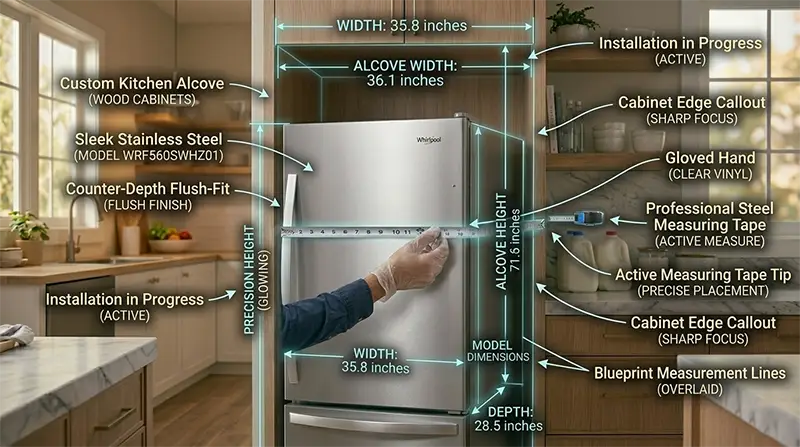
- Measure the Width: Measure the distance from the inside edge of the left cabinet to the inside edge of the right cabinet. Measure at three different heights (top, middle, and bottom) because walls and cabinets are rarely perfectly plumb. Always use the narrowest measurement as your strict guideline.
- Measure the Height: Measure from the finished floor to the underside of the upper cabinet. Again, take this measurement at the front of the opening and at the rear, keeping in mind the necessity to clear the Height to Top of Hinge.
- Measure the Depth: Measure from the back wall to the front edge of the cabinets. Decide whether you want a counter-depth or standard depth model based on how far you are willing to let the appliance protrude into the walking space.
- Account for Ventilation: Subtract the required manufacturer clearance (usually a minimum of 1/2 inch on the sides/top and 1 inch at the rear) from your raw measurements to find the maximum allowable appliance size.
- Map the Delivery Path: One of the most common oversights is failing to measure the pathway to the kitchen. You must measure the width of every hallway, doorway, and staircase the delivery team will need to navigate. It does not matter if the appliance perfectly fits the kitchen opening if it cannot make it through your front door.
Conclusion
Successfully integrating a new appliance into your home is a matter of precision and planning. By taking the time to fully understand and verify your required measurements, you elevate the design and functionality of your kitchen space. Whether you opt for a high-capacity unit to feed a bustling family or a sleek, built-in look for a modern design, respecting your standard cutout requirements and door clearances will ensure a seamless upgrade. Take your tape measure, document your space meticulously, and consult your specific model guidelines to make your next Whirlpool installation an absolute success.
Frequently Asked Questions
What is the difference between a standard depth and a counter-depth Whirlpool refrigerator?
Standard depth refrigerators are designed for maximum storage capacity and typically protrude 6 to 8 inches past the edge of your kitchen countertops. Counter-depth models have a shallower “case depth” of approximately 24 to 25 inches, allowing them to sit nearly flush with your cabinets for a streamlined, built-in appearance.
How much extra space should I allow for ventilation?
To ensure the compressor operates efficiently and does not overheat, you must provide adequate airflow. You should plan for a minimum of 1/2 inch of clearance on the top and both sides of the refrigerator, along with at least 1 inch of space at the rear of the unit.
Where can I find the specific model number for my Whirlpool appliance?
The model number is the key to finding exact dimensions for your specific unit. It is typically found on a permanently affixed sticker or metal plate located on the interior wall of the fresh food compartment. You can use this alphanumeric code on the official Whirlpool website to access precise technical specifications.
Why is the “Height to Top of Hinge” measurement important?
The hinges on most refrigerators sit slightly higher than the main body of the unit. If you have cabinets directly above your refrigerator alcove, measuring only the height of the refrigerator box might result in the unit not fitting. You must ensure the entire height, including the hinges, clears the bottom of your upper cabinetry.
What should I consider regarding door swing clearance?
To fully access interior crisper drawers and shelves, a refrigerator door must be able to open at least 90 degrees. When measuring your space, ensure there are no adjacent walls or islands that would prevent the doors from swinging open fully. Additionally, remember to account for door handles, which can add up to 3 inches to the total depth of the appliance.