
If you have opened your appliance after a full cycle only to find dirty, dry dishes, you are likely asking, “Why is my dishwasher not spraying water?” This frustrating issue can stem from several underlying problems, ranging from simple clogs to more complex mechanical failures.
Diagnosing the root cause requires a systematic approach to checking your machine’s water supply, circulation system, and internal components. By understanding how these parts interact, you can often identify the issue and restore your dishwasher’s cleaning power.
Why is my dishwasher not spraying water? Common causes
The most frequent reasons for a dishwasher failing to spray water involve a lack of water entering the machine or an inability to circulate the water that is present. Below are the primary culprits you should investigate.
1. Clogged spray arms and nozzles
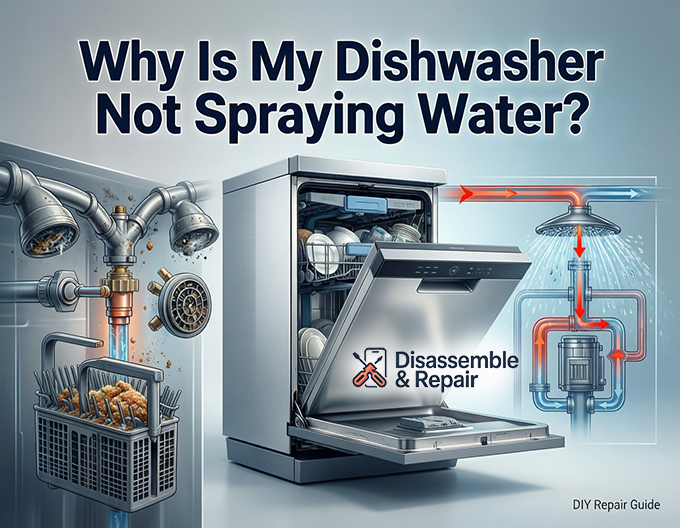
The spray arms are the rotating components responsible for distributing water onto your dishes. Over time, the small holes, known as spray arm nozzles, can become blocked by food debris or hard water deposits.
- The Issue: When these nozzles are obstructed, water cannot exit with enough force to clean the dishes or rotate the arms.
- The Fix: Remove the spray arms and inspect the nozzles. Use a small wire or toothpick to clear any blockages. Soaking the arms in vinegar can also help dissolve mineral buildup.
2. Malfunctioning water inlet valve
The water inlet valve is an electromagnetic device that controls the flow of hot water into the dishwasher.
- The Issue: If this valve is defective or its filter screen is clogged with sediment, the dishwasher will not fill with the correct water level. Without enough water in the tub, the pump cannot generate the pressure needed to spray.
- The Fix: Check the inlet valve for continuity using a multimeter. If the valve is functioning but the screen is dirty, clean it carefully. If the valve is electrically dead, it must be replaced.
3. Blocked filter assembly
Your dishwasher’s filter assembly is designed to trap food particles to prevent them from recirculating onto clean dishes.
- The Issue: Clogged filters restrict the flow of water to the circulation pump. If the pump is starved of water, it cannot push water up to the spray arms, resulting in a weak or non-existent spray.
- The Fix: Locate the filter at the bottom of the tub. Remove and rinse it thoroughly under running water to remove the “sludge” of food waste.
4. Issues with the float switch
The float switch acts as a safety device to prevent your dishwasher from overfilling. It is triggered by a floating component that rises with the water level.
- The Issue: If the float gets stuck in the “up” position due to debris or a mechanical jam, the switch will signal that the machine is full and prevent the water inlet valve from opening. Consequently, the cycle will start without water.
- The Fix: Check the float assembly inside the tub to ensure it moves up and down freely. If it is moving correctly but the water still won’t fill, the switch itself may need testing or replacement.
Mechanical failures affecting water circulation
If water is entering the machine but still not spraying, the problem likely lies within the circulation system.
The circulation pump and wash motor
The circulation pump is the heart of your dishwasher. Driven by the wash motor, it intakes water from the bottom of the tub and forces it through the spray arms.
- Symptoms: If you hear a low humming sound but see no spraying action, the wash motor might be seized, or the pump could be jammed. A completely silent machine during the wash cycle may indicate a burnt-out motor.
- Troubleshooting: Listen for sound during the wash cycle. If the motor runs but doesn’t spray, there may be an air lock or a blockage inside the pump housing.
Damaged impeller
Inside the circulation pump is a plastic fan-like component called the impeller. This part creates the pressure required to move the water.
- Symptoms: Food debris (like broken glass, bones, or popcorn kernels) can bypass the filter and damage the impeller blades. A broken impeller will spin but fail to push water with sufficient force.
- Troubleshooting: Accessing the impeller usually requires removing the pump. If the fins on the impeller are broken or stripped, the entire impeller or pump assembly will need replacement.
How to prevent future spraying issues
Maintaining your dishwasher is key to avoiding these problems.
- Clean Filters Regularly: Rinse your filter assembly weekly to ensure steady water flow to the pump.
- Combat Hard Water: If you live in an area with hard water, use a dishwasher cleaner monthly to break down hard water deposits that clog jets and valves.
- Scrape, Don’t Pre-Wash: Scrape large food debris off plates before loading them. Solid chunks are the primary enemy of your pump and spray arms.
- Load Correctly: Ensure that tall items do not block the rotation of the spray arms. If an arm cannot spin, it cannot spray effectively.
By systematically checking these components—from the water inlet valve to the spray arm nozzles—you can identify why your dishwasher is not spraying water and perform the necessary repairs to get your appliance running efficiently again.
Frequently asked questions
How can I tell if my spray arms are actually clogged?
If you notice that your dishes are coming out dirty or dry after a cycle, inspect the small nozzles on the spray arms. If you see visible food particles, seeds, or white mineral deposits in these holes, the arms are likely blocked. You can verify this by removing the arms and shaking them; if you hear debris rattling inside, they need to be cleaned with a small wire or soaked in vinegar.
What does it mean if my dishwasher is humming but not spraying water?
A humming sound usually indicates that the wash motor is trying to run but is either seized or the circulation pump is jammed. This can happen if food debris, such as a piece of glass or a bone, has bypassed the filter and gotten stuck in the pump or damaged the impeller. If the motor is humming but nothing is moving, the circulation system requires immediate inspection.
Why is there no water entering my dishwasher even though the cycle has started?
This is typically caused by a malfunctioning water inlet valve or a stuck float switch. If the float switch is jammed in the “up” position, the dishwasher “thinks” it is already full and will not allow the inlet valve to open. Alternatively, the water inlet valve itself may be defective or have a clogged filter screen, preventing water from filling the tub to the necessary level for the pump to create pressure.
How often should I perform maintenance to prevent spraying issues?
To keep your dishwasher running efficiently, you should rinse the filter assembly weekly to prevent food “sludge” from starving the pump. Additionally, using a dishwasher cleaner once a month is recommended if you have hard water, as this helps dissolve the mineral deposits that clog spray nozzles and internal valves. Always scrape large food scraps off your plates before loading to protect the pump and impeller.